Have you ever felt stuck in a situation where you can’t “fight back,” can’t explain yourself, and can’t see a way out?
That is exactly the emotional space behind Surah Yunus Ayat 85–86—a dua made by the believers who were facing Pharaoh’s ظلم (oppression). It is short. But it hits the heart.
Quick Answer
Surah Yunus ayat 85–86 is a dua about tawakkul (trust in Allah), asking Allah not to make believers a “fitnah” for wrongdoers and to save them by His mercy from disbelieving oppressors.
Surah Yunus Ayat 85–86 in Arabic (Complete Verses)
✅ Ayat 85 (10:85)
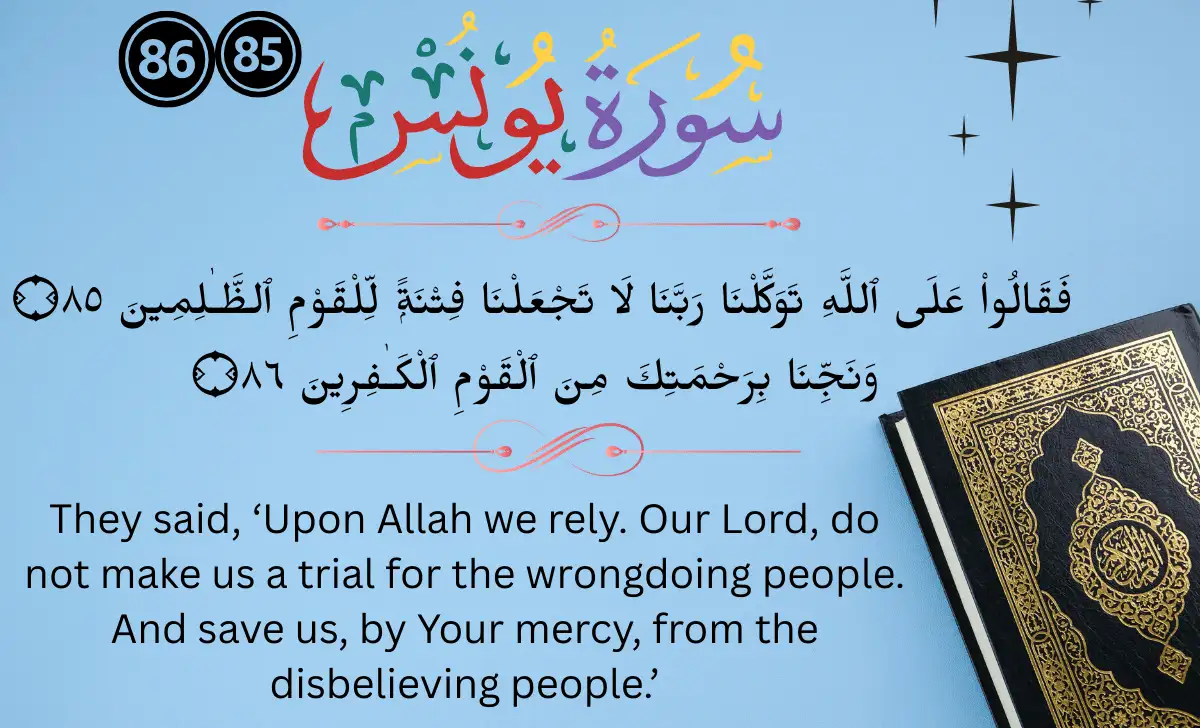
فَقَالُوا۟ عَلَى ٱللَّهِ تَوَكَّلْنَا رَبَّنَا لَا تَجْعَلْنَا فِتْنَةًۭ لِّلْقَوْمِ ٱلظَّـٰلِمِينَ
✅ Ayat 86 (10:86)
وَنَجِّنَا بِرَحْمَتِكَ مِنَ ٱلْقَوْمِ ٱلْكَـٰفِرِينَ
Transliteration (Easy to Read)
Fa-qālū ‘alā Allāhi tawakkalnā, rabbanā lā taj‘alnā fitnatan lil-qawmiẓ-ẓālimīn.
Wa-najjinā bi-raḥmatika mina l-qawmi l-kāfirīn.
English Translation (Clear Meaning)
“They said, ‘Upon Allah we rely. Our Lord, do not make us a trial for the wrongdoing people.
And save us, by Your mercy, from the disbelieving people.’”
Urdu Translation (اردو ترجمہ)
“تو انہوں نے کہا کہ ہم نے اللہ پر توکل کیا۔ اے ہمارے رب! تو ہمیں ان ظالموں کے لیے فتنہ (آزمائش/نشانہ) نہ بنا۔
اور ہمیں اپنی رحمت سے اس کافر قوم سے نجات عطا فرما۔”
Surah Yunus Ayat 85–86: A Powerful Dua of Trust, Protection, and Divine Mercy (PDF)
Tafsir-Style Explanation (Simple but Deep)
1) “Upon Allah we rely” = Tawakkul with courage
This is not passive. It is a decision of the heart:
- I will do what I can.
- But results are in Allah’s hands.
- My fear will not control my faith.
Classical tafsir sources explain this dua in the setting of Musa’s believers facing danger and choosing reliance on Allah.
2) “Do not make us a fitnah for the wrongdoing people” = a very smart dua
Many readers misunderstand fitnah here.
It can include meanings like:
- “Don’t let our weakness become a reason they mock الدين.”
- “Don’t let them think they are right because we are suffering.”
- “Don’t let our test become a tool that increases their ظلم.”
This is powerful because believers are not only asking for safety.
They are also asking for dignity and protection of faith.
3) “Save us by Your mercy” = humility
Notice they didn’t say: “Save us because we deserve it.”
They said: “by Your mercy.”
That one phrase teaches adab (good manners) in dua.
If you found this article helpful and would like to explore related Islamic content, you may also enjoy reading:
Surah Yunus Ayat 9 – Meaning, Benefits & Urdu Translation
Benefits of Surah Yunus Ayat 85–86 (Realistic & Quran-Based)
People love this dua because it speaks to real life. Benefits include:
- Strengthening tawakkul (trust in Allah)
- Emotional stability in oppression or fear
- Protection from becoming a “target” of wrongdoers
- A sunnah-style habit of turning pain into dua
- Hope when you feel powerless
Important note: These are spiritual benefits—not guaranteed “miracles on demand.” The dua is real, but outcomes are Allah’s decision.
Wazifa for 100 Times (Safe, Authentic Boundaries)
You asked for: “Wazifa for 100 times.” Here is a safe way to do it without making false claims.
✅ Recommended practice (100 times)
- After any salah (Fajr or Isha feels easiest).
- Read Surah Yunus 10:85–86 100 times.
- Read with attention, not speed.
- End with your personal dua in your own words.
Add this beautiful sunnah habit
- Begin and end with Durood Sharif (Salawat on the Prophet ﷺ).
- Keep it for 7 days or 40 days as a personal routine if you can, but don’t treat numbers like a “guarantee.”
Boundary (important):
No one can promise “instant relief” from a fixed number. Dua is worship, not a transaction. (Some modern posts do make strong promises—avoid that mindset.)
The Tawakkul Map Method (2 minutes after your recitation)
Most people recite and stop. Try this:
After your 100 recitations, write 3 lines:
- What is my fear right now? (name it honestly)
- What is my halal action step? (one small step you control)
- What am I handing over to Allah? (the outcome)
This simple practice turns the ayat into a daily transformation system:
dua + action + surrender.
It’s a practical tawakkul method many blogs don’t include.
Questions to Ask Yourself (For Better Understanding & Results)
Try answering these in your heart:
- Am I making tawakkul after effort, or using it as an excuse to avoid action?
- In this test, what would “Allah’s mercy” look like for me—patience, safety, guidance, strength?
- Could my reaction to hardship become a “fitnah” (negative example) for others?
- If Allah delays the outcome, can I still call Him Ar-Rahman?
These questions make your recitation more alive.
Final Reflection (Conclusion)
I come back to these ayat when life feels unfair. Because they teach a balanced faith:
You don’t deny pain.
You don’t worship panic.
You rely on Allah.
And you ask for mercy, not entitlement.
If you are going through something heavy today, read this dua slowly.
Let it rebuild your heart—one line at a time.
May Allah make us people of tawakkul, protect us from ظلم, and save us by His رحمت. Ameen.
People Also Ask
It means: “Our Lord, do not make us a trial/target for the wrongdoing people.” It’s a dua for protection, dignity, and faith under oppression.
It is in Surah Yunus, ayat 85, and the dua continues in ayat 86.
You can read it anytime, especially:
when facing ظلم, fear, false accusations
before difficult meetings
when you feel helpless
after salah as a daily habit
Yes, you may recite Quran frequently for worship and dua. Just avoid guaranteed claims and keep your trust in Allah’s wisdom.