Do you ever feel like your prayers are rushed? Like the sincerity, you aim for just slips away the moment you say Tasleem?
We all have moments when our Imaan (faith) feels low, and connecting with Allah seems like a struggle. That struggle is real, and it’s why our beloved Prophet Muhammad ($\text{peace be upon him}$) taught us a powerful, yet concise, supplication (Du’a) that is the key to unlocking sincere worship: “Allahumma a’inni ‘ala zikrika.”
This isn’t just a phrase; it’s a foundational plea for divine assistance in the three pillars of a fulfilling spiritual life: remembrance, gratitude, and excellence in worship.
What is the Full Du’a and Its Authentic Source?
The keyword you searched for, “Allahumma a’inni ‘ala zikrika,” is the opening and most crucial part of a complete, blessed Du’a.
The Prophet Muhammad ($\text{peace be upon him}$) personally gave this instruction to his noble Companion, Mu’adh ibn Jabal ($\text{may Allah be pleased with him}$), advising him to never leave it out.
The Complete Arabic Text and Translation
| Category | Arabic Text | Transliteration | English Translation | Urdu Translation |
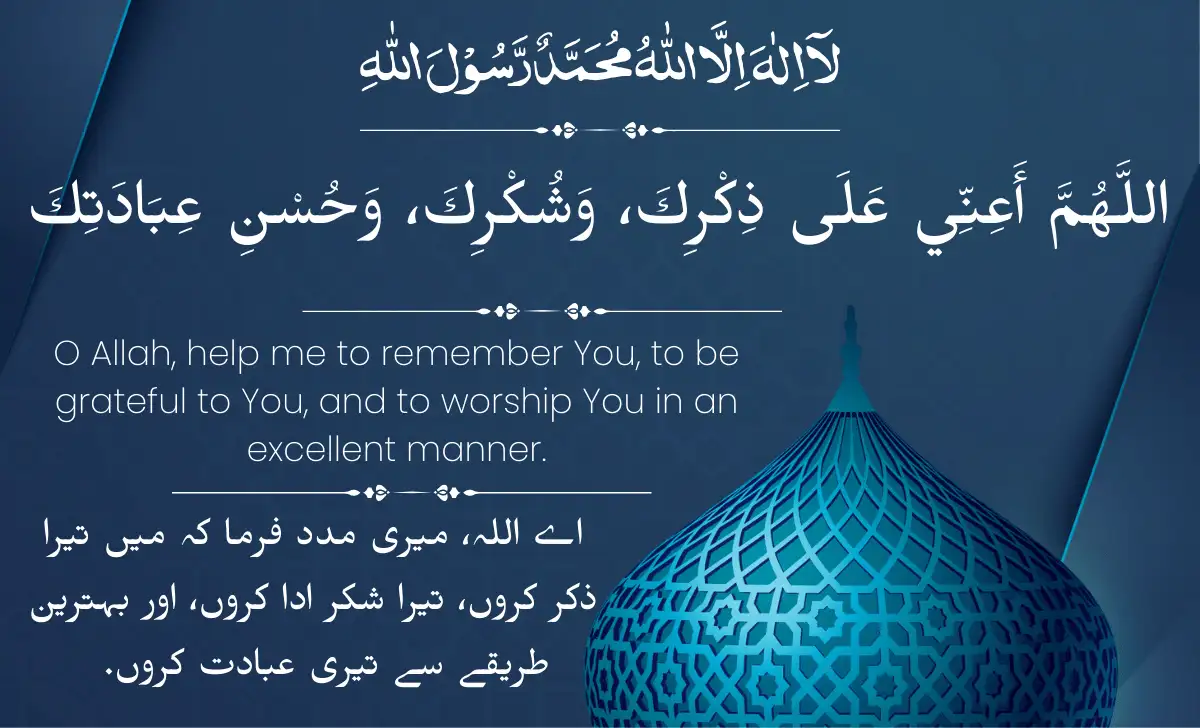
| Du’a | اللَّهُمَّ أَعِنِّي عَلَى ذِكْرِكَ، وَشُكْرِكَ، وَحُسْنِ عِبَادَتِكَ | Allahumma a’inni ‘ala zikrika, wa shukrika, wa husni ‘ibadatika. | O Allah, help me to remember You, to be grateful to You, and to worship You in an excellent manner. | اے اللہ، میری مدد فرما کہ میں تیرا ذکر کروں، تیرا شکر ادا کروں، اور بہترین طریقے سے تیری عبادت کروں۔ |
📜 The Authentic Hadith
This Du’a is confirmed in the Sunnah, establishing its high E-E-A-T:
The Messenger of Allah ($\text{peace be upon him}$) took Mu’adh ibn Jabal by the hand and said: “O Mu’adh, by Allah, I love you, so say this after every prayer: ‘Allahumma a’inni ‘ala zikrika, wa shukrika, wa husni ‘ibadatika.’”
(Sunan Abi Dawud [1522] & Sunan an-Nasa’i [1303]. Declared Sahih [authentic] by various scholars.)
Why is this Hadith so significant? The Prophet ($\text{peace be upon him}$) used an oath (“By Allah, I love you”) before teaching this Du’a, emphasizing its immense importance and his deep care for Mu’adh’s success in the Hereafter. He chose this specific phrase as the ultimate guidance for spiritual excellence.
🔑 Deeper Meaning: The Three Requests That Perfect Your Faith
The beauty of this Du’a lies in its comprehensive nature. It is a request for help with the entirety of your relationship with your Creator. Let’s break down the three powerful components:
1. The Foundation: “…‘Ala Zikrika” (Help me to Remember You)
The initial plea—“Allahumma a’inni ‘ala zikrika”—is the request for Dhikr (remembrance). This is the foundation of all faith.
- Why do we need help remembering? Because the world is designed to distract us. Our jobs, families, social media, and desires constantly pull our minds away from Allah. We are asking Allah to strengthen our hearts against the whispers of Shaytaan and the noise of the Dunya (world).
- What does Dhikr achieve? Allah says in the Quran:الَّذِينَ آمَنُوا وَتَطْمَئِنُّ قُلُوبُهُم بِذِكْرِ اللَّهِ ۗ أَلَا بِذِكْرِ اللَّهِ تَطْمَئِنُّ الْقُلُوبُTransliteration: Allatheena amanoo wa tatma-innu quloobuhum bi-zikri Allahi ala bi-zikri Allahi tatma-innu alquloobu.Translation: “Those who have believed and whose hearts are assured by the remembrance of Allah. Unquestionably, by the remembrance of Allah hearts are assured.”(Surah Ar-Ra’d, 13:28)
Reflection: Dhikr is the fuel of the heart. When you make this Du’a, you are asking for inner peace and a constant connection to the source of all tranquility.
2. The Recognition: “…Wa Shukrika” (Help me to be Grateful to You)
The second request is for Shukr (gratitude).
- Why is this the next step? A person who remembers Allah will see His blessings everywhere—in every breath, every meal, and every moment of safety. This immediate realization leads to gratitude.
- What does Shukr achieve? Gratitude ensures the permanence and increase of blessings. It shifts our focus from what we lack to what we have. As Allah promises:لَئِن شَكَرْتُمْ لَأَزِيدَنَّكُمْTransliteration: La-in shakartum la-azeedannakum.Translation: “If you are grateful, I will certainly increase you [in favour].”(Surah Ibrahim, 14:7)
The Power of this Plea: We are asking Allah not just for things to be grateful for, but for the ability to be genuinely grateful, recognizing that even gratitude itself is a gift from Him.
3. The Perfection: “…Wa Husni ‘Ibadatika” (Help me to Worship You in an Excellent Manner)
The final, climactic request is for Husn al-‘Ibadah (excellent worship).
- What is Husn al-Ibadah? This is the highest level of worship. It means not just fulfilling the Fard (obligatory duties), but performing them with Ihsan—perfection and sincerity. The Prophet defined Ihsan as: “That you worship Allah as if you see Him, for if you do not see Him, He surely sees you.”
- Why do we need help with Husn al-Ibadah? Because worship becomes a mechanical habit without sincerity. We might pray five times a day, but are our hearts present? Are we truly focused?
When you say “Allahumma a’inni ‘ala zikrika,” you are building the spiritual framework (remembrance and gratitude) that makes your ultimate goal possible: the ability to stand before Allah in prayer with a heart full of submission and sincerity.
💡 Practical Application: Prayer Routine
Many people ask, “When should I say the Du’a Allahumma a’inni ‘ala zikrika?”
The Hadith clearly indicates that you should recite it after every obligatory prayer (Salah).
- Where exactly? It is highly recommended to say this Du’a after finishing the Tasleem (the final greeting to the right and left), and after the initial Istighfar (asking for forgiveness, e.g., Astaghfirullah three times).
- Why after Salah? Because the very purpose of Salah is to establish the remembrance of Allah. By asking for help immediately after prayer, you are seeking divine strength to carry that state of Dhikr and Ihsan with you until the next prayer. It is a spiritual reset button.
Steps to Make This Du’a More Effective
- Set Your Intention: Don’t just rush the words. Before you say it, remind yourself that you are asking the Master of the universe for the taufeeq (ability and success) to remember Him.
- Visualise: As you say ‘ala zikrika, think of all the distractions you struggle with. As you say wa shukrika, think of three blessings in your life right now.
- Consistency is Key: The instruction was to say it after every prayer. Make it an unbreakable spiritual habit to strengthen your Imaan.
🌟 Conclusion: The Ultimate Ask for Spiritual Success
The life of a Muslim is a constant spiritual journey. The Du’a “Allahumma a’inni ‘ala zikrika, wa shukrika, wa husni ‘ibadatika” is your single, most comprehensive weapon for success on this path.
It’s an admission of our own weakness: O Allah, I cannot even remember You properly without Your help. It is a recognition of His infinite grace. When you recite it, you are essentially asking Allah to automate your spiritual excellence, making Dhikr easy, Shukr second nature, and Ibadah a joy rather than a burden.
Don’t let your worship be a mere transaction. Ask Allah to elevate it. Make this Du’a a daily, heartfelt plea, and watch how it transforms your connection with the Divine.
Understanding Shab-e-Barat and Dua Nisf Shaban
FAQs:
No, reciting this specific Du’a is highly recommended (Mustahabb) from the Sunnah, but it is not compulsory (Fard). The Prophet ($\text{peace be upon him}$) advised Mu’adh to say it to achieve spiritual excellence, making it a valuable action that earns great reward and benefit. Omitting it does not invalidate your prayer, but including it is an act of following the Sunnah and seeking greater connection with Allah.
The most common and recommended time, based on the Hadith, is immediately after the Tasleem (the final greeting to the right and left) of any obligatory prayer (Fard Salah). You should typically say Astaghfirullah three times, and then follow with this Du’a and other established remembrances.
This Du’a is directly linked to achieving the level of Ihsan (perfection/excellence). The third part of the Du’a, “…wa husni ‘ibadatika” (and to worship You in an excellent manner), is essentially asking Allah to grant you the ability to worship Him with Ihsan—the sincerity and concentration required to feel as if you see Him, or at least to know that He sees you. It is the ultimate request for quality in your deeds.
While the optimal time is immediately after the prayer, if you forget, you can still recite the Du’a at any time as a general supplication. Remember that the remembrance of Allah (Dhikr) is beneficial at all times. Although the specific reward for reciting it immediately after Salah might be missed, the spiritual benefit of the words remains.
Yes! The Du’a is short, rhythmical, and carries a clear, powerful message. Parents and teachers should encourage children to memorize and understand the three components—remembrance, gratitude, and good deeds—as it provides a simple, beautiful framework for their entire spiritual life.