Sometimes you feel cornered.
Not by a cave.
But by fear, pressure, family problems, or a toxic environment.
The youth of Ashab-e-Kahf faced real danger.
So they ran to safety.
And they made one short dua that still fits our lives today.
It is a dua for Allah’s mercy and right guidance when you do not know what will happen next.
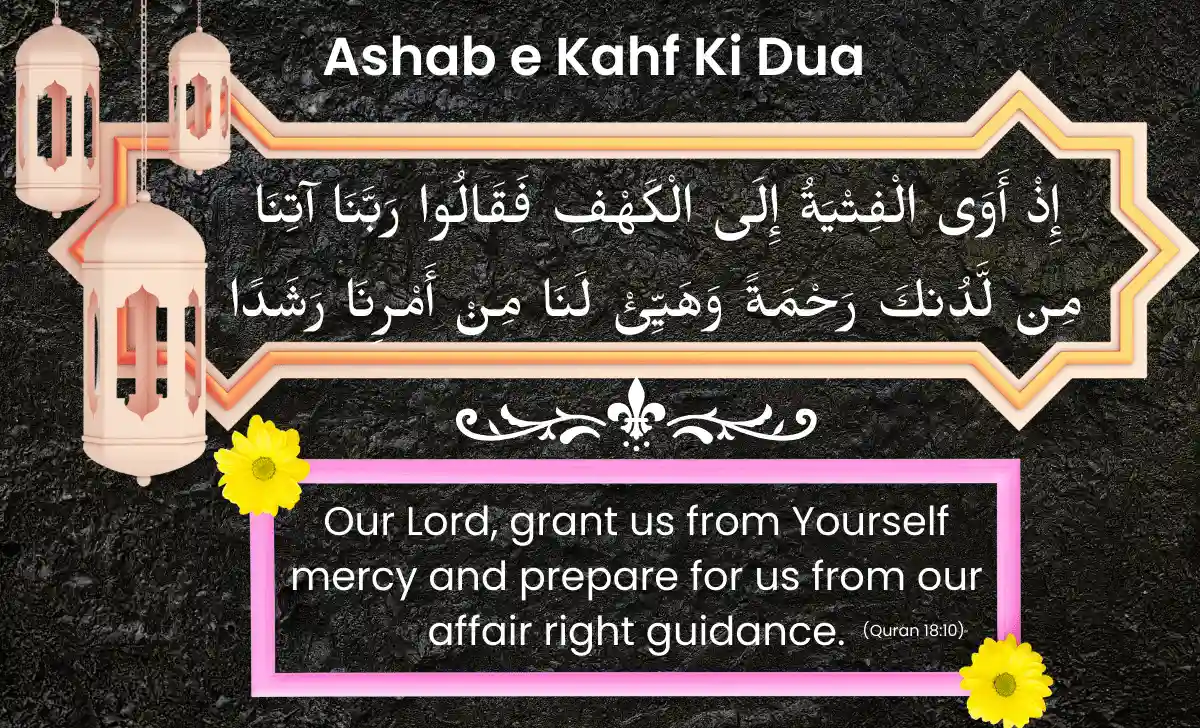
The exact Ashab e Kahf ki dua” from the Quran (Surah Al-Kahf 18:10)
Arabic (Quran 18:10)
إِذْ أَوَى الْفِتْيَةُ إِلَى الْكَهْفِ فَقَالُوا رَبَّنَا آتِنَا مِن لَّدُنكَ رَحْمَةً وَهَيِّئْ لَنَا مِنْ أَمْرِنَا رَشَدًا
Transliteration
Idh awa al-fityatu ila al-kahfi faqaloo:
Rabbana atina min ladunka rahmatan wa hayyi lana min amrina rashada.
English translation (meaning)
“Our Lord, grant us from Yourself mercy and prepare for us from our affair right guidance.”
Urdu translation (meaning)
“اے ہمارے پروردگار! ہم پر اپنے ہاں سے رحمت نازل فرما اور ہمارے کام درستی (کے سامان) مہیا کر۔”
What this dua really means
This dua has two powerful requests:
- “Give us mercy from You”
You are asking for Allah’s special mercy. Not just ease.
Mercy that protects your faith and heals your heart. - “Set our matter on right guidance”
You are asking Allah to fix the path.
To make your next step clean, wise, and safe.
Tafsir sources explain this as the youth asking Allah for mercy and for their situation to be arranged upon guidance and correctness. Surah Quran+2alim.org+2
Why Ashab-e-Kahf made this dua
They were young believers.
Their society was pushing them to leave truth.
They chose Allah over comfort.
So they withdrew to the cave and asked Allah for mercy and right direction.
That is why this dua is also a youth dua, a fitnah dua, and a decision dua. Surah Quran+1
When should you read “Ashab e kahf ki dua” in daily life?
Read it when you feel like this:
- “I am stuck. I need a way out.”
- “I am scared of what people will do.”
- “I want to protect my iman.”
- “I have a big decision and I might choose wrong.”
- “I need Allah to arrange my affairs.”
It is also beautiful to read:
- Before sleep
- After Fajr
- Before a hard meeting or conversation
- When leaving home
- During anxiety
Authentic Islamic references that strengthen this topic
1) Protection from Dajjal: first ten ayat of Surah Al-Kahf
The Prophet ﷺ said whoever learns by heart the first ten verses of Surah Al-Kahf will be protected from Dajjal. Sunnah+1
This matters because your dua (18:10) sits inside those opening verses.
2) Light between two Fridays
There are narrations about reciting Surah Al-Kahf on Friday bringing light until the next Friday. abuaminaelias.com+1
So if you make this dua part of your Friday recitation, it becomes a weekly reset.
How to memorize it fast
Use a 3-line memory pattern:
- Rabbana atina (Our Lord, grant us)
- min ladunka rahmah (from You, mercy)
- wa hayyi lana… rashada (and arrange our affair with right guidance)
Read it 7 times.
Then read it without looking once.
Do this for 3 days.
Most people lock it in.
The “60-Second Mercy & Guidance Decision Map”
Whenever you must choose and your heart is noisy, do this:
- Say the dua once slowly.
- Ask yourself 2 questions right away:
- “Which option protects my faith?”
- “Which option reduces sin pressure and future regret?”
- Then make a small action immediately (one message, one step, one boundary).
This turns the dua from a quote into a real life tool.
Questions to help you understand this topic better (for best results)
Ask yourself these honestly:
- What “fitnah” is pushing me right now? People, money, desires, fear, status?
- What do I want first: comfort or Allah’s mercy?
- Where am I ignoring guidance because it is hard?
- If Allah opens a door today, will I walk through it with courage?
These questions make the dua hit your heart, not only your tongue.
People also ask
No. It works for small daily matters too. The dua is short, but it asks for the two biggest needs: mercy and right direction.
It is in Surah Al-Kahf, Ayat 10 (18:10).
It means: “O Allah, give us Your mercy and set our matter on right guidance.”
When you feel fear, confusion, pressure, or you need Allah to guide your next step. It also fits well after Fajr and before sleep.
There are narrations about reciting it on Friday and receiving light until the next Friday.