Have you ever paused during your prayer and reflected on the words As-Salamu ‘alaika ayyuhan-Nabi (Peace be upon you, O Prophet)? Or maybe you’ve wondered why the Qur’an uses two distinct titles for the great figures sent by God: Nabi (Prophet) and Rasool (Messenger).
It’s a subtle but deeply significant point in Islamic theology. While both roles are an honour—both are chosen men who receive Divine Revelation—they carry unique, vital responsibilities that shaped the history of every nation.
As intermediate-level Muslims, understanding this distinction is key to appreciating the profound wisdom in Allah’s plan for humanity. Let’s dive deep into the beautiful linguistic and theological difference between a Nabi and a Rasool.
Are all Prophets considered Messengers in Islam?
This is the most common question, and the shortest answer is: No, not all Prophets are Messengers, but every Messenger is a Prophet.
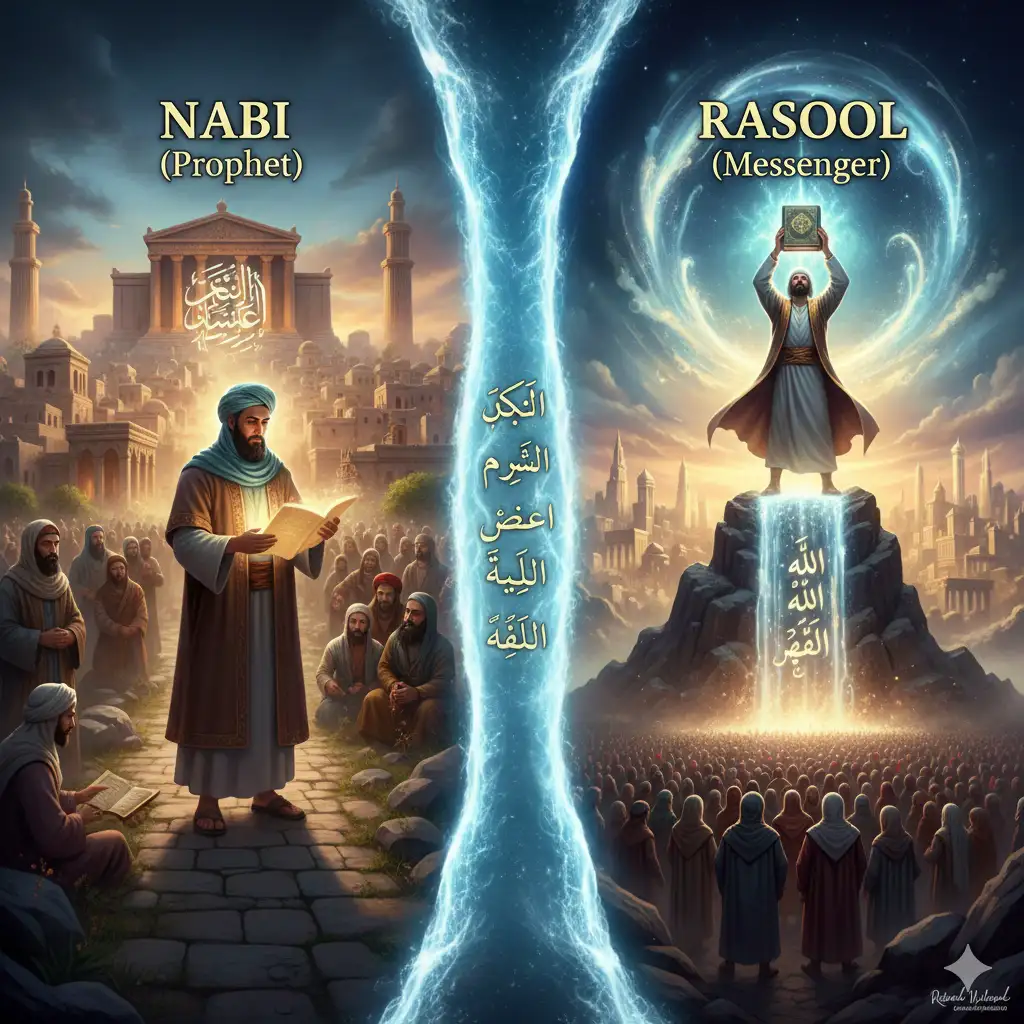
Think of it like this: being a Rasool (Messenger) is a specialized, higher-rank mission within the general category of Nabi (Prophet).
| Feature | 🌿 Nabi (Prophet) | 🌳 Rasool (Messenger) |
| Linguistic Root | From Naba’ (نَبَأ): to inform or give news. | From Risalah (رِسَالَة): a message or to send. |
| Core Function | Sent to uphold, reaffirm, and teach an existing Divine Law (Shariah). | Sent with a brand new, independent Divine Law or Scripture (Shariah). |
| New Law? | No. Follows the law of the Rasool who preceded him. | Yes. Brings a new set of laws and commandments. |
| Public Mandate | Receives revelation (Wahi) for self-guidance and to guide followers on the previous law. | Receives revelation and is explicitly commanded to convey it publicly and establish a new code. |
| Status | A foundational role. | A higher status that encompasses the role of a Nabi. |
🕋 The Distinction in the Holy Qur’an
The best evidence for a difference between Nabi and Rasool comes directly from the Qur’an, where Allah mentions them separately.
1. Surah Al-Hajj (22:52): The Clear Separation
In this verse, Allah mentions both roles together, suggesting they are distinct:
وَمَآ أَرۡسَلۡنَا مِن قَبۡلِكَ مِن رَّسُولٖ وَلَا نَبِيٍّ إِلَّآ إِذَا تَمَنَّىٰٓ أَلۡقَى ٱلشَّيۡطَٰنُ فِيٓ أُمۡنِيَّتِهِۦ
Transliteration: Wa mā arsalnā min qablika mir-Rasūlinw-wa lā Nabiyyin illā idhā tamannā alqash-Shayṭānu fī umniyyatih.
English Translation: “And We did not send before you, [O Muhammad], any Messenger (Rasool) or Prophet (Nabi), except that when he wished, Satan would inject something into his wish.
Urdu Translation: “اور ہم نے آپ سے پہلے کوئی رسول (Rasool) اور نہ کوئی نبی (Nabi) بھیجا مگر جب بھی اُس نے آرزو کی تو شیطان نے اُس کی آرزو میں کچھ ملا دیا۔
— Qur’an, Surah Al-Hajj (22:52)
The grammatical use of ‘wa lā’ (and not) to separate Rasool and Nabi is a strong indicator, as noted by classical scholars like Al-Khattabi and Ibn al-Mulaqqin, that they are two distinct types of divine appointments. If they were identical, mentioning both would be redundant.
- “How many Rasools were there?” The Quran doesn’t give a specific number. A famous Hadith in Ahmad states there were 315 Rasools (or more, as numbers vary in different narrations) among a much larger total of 124,000 Nabis. Only 25 are mentioned by name in the Quran.
- “Was Prophet Isa (Jesus) a Nabi or a Rasool?” He was both. The Quran calls him both “Isa ibn Maryam, the Nabi” (19:30) and a Rasool sent to the Children of Israel (3:49), as he confirmed the Tawrat and brought the Injil (Gospel).
- “What about our Prophet Muhammad (ﷺ)?” He is the ultimate example of both—the final Nabi and the final Rasool, sent with the complete and eternal law, the Quran, for all of humanity and jinn.
2. Surah Al-Ahzab (33:40): The Finality of Prophethood
This verse confirms the ultimate status of Prophet Muhammad peace be upon him by granting him both titles:
مَّا كَانَ مُحَمَّدٌ أَبَآ أَحَدٍ مِّن رِّجَالِكُمْ وَلَٰكِن رَّسُولَ ٱللَّهِ وَخَاتَمَ ٱلنَّبِيِّينَ
Transliteration: Mā kāna Muḥammadun abā aḥadim mir-rijālikum wa lākir-Rasūl Allāhi wa Khātam-an-Nabiyyīn.
English Translation: “Muhammad is not the father of [any] one of your men, but [he is] the Messenger of Allah (Rasool Allahi) and the Seal of the Prophets (Khatam an-Nabiyyin).
Urdu Translation: “محمد (صلی اللہ علیہ وآلہ وسلم) تمہارے مَردوں میں سے کسی کے والد نہیں ہیں، لیکن اللہ کے رسول (Rasool) اور آخری نبی (Khatam an-Nabiyyin) ہیں۔
— Qur’an, Surah Al-Ahzab (33:40)
By calling him the Messenger of Allah (Rasool) and the Seal of the Prophets (Nabi), it confirms his supreme and final status in both categories.
🏛️ The Three Main Differences: Law, Transmission, and Status
Let’s break down the essential theological distinctions that define the difference between Nabi and Rasool.
1. The Distinction of the Law (Shariah)
This is the most critical difference.
- Rasool: A Messenger (Rasool) is the one who brings a new Divine Law (Shariah) or a new heavenly book (like the Torah, Injil, or Qur’an). He is sent to an entire community with a complete set of legal and moral commandments tailored for that time.
- Examples: Prophet Noah, Prophet Abraham, Prophet Moses, Prophet Jesus, and Prophet Muhammad (peace be upon them all).
- Nabi: A Prophet (Nabi) is sent to implement and uphold the Shariah of the Rasool who came before him. His revelation is not a new law, but rather guidance on how to correctly apply the existing law, or to warn his people against corruption of that law.
- Example: Prophet Harun (Aaron) was a Nabi who assisted the Rasool, Prophet Musa (Moses). Many later Prophets of Israel followed the Shariah of Musa.
2. The Command of Transmission
While both receive Wahy (Revelation), the command to transmit it publicly differs:
- Rasool: The Messenger is commanded to deliver the message, establish the law, and confront the rejecting nation with an undeniable, public challenge. This mission often culminates in a definitive judgment on that nation.
- Nabi: The Prophet is primarily informed of the unseen and of God’s commands, but may not be explicitly commanded to convey a new message to a new nation in the same confrontational, judicial way. He focuses on reminding and teaching the existing followers.
3. The Number and Hierarchy Number of Prophets)
Though the exact numbers are known only to Allah, a famous (though debated) Hadith gives us a conceptual idea:
- Nabi: The number of Prophets (Anbiya) is much larger—said to be around 124,000. This reflects the vast number of figures sent throughout history to keep nations on the right path.
- Rasool: The number of Messengers (Rusul) is much smaller—said to be around 315. This reflects the rarity of introducing an entirely new, major religious system.
This shows that the position of a Rasool is an exclusive, higher honour due to the immense burden of bringing a new Shariah.
💡 A Spiritual Reflection: Why Does This Matter Today?
Sometimes we read these theological distinctions and wonder, how does this impact my daily life?
The answer lies in the concept of Risalah (The Mission).
The fact that Allah sent thousands of Prophets (Nabi) proves that He never leaves humanity without guidance. The moment one nation started to drift, another Prophet arrived, reaffirming the truth. The continuity of this light is a profound act of mercy.
The climax of this Divine guidance was the sending of Prophet Muhammad ($\text{peace be upon him}$), the last Rasool and the Seal of the Prophets (Khatam an-Nabiyyin).
- He was a Rasool because he brought the Final and Universal Law (the Qur’an) that supersedes all others.
- He was a Nabi because he was the very last to receive direct revelation from God.
His status as the Khatam an-Nabiyyin means the chain is complete. We do not wait for a new law or a new book. Everything we need for this life and the next is preserved in the Qur’an and his Sunnah. This knowledge gives us certainty and trust in our faith.
Next time you hear the words Nabi or Rasool, remember the tremendous responsibility carried by these chosen men, and let it strengthen your commitment to the perfect message they delivered.
A Pledge of Allegiance and Hope
Connect with the beloved Imam of our Time (may Allah hasten his return) by reciting the powerful supplication. Strengthen your faith and renew your commitment to justice.
📖 Recite Dua-e-Imam-e-ZamanaFAQs:
A Law-Bearing Messenger (Rasool) brings a new Shariah (e.g., Prophet Moses). A Non-Law-Bearing Prophet (Nabi) follows and enforces the Law of the previous Messenger (e.g., Prophet Aaron, who followed the law of Moses).
All the major five Messengers of resolve (Ulul Azm) are both: Noah, Abraham, Moses, Jesus, and Muhammad peace be upon him. The Qur’an also explicitly calls Moses a Messenger, a Prophet in Surah Maryam (19:51).
He is called the Seal of the Prophets (Khatam an-Nabiyyin) because he is the final Nabi and Rasool sent to mankind. His revelation, the Qur’an, is the last divine scripture, ensuring that no new prophet or messenger will come after him.