INTRODUCTION
Many Muslims, especially in Pakistan and India, hear or recite the phrase “Ha Meem La Yunsaroon” for protection and spiritual strength. The words are short, but they carry a deep message of hope, justice, and Allah’s power over every enemy and every hardship. This article explains the meaning, Qur’anic context, tafsir, benefits, and emotional reflections behind this phrase—written in a simple, spiritual, and heart-touching style.
WHAT DOES HA MEEM LA YUNSAROON MEAN?
The phrase “Ha Meem La Yunsaroon” comes from two Qur’anic expressions:
- “Ha Meem” – disjointed letters found at the beginning of Surahs 40 to 46.
- “La yunsaroon” – a Qur’anic phrase meaning “they will not be helped.”
Together, these words remind us that those who fight the truth will never succeed.
ARABIC, TRANSLITERATION, AND TRANSLATIONS
Arabic
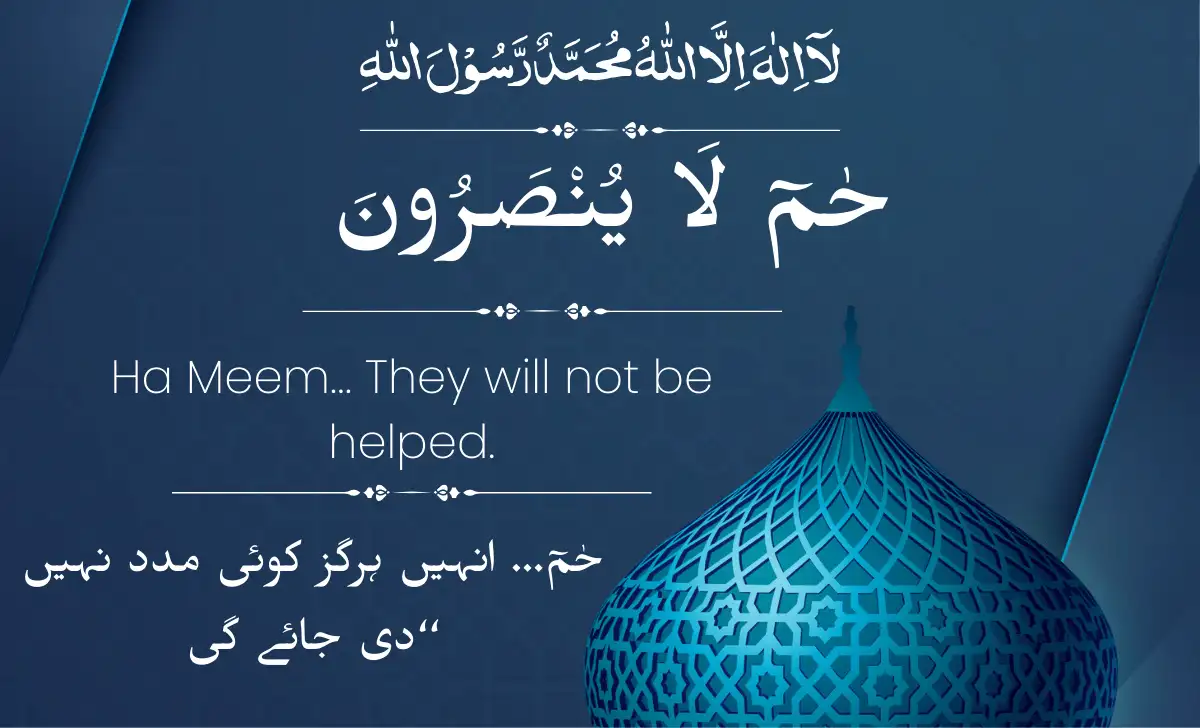
حٰمٓ
لَا يُنْصَرُونَ
Transliteration
Ha Meem
Laa yunsaroon
English Translation
“Ha Meem… They will not be helped.”
Urdu Translation
’’حٰمٓ… انہیں ہرگز کوئی مدد نہیں دی جائے گی‘‘
WHERE DOES THIS PHRASE COME FROM IN THE QUR’AN?
The exact phrase as people commonly recite is a combination of two Qur’anic styles:
• “Ha Meem” appears at the beginning of several Surahs.
• “La yunsaroon” appears repeatedly in verses describing the failure of falsehood.
One powerful related verse is in Surah As-Saffat (37:172–173):
وَإِنَّ جُندَنَا لَهُمُ الْغَالِبُونَ
Transliteration: Wa inna jundanā lahumul ghaaliboon
English: “And indeed, Our soldiers will surely be victorious.”
Urdu: ’’بے شک ہمارے سپاہی ہی غالب رہیں گے‘‘
And Allah says about the enemies of truth:
وَمَا كَانُوا مُنصَرِينَ
English: “And they were never going to be helped.”
These verses reflect the spirit of “Ha Meem La Yunsaroon”:
Truth will rise. Falsehood will fall. Allah decides victory.
TAFSIR EXPLANATION (IBN KATHIR, TABARI, QURTUBI)
TAFSIR IBN KATHIR
Ibn Kathir states that the letters “Ha Meem” signify the greatness of the Qur’an. Right after these letters, Allah speaks about His power, His justice, and the downfall of those who resist His message.
TAFSIR QURTUBI
Imam Qurtubi explains that “la yunsaroon” means oppressors will receive no divine help—no matter how strong they appear. Allah may give them time, but not victory.
TAFSIR TABARI
Imam Tabari writes that those who oppose the truth cannot be saved by:
• their wealth
• their alliances
• their plots
• their apparent strength
Allah’s plan is greater than every human plan.
Together, these tafasir show that “Ha Meem La Yunsaroon” is not magic. It is a reminder that:
If Allah is with you, no one can defeat you.
If Allah is against someone, no one can help them.
WHY DO MUSLIMS RECITE “HA MEEM LA YUNSAROON”?
Many Muslims recite these words when facing:
• enemies
• jealousy
• workplace politics
• family disputes
• unfair treatment
• fear of harm
It brings comfort because it expresses a Qur’anic truth:
Those who plan evil will not be helped.
This is not a fixed “wazifa,” but reciting Qur’an to seek courage, safety, and Allah’s help is completely permissible.
THE SPIRITUAL MESSAGE BEHIND THE PHRASE
“Ha Meem La Yunsaroon” teaches us three deep lessons:
- Allah sees your enemies even when you don’t.
- No plot, jealousy, or harm can override Allah’s protection.
- Falsehood may rise for a moment, but it always collapses in the end.
Sometimes people fear humans more than they fear Allah. This Qur’anic expression reminds the heart:
Your fate is in Allah’s hands—not theirs.
EMOTIONAL REFLECTION FOR TODAY’S BELIEVER
Every Muslim goes through moments of fear—when someone tries to harm you, lies about you, or secretly works against you. During those moments, your heart trembles. But the Qur’an speaks to you:
“They will not be helped.”
“Truth will win.”
“Allah is with the believers.”
These simple words become a shield around your heart.
A SHORT REAL-LIFE EXAMPLE (PROTECTION FROM AN ENEMY)
A man from Lahore once went through a painful situation. A coworker was jealous of his success and began spreading lies to ruin his reputation. Every day felt heavier. The man felt helpless.
One evening, while reading Qur’an, he came across Surahs beginning with “Ha Meem” and repeatedly read verses saying that oppressors “will not be helped.”
He whispered to himself:
“Ya Allah, You know the truth. You know my heart. Protect me.”
He recited these verses—not as a ritual, but as a reminder of Allah’s promise.
Within a short time, the truth came out. The jealous coworker was exposed. The man said:
“It wasn’t me. It was Allah’s protection. The oppressor never receives real help.”
This story reflects the spiritual reality behind “Ha Meem La Yunsaroon.” Allah defends those who cannot defend themselves. He strengthens weak hearts. He silences false accusations.
BENEFITS OF “HA MEEM LA YUNSAROON”
The phrase itself is not a separate dua, but the Qur’anic message behind it carries powerful spiritual benefits. These benefits come from the meanings of the verses—not from a fixed ritual.
- Strengthens Tawakkul (trust in Allah)
It reminds you that help comes only from Allah, not from people, numbers, or power. - Calms fear of enemies
When someone is plotting against you, these words comfort your heart:
“They will not be helped.” - Helps during injustice
Whether it is workplace politics, family oppression, jealousy, or lies—this message keeps you firm. - Encourages patience
It teaches believers to stay strong because Allah’s promise always favors the righteous. - Protects the heart from despair
Sometimes the enemy looks stronger. These words restore hope. - Strengthens spiritual courage
Knowing that Allah defends His servants gives deep emotional strength. - Reminder of divine justice
Oppressors might rise temporarily, but Allah eventually removes their power.
SAFE RUQYAH GUIDANCE
Important: This is NOT a wazifa with a fixed amount. It is general Qur’anic recitation for comfort and reliance on Allah.
How to recite safely:
- Recite “Ha Meem” verses from the Qur’an in a calm voice.
- Reflect on their meaning—Allah protects, and oppressors fail.
- Recite “Laa yunsaroon” wherever it appears in the Qur’an to remind your heart of Allah’s justice.
- Make dua afterwards:
“Ya Allah, protect me from harm and give me victory over those who wish me wrong.” - Believe that protection comes from Allah alone—not from numbers, rituals, or formulas.
This approach is supported by scholars because:
• It is Qur’an-based.
• It is free from bid’ah.
• It focuses on meaning, not ritual.
As Ibn Taymiyyah and other scholars of ruqyah teach:
“Any Qur’anic verse recited with faith and sincerity is a source of healing and protection.”
PEOPLE ALSO ASK
What does La Yunsaroon teach us about Allah’s justice?
Why do Ha Meem surahs emphasize victory of truth?
Is it sunnah to recite Ha Meem for protection?
How did classical scholars explain Ha Meem?
Can anyone recite these verses without special knowledge?
SPIRITUAL LESSONS FROM “HA MEEM LA YUNSAROON”
This phrase is not meant to be a ritual.
It is meant to be a reminder.
A reminder that:
• Allah sees every plot against you.
• Allah hears every whisper of your heart.
• Allah knows when you feel weak.
• Allah protects in ways you cannot see.
Sometimes you feel surrounded by enemies, yet Allah tells you:
“They will not be helped.”
Sometimes people plan secretly against you, yet Allah says:
“I am with My believers.”
This Qur’anic message is a shield—not around your body, but around your heart.
CONCLUSION AND PERSONAL REFLECTION
Every believer faces a moment when someone tries to harm them—through lies, jealousy, hatred, or unfair treatment. During those moments, fear enters the heart. The world feels dark.
But the Qur’an gives light.
“Ha Meem La Yunsaroon” reminds you that no oppressor, no magician, no enemy, no jealous person, and no plotter has more power than Allah. Their strength is temporary. Their plans are weak. Their support is nothing.
Allah says:
“They will not be helped.”
The real question is:
Who do you rely on—people or Allah?
When your heart relies on Allah, every mountain becomes light, every fear becomes small, and every enemy becomes powerless.
Hold onto these Qur’anic words.
Let them flow into your heart.
Let them remind you that Allah is your Protector.
And if Allah protects you, no one can harm you.
FAQs:
Ha Meem” are disjointed letters that appear at the beginning of several Surahs (40–46).
“La yunsaroon” means: “They will not be helped.”
Combined meaning:
“Ha Meem… they will not be helped.”
It expresses a Qur’anic reality that those who oppose Allah’s truth, commit injustice, or rely on falsehood will never receive real help or victory.
No, it is not a dua.
It is a Qur’anic expression combining two parts:
• “Ha Meem” – opening letters of some Surahs
• “La yunsaroon” – a Qur’anic phrase describing the defeat of wrongdoers
Although it is not a dua from Sunnah, reciting Qur’anic words for comfort, protection, and spiritual strength is permissible.
The phrase “la yunsaroon” appears in multiple Surahs in different forms.
Some relevant Surahs include:
• Surah As-Saffat (37)
• Surah Ad-Dukhan (44)
• Surah Al-Anbiya (21)
• Surah Al-Baqarah (2)
Each time, Allah explains that those who reject truth or become oppressors will not be supported.
Yes, you may recite the Ha Meem verses as part of general Qur’anic recitation for:
• protection
• courage
• reliance on Allah
• calming the heart
There is no fixed number from Sunnah.
It should be recited with understanding, not as a ritual formula.
Protection comes from Allah, not from the letters themselves.
No, it is not a traditional or Sunnah-prescribed wazifa.
However:
• reciting Qur’anic verses for protection
• reflecting on Allah’s promises
• strengthening tawakkul
is allowed and recommended by scholars of ruqyah—as long as no fixed count or invented ritual is attached.
Yes.
It is fully permissible and supported by scholars.
The Prophet (صلى الله عليه وسلم) himself used Qur’anic verses such as:
• Surah Al-Falaq
• Surah An-Nas
• Ayatul Kursi
Using Qur’anic verses for ruqyah is allowed if:
• the person believes protection comes only from Allah
• no innovation is added
• no specific number is fixed without evidence
The Ha Meem Surahs (40–46) carry themes of:
• Allah’s protection over believers
• defeat of oppressors
• downfall of falsehood
• strength of truth
• reassurance during fear
• spiritual courage
So the benefits include:
Emotional strength
Calmness during fear
Protection from harmful people
Reminder of Allah’s justice
Hope during trials
Patience in conflict
Trust in Allah’s plan
These benefits come from the meanings—not from rituals.
Islam teaches several authentic ways:
Recite Surah Al-Falaq and Surah An-Nas morning and evening.
Recite Ayatul Kursi for protection.
Make dua: “HasbiAllahu la ilaha illa Huwa.”
Trust Allah more than you fear the enemy.
Avoid sin—sin weakens spiritual protection.
Recite Qur’anic verses like “Ha Meem” Surahs to strengthen iman.
Do no injustice yourself—Allah helps the oppressed.
The biggest protection is tawakkul.
Allah says:
“And Allah is the best of Protectors.”