The statement “من كنت مولاه فعلي مولاه” (Man Kunto Maula Fa Aliyyun Maula) is one of the most discussed sentences in early Islamic history. It appears in several hadith collections, most famously in Jamiʿ al-Tirmidhi, and is tied to an important event known as Ghadīr Khumm.
Because this hadith is sometimes misunderstood or used out of context, a balanced, Sunni-friendly, deeply researched explanation is essential — especially for modern readers searching for authentic knowledge.
This article provides exactly that.
Arabic Text of the Hadith
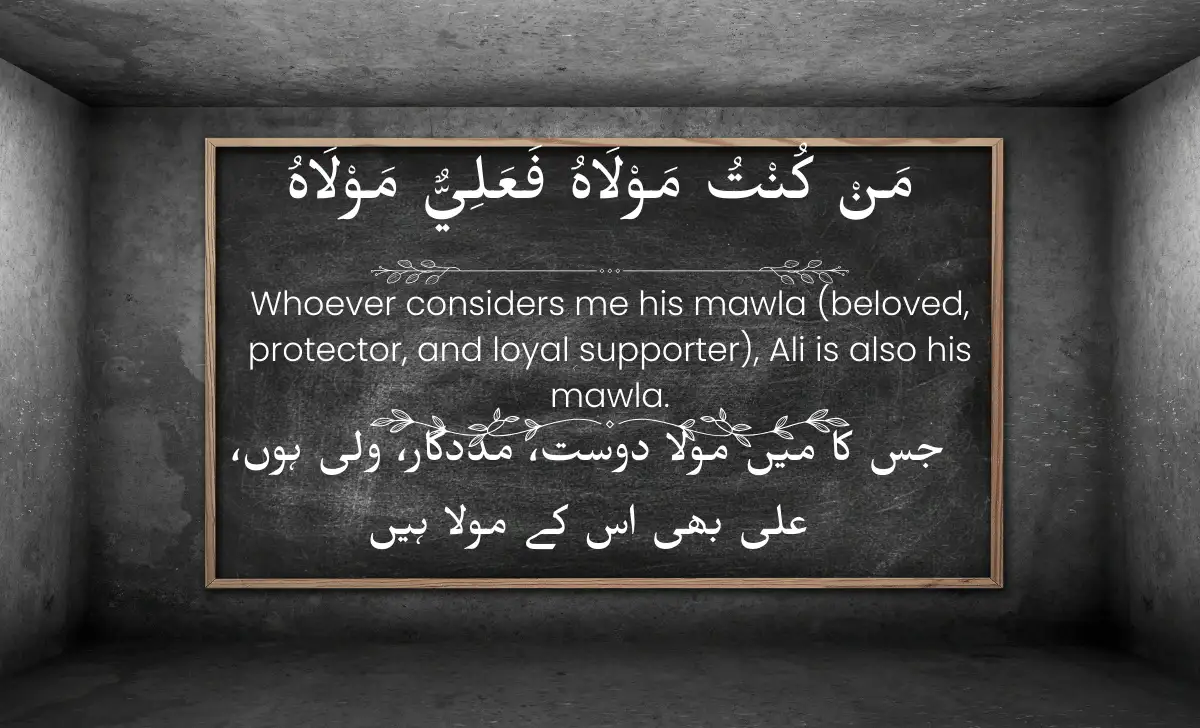
مَنْ كُنْتُ مَوْلَاهُ فَعَلِيٌّ مَوْلَاهُ
Transliteration:
Man kuntu mawlahu fa ‘Aliyyun mawlahu.
English Translation:
“Whoever considers me his mawla (beloved, protector, and loyal supporter), Ali is also his mawla.”
Urdu Translation:
“جس کا میں مولا (دوست، مددگار، ولی) ہوں، علی بھی اس کے مولا ہیں۔”
What Is the Literal Meaning of “Mawla”?
One of the most important questions is:
What does “Mawla” mean?
The Arabic word مولى (Mawlā) has over 20 meanings, including:
- Friend
- Supporter
- Helper
- Loved one
- Ally
- Protector
- Patron
- Freed slave
- Leader
- One deserving loyalty
Because the word has multiple meanings, scholars emphasize that:
➤ Meaning must be determined by context, not by assumption.
In Arabic usage — especially early Islamic usage — mawla most commonly meant:
✔ Supporter
✔ Beloved companion
✔ One who deserves loyalty
Thus, the hadith indicates a special status and closeness of Ali ibn Abi Talib رضي الله عنه, not necessarily political succession.
Historical Context: What Happened at Ghadīr Khumm?
To understand the hadith properly, one needs the background.
✔ The event took place during the Prophet’s ﷺ return from the Farewell Hajj (10 AH).
✔ At a place called Ghadīr Khumm, the Prophet ﷺ paused and addressed thousands of companions.
✔ He reminded them of the rights of believers upon one another.
Then he stood up, took Ali’s hand, and said:
“Whoever I am mawla to, Ali is his mawla.”
Why was this said?
Scholars explain:
- Some people had complained about Ali’s strictness in distributing spoils in Yemen.
- The Prophet ﷺ clarified Ali’s honor, love, and closeness.
- The statement restored unity and emphasized that loving Ali is part of loving the Prophet ﷺ.
❗ Important Sunni point:
The Prophet ﷺ did not say:
- “Ali is your leader after me.”
- “Ali is your political successor.”
- “Ali must be obeyed as a ruler after me.”
He only affirmed Ali’s status, virtue, and closeness, not political appointment.
Authenticity of the Hadith — Sunni Scholarly Position
The narration appears in Tirmidhi (3713). Scholars differed:
✔ Many declared it Hasan (good).
- Imam Tirmidhi
- Imam Ahmad (in some narrations)
- Ibn Hajar
- Al-Dhahabi
✔ Some considered certain chains weak.
Because some routes of narration have weak transmitters.
✔ Consensus:
Though individual chains differ in strength, the overall meaning is accepted, and the hadith is widely quoted in Sunni sources as a statement of virtue — not political authority.
Does “Mawla” Mean Leadership or Political Succession?
Short Answer:
➡ No.
Sunni scholars agree that the hadith praises Ali رضي الله عنه but does not appoint him as the political leader after the Prophet ﷺ.
Reasons:
- Sahih hadiths clearly indicate Abu Bakr’s priority (prayer leadership, companionship, ijmāʿ of companions).
- The word “mawla” is never used by the Prophet ﷺ to mean “caliph.”
- The companions understood the statement as respect, not as a transfer of authority.
- Ali himself accepted Abu Bakr, Umar, and Uthman, proving he did not interpret the hadith as political designation.
Thus, the Sunni interpretation is both historically and linguistically consistent.
Why Did the Prophet ﷺ Emphasize Ali’s Status?
Ali رضي الله عنه was:
- One of the earliest Muslims
- The Prophet’s cousin and son-in-law
- A brave warrior (Badr, Uhud, Khaybar)
- Scholar and judge
- Ahl al-Bayt (family of the Prophet)
The Prophet ﷺ wanted to ensure:
- Ali is respected
- People do not criticize him unjustly
- Unity among Muslims remains strong
Thus, the hadith promotes love, loyalty, and justice toward Ali.
What Does This Hadith Teach Modern Muslims?
1. Loving the Ahl al-Bayt is essential.
Ali, Fatima, Hasan, Husayn — all are honored.
2. Differences must not divide the Ummah.
The hadith was originally about ending disputes.
3. Leadership in Islam must follow Qur’an, Sunnah, and ijma’.
This protects the Ummah from misinterpretation.
4. Spiritual connection with righteous companions elevates faith.
Ali’s courage, humility, and knowledge inspire Muslims today.
Man Kunto Maula Hadees Lyrics in Urdu- (PDF)
People Also Ask:
What is the meaning of “Man Kunto Maula”?
It means: “Whoever regards me as their beloved/supporter/protector, Ali is also their beloved/supporter/protector.”
Is this hadith authentic?
Yes, it is reported in Tirmidhi and other sources. Scholars classify it as hasan or acceptable, though some chains are weak.
Did the Prophet appoint Ali as a political leader?
No. Sunni scholars agree the hadith shows Ali’s status, not succession. The companions’ ijma’ confirms this.
Why was this statement made at Ghadir Khumm?
To resolve complaints against Ali and emphasize his virtue.
What is the Sunni understanding of this hadith?
It teaches love, respect, and loyalty to Ali رضي الله عنه, not political designation.
If you are interested in reading more, please visit these links:
Emotional Reflection
Imagine standing in the desert heat. Thousands are gathered. The Prophet ﷺ takes the hand of Ali — a man who has sacrificed everything for Islam.
He raises his hand and says:
“Whoever loves me, loves Ali.”
In that moment, hearts soften. Old disputes fade. Unity returns.
This is the real spirit of the hadith.
Not politics.
Not division.
Not arguments.
Just love, loyalty, and respect — the foundations of a strong Ummah.
Summary Box
Hadith: “Man Kunto Maula Fa Aliyyun Maula”
Meaning: Whoever loves, supports, and honors the Prophet ﷺ must also love, support, and honor Ali رضي الله عنه.
Authenticity: Hasan in Tirmidhi; accepted for virtues, not for leadership.
Sunni Belief: A statement of honor, not political succession.
Lesson: Love for Ahl al-Bayt is part of faith, and unity is essential.
FAQs:
It is accepted in Sunni books like Tirmidhi but interpreted differently. Sunnis see it as a declaration of love and honor, not political leadership.
Sunni scholars do not classify it as mutawatir. It has multiple chains, some stronger than others.
No. Ali gave allegiance to Abu Bakr, Umar, and Uthman — proving he did not interpret the statement as political appointment.
Because it expresses the Prophet’s deep love and respect for Ali and teaches unity.
As a call to love Ali, respect the Ahl al-Bayt, and maintain unity — exactly as the Prophet ﷺ intended.