Have you ever felt a deep desire to give something back to Allah? Maybe you’re expecting a child, starting a business, or beginning a new chapter in life. Surah Al Imran Ayat 35 tells the beautiful story of a mother’s heart—Hannah (the wife of Imran)—and her powerful vow to her Creator.
The Sacred Verse (Arabic)
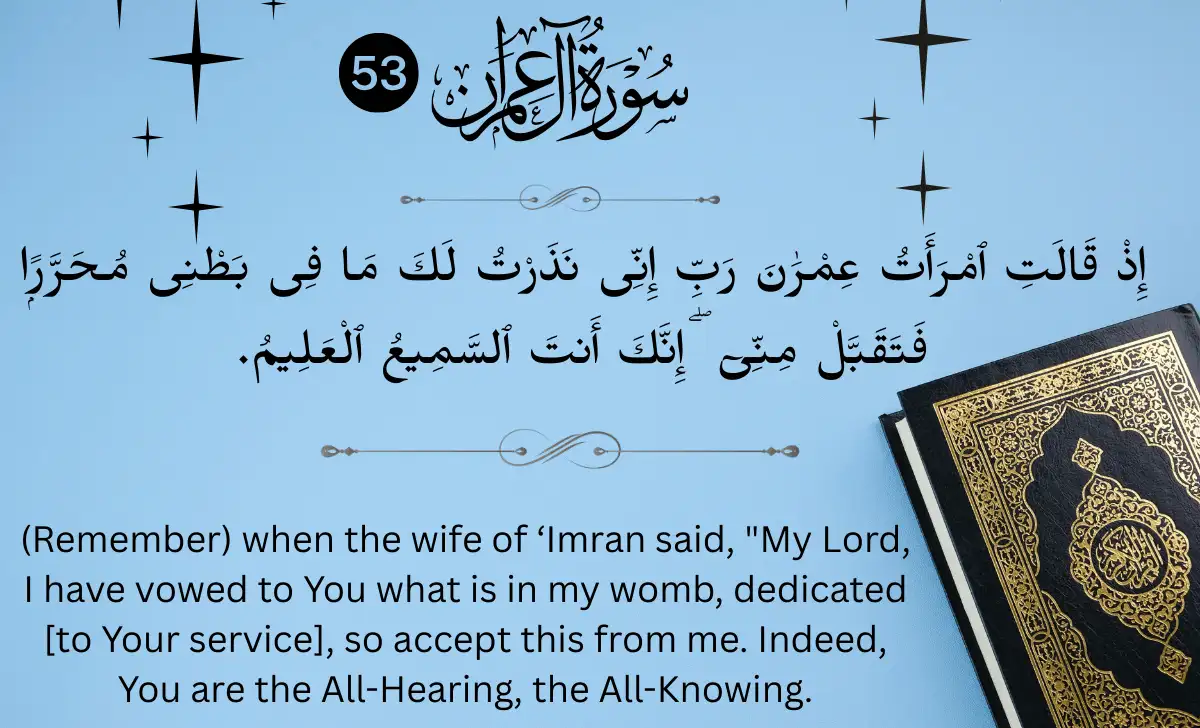
إِذْ قَالَتِ ٱمْرَأَتُ عِمْرَٰنَ رَبِّ إِنِّى نَذَرْتُ لَكَ مَا فِى بَطْنِى مُحَرَّرًۭا فَتَقَبَّلْ مِنِّىٓ ۖ إِنَّكَ أَنتَ ٱلسَّمِيعُ ٱلْعَلِيمُ
Transliteration
Iz qaalatim-ra-atu ‘Imraana Rabbi innee nazartu laka maa fee batnee muharraran fataqabbal minnee; innaka Antas-Samee‘ul ‘Aleem.
English & Urdu Translations
- English: (Remember) when the wife of ‘Imran said, “My Lord, I have vowed to You what is in my womb, dedicated [to Your service], so accept this from me. Indeed, you are the All-Hearing, the All-Knowing.”
- Urdu:
جب عمران کی بیوی نے کہا: “اے میرے رب! جو میرے پیٹ میں ہے میں اسے تیرے لیے آزاد (وقف) کرنے کی نذر مانتی ہوں، سو تو میری طرف سے قبول فرما لے، بیشک تو خوب سننے والا اور جاننے والا ہے۔”
Deep Tafsir: What “Rabbi Inni Nazartu Laka” Really Means
In classical works like Tafsir Ibn Kathir and Ma’ariful Quran, scholars highlight the word “Muharraran” (مُحَرَّرًا). This doesn’t just mean “dedicated”; it means “freed.”
Hannah was saying: “I want this child to be free from worldly distractions, free from the service of men, and dedicated only to You, Ya Allah.”
Key Lessons from the Verse:
- Sincerity (Ikhlas): She made this dua before the child was even born. She didn’t know if it would be a boy or a girl—she just wanted whatever Allah gave her to be for Him.
- The Role of a mother: This verse establishes that a mother’s prayer and her intention for her children carry immense weight in the sight of Allah.
- Trust in Allah’s Hearing: By ending with As-Samee’ul ‘Aleem, she acknowledges that Allah hears the silent whisper of her heart and knows her true intent.
The Benefits of Reciting and Reflecting on Ayat 35
While every verse of the Quran is a blessing, scholars and spiritual mentors often mention specific benefits (Faza’il) of this passage:
- For Expectant Parents: It is a beautiful Sunnah to recite this verse and make the same intention for your unborn child. It sets a spiritual foundation for their life.
- Seeking Acceptance: If you are starting any project “for the sake of Allah,” use the phrase “Fataqabbal minni” (So accept from me). It is the ultimate plea for Barakah.
- Strengthening Niyyah: It reminds us that our primary goal should be too “free” our actions from worldly ego and dedicate them to the Divine.
My Personal Reflection: The Beauty of the Unseen
What moves me most about this verse is that Hannah’s plan didn’t go exactly how she expected. She wanted a son to serve in the temple, but Allah gave her a daughter—Maryam (AS).
Sometimes, we offer something to Allah and feel disappointed when the outcome looks “different.” But Maryam (AS) became the most honored woman in history! This teaches us: Give your best intention to Allah and let Him choose the form of the blessing.
🛡️ The Divine Shield: Why Maryam (AS) and Isa (AS) Never Cried at Birth
Many of us wonder why newborns cry the moment they enter the world. While science gives us one reason, the Prophet Muhammad (ﷺ) gave us a spiritual insight that directly connects to the prayer of Hannah in Ayat 35 and 36.
The Authentic Hadith (Sahih Bukhari & Muslim)
Narrated by Abu Huraira (RA), the Messenger of Allah (ﷺ) said:
“No child is born among the offspring of Adam but Satan touches it. A child, therefore, cries loudly at the time of birth because of the touch of Satan, except Mary and her child.”
(Sahih Bukhari 3431, Sahih Muslim 2366)
After sharing this, Abu Huraira (RA) would often recite the very next verse from Surah Al Imran:
The Answer in Ayat 36
“…And I seek refuge for her in You and [for] her descendants from Satan, the expelled [from the mercy of Allah].” (Surah Imran 3:36)
💎 The “Hidden” Connection: Why This Matters for You
Most people read Ayat 35 as a simple story, but when you combine it with this Hadith, a powerful “Success Strategy” for parents emerges.
- The Power of Pre-Emptive Dua: Hannah made the dua before the child was born and immediately after. She didn’t wait for a problem to arise; she built the shield before the battle began.
- The Miracle of “Acceptance”: Because her intention in Ayat 35 was pure (“dedicated to Your service”), Allah granted her a request in Ayat 36 that He had never granted anyone else in history.
- A Lesson in Gender: Hannah was slightly disappointed at first because she thought only a boy could serve Allah in the temple. But Allah showed her that a protected, pious daughter (Maryam) would achieve more than a thousand sons.
🕊️ A Final Reflection for Your Heart
When you say “Rabbi inni nazartu laka” (My Lord, I vow to You…) about any part of your life—your children, your job, or your daily efforts—you are placing that thing under Divine Protection.
Hannah teaches us that when we “free” our intentions from worldly greed, Allah “frees” our outcomes from the touch of Shaytan.
People Also Ask
Her name was Hannah bint Faqudh. She was the mother of Maryam (Mary) and the grandmother of Prophet Isa (Jesus), peace be upon them.
Yes! Many scholars recommend reciting this as a way to dedicate your child to a life of righteousness and service to Islam.
It refers to someone who is liberated from worldly occupations to focus entirely on the service of the Mosque (specifically Bait-ul-Maqdis at that time) and the worship of Allah.