Have you ever felt like you were at the end of your rope? You’ve worked hard, you’ve prayed, but the doors still seem closed. I’ve been there. In those moments, I turned to the story of Prophet Isa (peace be upon him) and his disciples. When they were hungry and seeking a sign, Isa (AS) didn’t just ask for a meal; he asked for a “Ma’idah”—a heavenly table spread that would change their lives forever.
Surah Al-Ma’idah Ayat 114: Details
| Feature | Detail |
| Surah Name | Al-Ma’idah (The Table Spread) |
| Surah Number | 5 |
| Para (Juz) Number | Para 7 (Wa Iza Sami’u) |
| Ayat Number | 114 |
| Ruku Number | Ruku 15 of the Surah |
| Place of Revelation | Madina (Madani Surah) |
| Total Ayat in Surah | 120 |
| Chronological Order | 112th Surah revealed (post-Hijra) |
The Quranic Verse (Arabic & Transliteration)
First, let’s look at the powerful words as they appear in the Holy Quran:
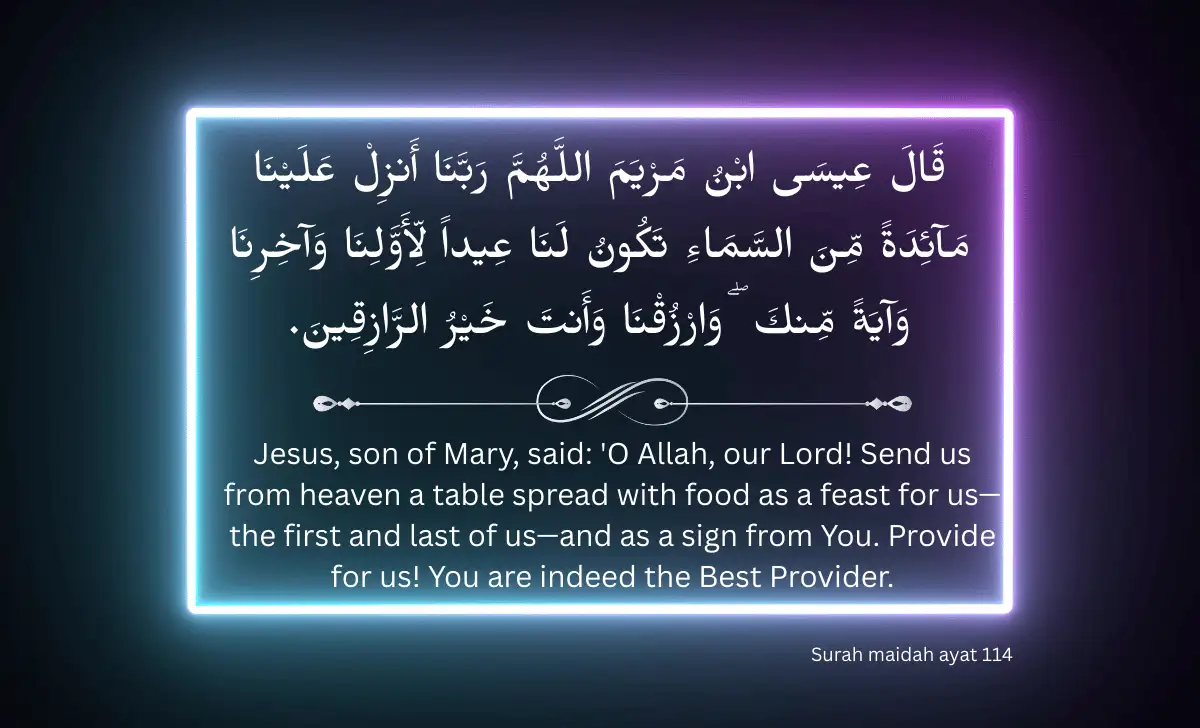
قَالَ عِيسَى ابْنُ مَرْيَمَ اللَّهُمَّ رَبَّنَا أَنزِلْ عَلَيْنَا مَآئِدَةً مِّنَ السَّمَاءِ تَكُونُ لَنَا عِيداً لِّأَوَّلِنَا وَآخِرِنَا وَآيَةً مِّنكَ ۖ وَارْزُقْنَا وَأَنتَ خَيْرُ الرَّازِقِينَ
Transliteration:
Qala ‘Eesab-nu Maryamal-lahumma Rabbana anzil ‘alaina ma’idatam minas-sama’i takoonu lana ‘eedal-li awwalina wa akhirina wa ayatam-minka warzuqna wa Anta khayrur-raziqeen.
Meaning & Translations
English Translation:
“Jesus, son of Mary, said: ‘O Allah, our Lord! Send us from heaven a table spread with food as a feast for us—the first and last of us—and as a sign from You. Provide for us! You are indeed the Best Provider.’”
Urdu Translation:
“عیسیٰ ابن مریم نے عرض کیا: اے اللہ! اے ہمارے پروردگار! ہم پر آسمان سے دسترخوان اتار کہ وہ ہمارے لیے یعنی ہم میں جو اول ہیں اور جو بعد کے ہیں سب کے لیے ایک خوشی کی بات ہوجائے اور تیری طرف سے ایک نشانی بن جائے، اور ہمیں رزق دے اور تو بہترین رزق دینے والا ہے۔”
💎 “Maidah for Spiritual Success
The Transference of Gratitude.
When Isa (AS) prayed, he didn’t just ask for food for the hungry people in front of him. He asked that it be a festival for those “to come after them.” The Lesson: When you pray for yourself, include the future generations of your family and the Ummah. By widening your intention (niyyah), you draw more of Allah’s Barakah (blessing) because your prayer becomes selfless.
🤲 Authentic Wazifa & Spiritual Benefits
Scholars and spiritual mentors have highlighted this verse for various needs. Here is how you can use it with sincerity (Ikhlas).
1. Wazifa for Rizq (Abundant Provision)
If you are facing debt or a stagnant business:
- Method: Recite this verse 11 times after every Farz prayer.
- Special Tip: Recite it 7 times before breaking your fast (Iftar) in Ramadan or on Sunnah fasts. It is said that at the moment of Iftar, this Dua opens the gates of the “Heavenly Table.”
2. Wazifa for Marriage (Finding a Pious Partner)
Marriage is also a form of “Rizq” (provision of the soul).
- Method: Recite Darood-e-Ibrahim 11 times, followed by Ayat 114 41 times, and end with Darood-e-Ibrahim 11 times.
- Consistency: Do this for 21 days after Tahajjud or Isha. Ask Allah for a partner who will be a “festival” (joy) for your life.
3. General Benefits
- Heart Satisfaction: It removes anxiety about the future.
- Strengthening Faith: It serves as a reminder that Allah can provide from sources you cannot imagine.
🖋️ Reflection: My Personal Take
I remember a time when my family was going through a very tough financial patch. We felt stuck. I started reciting “Qala Isa ibn Maryam…” not just as a ritual, but as a conversation. I stopped looking at my empty bank account and started looking at the “Sky of Allah’s Mercy.” Within weeks, unexpected opportunities appeared.
Allah doesn’t just want to give you “bread”; He wants to give you a “Feast.” He wants your provision to be a source of joy (Eid) for you and your family. Don’t just ask for a way out; ask for a way that brings you closer to Him.
May Allah open the doors of His Ma’idah for you today. Ameen.
🕋 Tafsir Why did Prophet Isa (AS) ask for an “Eid”?
In classical commentaries like Tafsir Ibn Kathir and Ma’ariful Quran, scholars explain that the word “Eid” (from the root ‘awada, meaning “to return”) wasn’t just about a party or food. It had three deep spiritual layers:
1. A Recurring Day of Gratitude
According to As-Suddi, Prophet Isa (AS) intended that the day the Ma’idah descended would be a sacred anniversary. It was to be a day where “the first and the last” (meaning the present generation and those to come) would gather to thank Allah for His manifest miracle.
2. A Return to “Fitra” (Purity)
Ayatullah Makarem Shirazi notes that “Eid” signifies a “return” to one’s original state of ease and certainty. By witnessing the food from heaven, the disciples’ doubts would vanish, and their hearts would return to a state of pure, unwavering faith—the ultimate spiritual “Eid.”
3. A Feast for the Soul, Not Just the Body
The Tafsir emphasizes that while the disciples asked for food to “satisfy their stomachs,” Prophet Isa (AS) elevated the request. He asked for an Ayah (Sign). The “Eid” was the celebration of Divine Connection—the realization that the Creator is intimately aware of His servants’ needs.
Key Insight: In Islamic tradition, every day you do not commit a sin is a day of Eid.” By reciting this verse, you are asking Allah to return your life from a state of hardship to a state of “Eid” (ease and joy).
People Also Ask
Yes! While it focuses on provision (Rizq), scholars suggest it can be recited for any legitimate Hajat (need) because it calls upon Allah as the “Best Provider.
While you can recite it anytime, the times of “acceptance” (between Adhan and Iqamah, during rain, or at Tahajjud) are highly recommended.
It means “The Best of Providers.” It reminds us that while bosses or clients are means, the actual Provider is only Allah.