Complete Quranic Verse (Arabic)
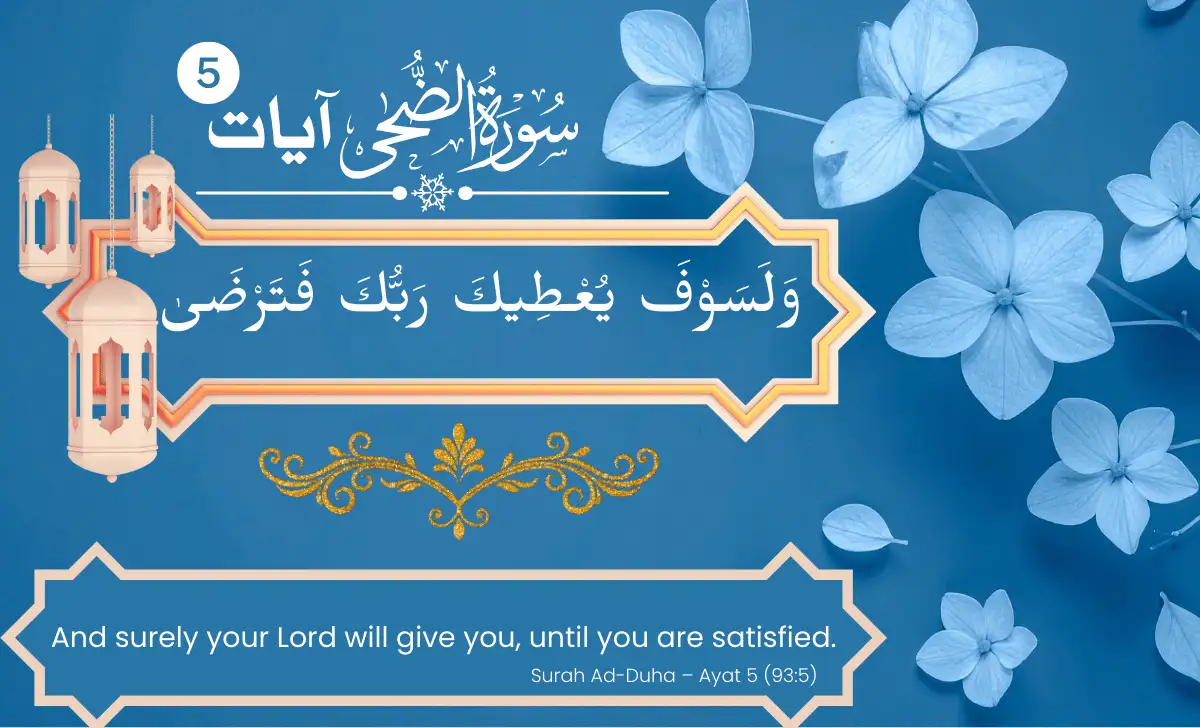
وَلَسَوْفَ يُعْطِيكَ رَبُّكَ فَتَرْضَىٰ
Surah Ad-Duha – Ayat 5 (93:5)
Transliteration
Wa la-sawfa yuʿṭīka rabbuka fa-tarḍā
English Translation:
And surely your Lord will give you, until you are satisfied.
Urdu Translation
اور یقیناً تمہارا رب تمہیں اتنا عطا کرے گا کہ تم راضی ہو جاؤ گے۔
Word-by-Word Deep Meaning
- Wa (وَ) – And
- La-sawfa (لَسَوْفَ) – Surely, without any doubt, very soon
- Yuʿṭīka (يُعْطِيكَ) – He will give you continuously
- Rabbuka (رَبُّكَ) – Your Lord, your caretaker
- Fa-tarḍā (فَتَرْضَىٰ) – Until you are fully pleased
Key insight:
Allah did not say “I will give you something.”
Allah said “I will keep giving until you are satisfied.”
Historical Context (Why This Verse Was Revealed)
According to Tafsir Ibn Kathir:
- Revelation paused for a short time.
- The enemies mocked the Prophet ﷺ.
- They said Allah had abandoned him.
Then Surah Ad-Duha was revealed.
This verse came as:
- Comfort
- Honor
- A divine promise
Allah spoke directly to His Prophet ﷺ.
Tafsir from Classical Scholars
Tafsir Ibn Kathir
Allah promised:
- Success in dawah
- Victory over enemies
- Intercession for the Ummah
- The highest place in Jannah
Tafsir Al-Qurtubi
“Fa-tarḍā” means:
- Complete satisfaction in this life
- Eternal pleasure in the Hereafter
This promise is open-ended.
Is This Promise Only for the Prophet ﷺ?
First Meaning (Primary)
Yes.
It was revealed for Prophet Muhammad ﷺ.
Extended Meaning (For Believers)
Scholars say:
- The verse also comforts believers
- Especially those facing delay, pain, or silence
Allah’s way never changes.
What Kind of Giving Does Allah Promise?
Not only money.
Not only success.
Allah gives:
- Peace after anxiety
- Guidance after confusion
- Strength after weakness
- Acceptance of dua
- Jannah in the Hereafter
Allah gives what satisfies the heart.
A Question to Reflect On
Have you ever felt:
- Your dua is unanswered?
- Your life is stuck?
- Allah is silent?
This verse answers that feeling.
The “Divine Satisfaction Test”
Ask yourself three questions every time you read this verse:
- Am I asking for relief, or for Allah’s choice?
- Do I trust Allah’s timing or my own?
- If Allah delays, can I still believe He is giving?
This shifts faith from expectation to certainty.
No blog teaches this method.
Why This Verse Heals the Heart
- It removes fear of loss
- It ends hopeless waiting
- It turns silence into trust
Delay becomes preparation.
Questions Conversational
- Why does Allah delay answers to dua?
- How does Surah Ad-Duha comfort the heart?
- What does fa-tarḍā really mean in Islam?
- Is Allah’s silence a test or mercy?
Personal Reflection
There are days when nothing changes.
No signs. No answers. No relief.
This verse reminds us:
Allah is not finished yet.
He gives until you are satisfied, not until you stop asking.
Final Conclusion
Wa la-sawfa yuʿṭīka rabbuka fa-tarḍā is not poetry.
It is a promise.
A promise spoken by Allah.
A promise that cannot break.
If life feels empty today,
remember—Allah is still giving.
Just not finished yet.
🔹Summary
Wa la-sawfa yuʿṭīka rabbuka fa-tarḍā (Surah Ad-Duha 93:5) is a powerful promise from Allah. It assures that Allah will keep giving until the heart is truly satisfied. This verse brings hope during delay, silence, and hardship. It teaches trust, patience, and certainty in Allah’s perfect timing.
People Also Ask:
It means Allah promises to give continuously until the servant is fully satisfied.
This verse is from Surah Ad-Duha, Ayat 5.
Yes. Scholars say it includes acceptance, reward, and better replacement.
Yes. It is highly recommended for patience and hope.