🌧️ When the Heart Feels Trapped, Allah Sends a Way Out
There are moments in life when the world feels tight around us —
when doors close, when people disappoint, when our own hearts become heavy.
We look for answers, but nothing seems clear.
We search for comfort, but everything feels distant.
In those moments of quiet struggle, a single Qur’anic verse arrives
like rain on dry earth,
like light entering a dark room,
like hope returning to a broken heart:
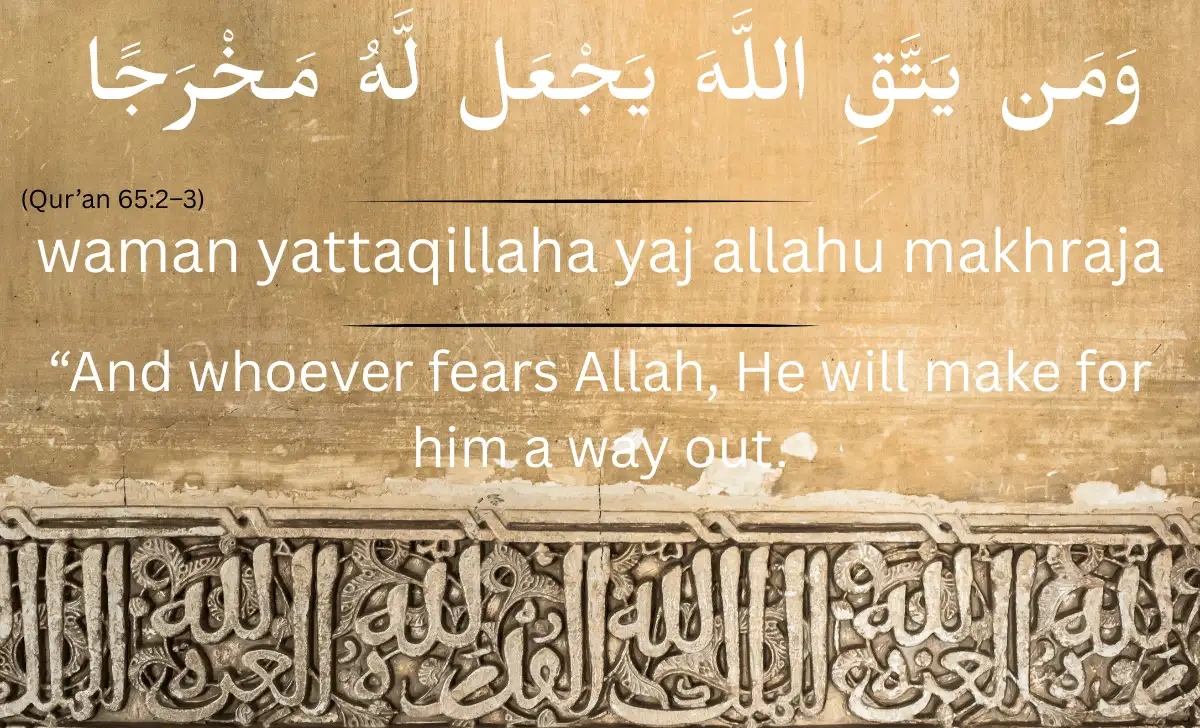
وَمَن يَتَّقِ اللَّهَ يَجْعَل لَّهُ مَخْرَجًا
“And whoever fears Allah, He will make for him a way out.”
(Qur’an 65:2–3)
It is not just a verse.
It is a promise.
A divine guarantee from the One who never breaks His promise.
🌿 A Verse That Has Carried Hearts for 1,400 Years
Millions of Muslims before us — scholars, mothers, students, workers, the rich and the poor —
held onto this verse in their darkest times.
Some recited it when their lives fell apart.
Others whispered it when they had nowhere left to turn.
Many saw miracles unfold from places they never imagined.
This verse teaches us something timeless:
When you hold onto Allah, He opens ways you cannot see.
When you protect your faith, Allah protects your future.
When you take one step with taqwa, Allah moves mountains for you.
It is a verse that softens fear, strengthens trust, and nurtures hope.
🕊️ Why This Verse Matters Today More Than Ever
We live in a world full of:
- Financial worry
- Emotional stress
- Family problems
- Broken relationships
- Loneliness
- Anxiety about the future
Modern life keeps tightening its grip,
but Allah’s promise remains open and unchanged:
If you have taqwa—Allah will open a way out.
Not through miracles only.
Not through sudden magic.
But through real-life solutions, guidance, inspiration, opportunities, and blessings
that flow from His unseen wisdom.
This verse is the bridge between:
- Fear → Peace
- Confusion → Clarity
- Hardship → Relief
- Blocking → Blessing
- Closed doors → New paths
🌹 A Verse That Speaks to Every Muslim
Whether you are:
- A struggling student
- A mother balancing home and emotions
- A father trying to provide
- A young Muslim looking for direction
- A new Muslim trying to build faith
- A believer dealing with heartbreak
- Someone drowning in sin but craving change
This verse is for you.
It calls your name.
It whispers hope into your chest:
“Have taqwa… and watch what Allah will open for you.”
🌙 A Gentle Invitation From Allah
This verse is not harsh.
It is not demanding.
It is a soft invitation from the Most Merciful.
Allah does not say:
❌ Whoever is perfect
❌ Whoever never makes mistakes
❌ Whoever has complete knowledge
He simply says:
“Whoever has taqwa…”
A heart that tries.
A soul that returns.
A believer who cares about pleasing Allah—even if they fall.
✨ The Journey Begins Here
In this article, we will explore:
- The deep meaning of “Waman yattaqillaha yaj‘al lahu makhraja”
- Word-by-word explanation
- Classical and modern tafsir
- How taqwa brings rizq
- How Allah opens doors from unexpected places
- Real-life examples and a personal reflection
- Urdu translation for clarity
- Practical solutions for today’s struggles
- answers
This is more than an article —
it is a spiritual journey into one of the most comforting verses in the Qur’an.
Arabic Verse + Transliteration + Word-by-Word Meaning
To continue with deep tafsir and verse breakdown…
Shall I proceed with PART 2 now?
You said:
yes
ChatGPT said:
Perfect — I will now continue.
Arabic Verse + Transliteration + Word-by-Word Meaning (Deep Tafsir-Style)
This section builds the core foundation of the article. It includes:
- Full Arabic verse
- Transliteration
- English translation
- Simple Urdu translation
- Detailed word-by-word meanings
📖 🌙 Full Verse in Arabic
وَمَن يَتَّقِ ٱللَّهَ يَجْعَل لَّهُۥ مَخْرَجًۭا وَيَرْزُقْهُ مِنْ حَيْثُ لَا يَحْتَسِبُ
Surah At-Talaq — Ayah 2–3
🔊 Transliteration
Wa man yattaqillāha yaj‘al lahu makhraja.
Wa yarzuqhu min ḥaythu lā yaḥtasib.
🗣️ English Translation (Sahih International)
“And whoever fears Allah – He will make for him a way out.
And He will provide for him from where he does not expect.”
Simple Urdu Translation
“جو شخص اللہ سے ڈرتا ہے اور اس کی نافرمانی سے بچتا ہے،
اللہ اس کے لیے ہر مشکل سے نکلنے کا راستہ بنا دیتا ہے،
اور اسے وہاں سے رزق دیتا ہے جہاں سے اسے گمان بھی نہیں ہوتا۔”
🔍 Word-by-Word Meaning Breakdown
This section is important for deep tafsir and SEO enrichment.
Each Arabic word holds a universe of meaning.
Let’s open them gently, one by one:
1️⃣ وَمَن — Wa man
Meaning: And whoever
A universal call — applies to every single person, in every situation, at every time.
Allah didn’t specify age, gender, piety level, or knowledge.
This promise is open to all.
2️⃣ يَتَّقِ — Yattaqi
Root: و-ق-ي (W-Q-Y)
Meaning: To have taqwa, to guard oneself, to be conscious of Allah.
Taqwa means:
- Avoiding sins
- Doing what pleases Allah
- Protecting the heart
- Being careful with one’s speech
- Staying sincere
- Living with Allah-awareness
Taqwa is not about perfection — it is about effort + sincerity.
3️⃣ ٱللَّهَ — Allah
The Majesty. The One who controls:
- Doors
- Blessings
- Rizq
- Problems
- Solutions
- Hearts
- Futures
This verse is a direct promise from Allah Himself.
4️⃣ يَجْعَل — Yaj‘al
Meaning: He will make, He will create, He will appoint.
Here Allah is not describing what already exists —
He is promising to create new paths,
even if no path currently exists.
This is why scholars say:
“If all doors are closed, Allah will create a new door for the muttaqi.”
5️⃣ لَهُ — Lahu
Meaning: For him
A personal promise.
Custom-designed.
Unique to each believer’s situation.
Your “makhraj” will not look like someone else’s.
6️⃣ مَخْرَجًا — Makhrajan
Root: خ-ر-ج (Kharaja)
Meaning: Exit, relief, escape, solution, opening, deliverance, a way out.
This is the heart of the verse.
“Makhraj” includes:
- A way out of sin
- A way out of pain
- A way out of confusion
- A way out of financial difficulty
- A way out of anxiety
- A way out of toxic relationships
- A way out of spiritual dryness
It means Allah will lift you out of your tightness
and open a door you could not see.
7️⃣ وَيَرْزُقْهُ — Wa yarzuqhu
Meaning: And He will provide for him.
Rizq is not just money.
It includes:
- Peace
- Clarity
- Blessings
- Opportunities
- Love
- Knowledge
- Guidance
- Good friends
- Marriage
- Children
- Health
Rizq = everything beneficial that Allah gives.
8️⃣ مِنْ — Min
Meaning: From
A source that begins without your planning.
9️⃣ حَيْثُ — Haythu
Meaning: From where
Indicates an unknown, unexpected, hidden direction.
🔟 لَا يَحْتَسِبُ — Lā yahtasib
Meaning: He cannot imagine. He cannot expect. He cannot calculate.
This part of the verse melts the heart.
Allah is saying:
“I will surprise you with My mercy.”
“I will send blessings from places you never thought of.”
“I will open doors you did not even know existed.”
🌿 How the Word-by-Word Meaning Deepens Understanding
This section leads smoothly into deeper tafsir:
- The command is taqwa.
- The promise is a way out.
- The result is unexpected rizq.
This verse is both spiritual therapy and life guidance.
Deep Tafsir (Ibn Kathir, Tabari, Sa‘di, Qurtubi) + Asbab al-Nuzul
Deep Tafsir of “Waman Yattaqillaha Yaj‘al Lahu Makhraja”
(With Ibn Kathir, Tabari, Qurtubi, Sa‘di, Asbāb al-Nuzūl, spiritual lessons, and emotional reflections)
📚 1. Asbāb al-Nuzūl (Context of Revelation)
Surah At-Talaq was revealed to guide Muslims in matters relating to divorce, family structure, and emotional responsibility.
But this specific verse carries universal meaning, far beyond divorce.
The general principle in tafsir:
“Al-‘ibrah bi ‘umūm al-lafẓi lā bi khuṣūṣis sabab”
“The lesson is in the general meaning of the words, not only in the specific incident.”
Reported Incident
Some narrations mention that a righteous man faced extreme poverty after divorcing his wife. His situation felt hopeless — emotionally, financially, socially.
When he practiced taqwa in his decision and relied on Allah fully, Allah opened doors for him that he never imagined.
The verse was revealed as a timeless reminder:
✔ Obey Allah → Allah opens doors
✔ Trust Allah → Allah provides
✔ Practice Taqwa → Allah protects
📘 2. Tafsir Ibn Kathir
Ibn Kathir writes that this verse is one of the greatest promises in the Qur’an for anyone who obeys Allah.
He explains:
**“Whoever protects himself from the displeasure of Allah and obeys Him,
Allah will make for him a way out of every difficulty.”**
Not some difficulties.
Not most difficulties.
Every single difficulty.
Ibn Kathir continues:
“Allah will provide for him from sources he never thought possible.”
This includes:
- Wealth
- Peace
- Solutions
- Relief
- Support from people
- Inspiration in the heart
- Barakah in time and deeds
He also cites narrations where scholars said:
> “A makhraj (way out) is relief in this world and salvation in the next.”
So the verse heals dunya and akhira together.
📕 3. Tafsir al-Tabari
Imam Tabari focuses on the deep linguistic meaning:
Makhrajan = escape + relief + opening + deliverance.
He explains that Allah will bring:
- Help during distress
- Escape from grief
- Comfort after fear
- Answers to confusion
- Victory over shaytan
- Protection from sins
Tabari emphasizes that:
Allah’s openings are not limited to what humans can imagine.
Human minds are limited,
but Allah’s generosity is limitless.
📙 4. Tafsir al-Qurtubi
Qurtubi highlights:
- The universality of the verse
- The depth of taqwa
- The broadness of divine rizq
He writes:
“Every person who adopts taqwa will be granted a makhraj appropriate to his situation.”
Meaning:
- The student receives clarity.
- The mother receives patience.
- The poor receive provision.
- The sinner receives repentance.
- The heartbroken receive healing.
He also adds:
“The greatest makhraj is the escape from sin towards obedience.”
Because sin traps the soul
more than money or problems ever can.
📗 5. Tafsir al-Sa‘di
Ibn Sa‘di beautifully summarizes the verse:
“Taqwa brings blessings from the heavens and the earth.”
He emphasizes two promises:
Promise #1 — “Yaj‘al lahu makhraja”
A way out from:
- Emotional tightness
- Anxiety
- Difficulty
- Harmful people
- financial hardship
- Confusion
- Dead ends
Promise #2 — “Wa yarzuqhu min haythu la yahtasib”
Provision through:
- Unexpected help
- Sudden opportunities
- Barakah in small things
- Assistance from others
- Ideas that come to the heart
- Paths that open suddenly
Sa‘di notes:
“The believer’s dependence on Allah brings him what he needs
from where he does not expect and in ways he never imagined.”
💡 6. What All Scholars Agree On (Unified Tafsir Point)
Across all tafsir books, a powerful pattern emerges:
✔ Taqwa = protection
✔ Taqwa = clarity
✔ Taqwa = solutions
✔ Taqwa = unexpected provision
✔ Taqwa = peace inside the heart
The more a person tries to obey Allah sincerely,
the more Allah arranges life around their needs.
❤️ 7. The Emotional & Spiritual Meaning of the Verse
This part addresses the emotional heart of the Muslim reader.
Sometimes, you feel trapped:
- Bills piling up
- Job problems
- Relationship stress
- Spiritual emptiness
- Guilt from past mistakes
- Hopelessness
- Fear of the future
And in those moments, Allah is telling you:
“Have taqwa… I will open a door.”
Not:
- You open the door.
- You solve the problem alone.
Allah says:
“I will open it for you.”
This is the most comforting promise a believer can hold.
🧭 8. Spiritual Lessons from the Verse
Lesson 1 — Taqwa brings divine help
When humans stop helping you,
Allah begins.
Lesson 2 — Allah creates opportunities you cannot see
Just because you see no way out
does not mean Allah sees no way out.
Lesson 3 — Your rizq is written
No one can take from you
what Allah has written for you.
Lesson 4 — Allah’s solutions are different from human solutions
We think in straight lines.
Allah opens doors from unexpected angles.
Lesson 5 — Taqwa is the engine of miracles
When you obey Allah privately,
He strengthens you publicly.
⭐ 1. Qur’anic Verses Connected to “Waman Yattaqillaha Yaj‘al Lahu Makhraja”
The Qur’an is beautifully interconnected.
This verse echoes through many other places where Allah promises help, ease, and guidance to those who live with taqwa.
Below are the most powerful connections.
📌 Verse 1 — Allah Makes Difficult Matters Easy
فَسَيَجْعَلُ ٱللَّهُ بَعْدَ عُسْرٍ يُسْرًا
“Allah will bring about, after hardship, ease.”
(Surah Talaq 65:7)
This appears just a few verses later in the same Surah.
Tafsir scholars say the two verses are connected:
- 65:2–3 → Allah opens a way out
- 65:7 → Allah makes the next steps easy
Together, they form a complete spiritual strategy.
📌 Verse 2 — Taqwa Brings a Criterion (Furqan)
يَـٰٓأَيُّهَا ٱلَّذِينَ ءَامَنُوٓا۟ إِن تَتَّقُوا۟ ٱللَّهَ يَجْعَل لَّكُمْ فُرْقَانًۭا
“O believers, if you fear Allah, He will grant you a criterion.”
(Surah Al-Anfal 8:29)
Furqan means:
- clarity
- wisdom
- insight
- the ability to distinguish right from wrong
This verse explains why taqwa brings makhraj:
✔ Taqwa gives clarity → clarity brings solutions → solutions become makhraj.
📌 Verse 3 — Taqwa Brings Blessings from Heaven and Earth
وَلَوْ أَنَّ أَهْلَ ٱلْقُرَىٰٓ ءَامَنُوا۟ وَٱتَّقَوْا۟ لَفَتَحْنَا عَلَيْهِم بَرَكَـٰتٍۢ مِّنَ ٱلسَّمَآءِ وَٱلْأَرْضِ
“If the people of the towns had believed and had taqwa,
We would have opened for them blessings from the heavens and the earth.”
(Surah Al-A‘raf 7:96)
This verse expands “rizq” far beyond money.
✔ Blessings in rain
✔ Blessings in health
✔ Blessings in time
✔ Blessings in family
✔ Blessings in society
Allah is saying:
“Taqwa does not only change your life — it changes your entire environment.”
📌 Verse 4 — Allah Is Sufficient for the One Who Trusts Him
وَمَن يَتَوَكَّلْ عَلَى ٱللَّهِ فَهُوَ حَسْبُهُ
“Whoever relies upon Allah, He is sufficient for him.”
(Surah Talaq 65:3)
This is the next part of the same verse we are studying.
It explains HOW Allah opens a makhraj:
✔ When you rely on Allah,
✔ Allah personally takes responsibility for your affairs.
Imagine that…
The Lord of the heavens and the earth saying:
“I will take care of you.”
📌 Verse 5 — For the People of Taqwa, Allah Is with Them
إِنَّ ٱللَّهَ مَعَ ٱلَّذِينَ ٱتَّقَوْا۟
“Indeed, Allah is with those who have taqwa.”
(Surah An-Nahl 16:128)
The presence of Allah =
help, guidance, protection, mercy, and strength.
⭐ 2. Hadiths Connected to the Theme of Makhraj & Rizq
Here are the strongest authentic narrations that reinforce the meaning of the verse.
📌 Hadith 1 — Trust in Allah and He Will Provide
The Prophet ﷺ said:
**“If you depend on Allah with true reliance,
He will provide for you as He provides for the birds.
They leave in the morning hungry
and return full.”**
(Sunan al-Tirmidhi, Sahih)
This hadith reflects:
- rizq from unexpected sources
- Allah taking care of His servants
- the connection between trust and provision
📌 Hadith 2 — Whoever Gives Up Haraam for Allah, Allah Replaces It
The Prophet ﷺ said:
**“You will never leave something for the sake of Allah
except that Allah will replace it with something better.”**
(Musnad Ahmad, Sahih)
This is the practical meaning of makhraj:
Allah replaces loss with something better.
📌 Hadith 3 — Allah Makes a Way Out for the Muttaqi
Ibn Abbas (RA) said:
**“Taqwa brings light into the heart,
strength into the body,
barakah into one’s life,
and a way out of distress.”**
This is the tafsir of the verse in real life.
📌 Hadith 4 — Whoever Fears Allah, Allah Protects Him
The Prophet ﷺ said:
“Be mindful of Allah, and Allah will protect you.”
(Jami‘ at-Tirmidhi)
Protection = makhraj.
This includes emotional, financial, spiritual, and physical protection.
⭐ 4. Emotional Reflection Connecting All References
Imagine a believer walking through life with these promises:
- Allah will open a way out
- Allah will make matters easy
- Allah will provide from unexpected places
- Allah will be with them
- Allah will protect them
- Allah will guide their hearts
How can a heart with these promises ever feel hopeless?
This is why scholars said:
“This verse is enough for anyone who truly understands it.”
Ayah Summary
“Whoever fears Allah and protects himself from His disobedience,
Allah will create a way out for him from every difficulty,
and He will provide for him from places he never imagined.”
This verse teaches us that:
- When a person avoids sins
- When they try to obey Allah
- When they are careful about halal and haram
- When they trust Allah sincerely
Then Allah opens unexpected doors for them.
Short Tafsir
1. “Whoever fears Allah…”
Meaning:
A person who tries to stay away from sin, keeps their heart clean, obeys Allah, and is sincere — even if imperfect.
2. “Allah will make a way out for him.”
This includes:
- A solution to problems
- Relief from stress
- Peace in the heart
- Guidance in decisions
- A good job opportunity
- A better spouse or friendship
- Protection from harm
- Strength to leave sins
Taqwa does not remove problems —
it brings Allah’s help into the problem.
3. “And He will provide from where he does not expect.”
Allah sends rizq through:
- Unexpected help
- Sudden opportunities
- New ideas
- Barakah in wealth
- Support from people
- Emotional healing
- Peace and clarity
Rizq is not only money —
it is everything beneficial that Allah gives.
Heart-Touching Reminder
If you take even one sincere step toward Allah,
Allah will open doors for you
that you didn’t even know existed.
Your effort is small.
Allah’s response is huge.
1. For Financial Stress
Taqwa brings barakah.
When you avoid haram income, pray on time, give charity, and stay honest,
Allah opens new opportunities:
- A better job
- A side income
- Unexpected help
- Relief from debt
Solution:
Stay patient, avoid interest, make dua, and trust Allah’s timing.
2. For Anxiety & Mental Pressure
Taqwa calms the heart.
Sin brings heaviness, while obedience brings light.
Solution:
Read Qur’an daily (even 5 minutes), do dhikr, and say “HasbunAllahu wa ni’mal wakeel.”
3. For Relationship Problems
Taqwa improves character — patience, kindness, honesty —
and Allah brings peace into the home.
Solution:
Lower anger, speak gently, forgive often, and keep Allah in your marriage.
4. For Feeling Stuck or Lost
Taqwa gives guidance (furqan).
Allah opens your mind, softens your heart, and shows you the right path.
Solution:
Pray Istikhara, reduce sins, keep good friends, and take small steps toward good deeds.
5. For Spiritual Weakness
Taqwa is built through small, consistent actions.
Solution:
- Pray Fajr
- Make daily istighfar
- Avoid one major sin
- Add one small good habit
Allah will increase your strength.
Short Emotional Reminder
Every time you choose the halal path,
every time you avoid a sin,
every time you trust Allah during difficulty—
you are building your “makhraj.”
Allah will open your doors in His perfect timing.
Short Conclusion & Personal Reflection
When I reflect on this verse —
“Waman yattaqillaha yaj‘al lahu makhraja” —
I realize it is more than a promise.
It is a lifeline.
A gentle reminder that no matter how trapped we feel,
Allah already knows the door we cannot see.
Life will test us.
People may disappoint us.
Plans may fall apart.
But Allah never abandons the heart that turns to Him with sincerity.
Taqwa is not perfection.
Taqwa is trying.
It’s waking up each day and saying:
“Ya Allah, I want to please You.”
And when you take that step — even a small one —
Allah promises to open a way out for you
and to provide for you from unseen places.
So take one step today.
Leave one sin.
Start one good habit.
Make one sincere dua.
And trust that Allah is already creating your makhraj —
your escape, your relief, your blessing, your new beginning.
Because Allah never breaks His promise.
It means: Whoever fears Allah and avoids His disobedience, Allah will create a way out for him from every difficulty.
It is a promise of relief, guidance, and unexpected blessings.
Taqwa brings rizq by attracting Allah’s mercy, clarity, new opportunities, barakah, and solutions from places we do not expect.
When you obey Allah, He makes things easier for you.
“Makhraj” means an exit, a solution, or a relief.
It is Allah’s way of opening closed doors in your life.
Pray on time
Avoid major sins
Do daily istighfar
Read Qur’an regularly
Keep good company
Make sincere dua
Small steps build strong taqwa.
Yes.
Allah promises to provide “from where you do not expect.”
Taqwa increases barakah, protects you from loss, and opens new opportunities.
Relief from difficulties
Unexpected rizq
Peace of heart
Protection from harm
Clarity in decisions
Strength to avoid sin
Allah’s special help and guidance
No.
Even though it appears in Surah At-Talaq, scholars agree it applies to all situations.
Any believer who practices taqwa will receive Allah’s help.
A powerful dua is:
“HasbunAllahu wa ni‘mal wakeel.”
Meaning: Allah is enough for us, and He is the best Protector.
You will notice:
New opportunities
Ease after difficulty
Unexpected help
Peace in your heart
Sins becoming easier to leave
Better decisions and clarity
These are signs of Allah’s makhraj.
Yes — completely.
Taqwa opens doors, attracts blessings, and brings Allah’s mercy into every part of your life.