Why This Article Matters
Earthquakes (زلزلے / “zalzaly”) strike without warning. In moments of trembling earth and rising fear, many of us instinctively search for a dua — a supplication — that can calm our hearts and draw us closer to Allah.
You may have come across many online articles titled “Zalzaly ki dua”, often giving an Arabic line, Urdu translation and sometimes English meaning. But many of those write-ups suffer from gaps: missing references, unclear sources, no Qur’anic context, and weak spiritual depth.
- A clear understanding of what Islam actually says about earthquakes and supplication,
- Authentic duas (Arabic + transliteration + Urdu & English) you can recite,
- Qur’anic verses and their meaning that give heart and hope,
- Practical spiritual & physical guidance during calamities,
- A sense of humility, reflection and closeness to Allah in times of fear.
Let’s begin.
1. What does Islam say about Earthquakes & Natural Calamities?
🌩️ Earthquakes are “Signs”, Means of Reminder or Test
According to credible Islamic scholarship, earthquakes are among the great signs (Āyāt) of Allah — meant to remind humanity of their weakness, mortality, and need for Allah.
As a result:
- They may serve as a warning or a call to repentance for individuals or communities.
- They remind us that everything — our lives, wealth, comfort — is fleeting and under Allah’s control.
- They call believers to humility, self-examination, and turning back to Allah with sincerity.
Thus, when the earth trembles, our hearts should quiet, we should remember Allah’s power, and recognize our own fragility before Him.
2. Is there a “Fixed / Prescribed” Dua for Earthquake in Sunnah?
A common belief is that there is a special, fixed dua (supplication) taught by Prophet ﷺ exclusively for earthquakes. But that belief is not supported by authentic evidence, according to the respected fatwa site IslamQA.
Key facts:
- There is no hadith with a chain of narration that mandates a specific dua for “earthquake moments”.
- What is encouraged, however — whenever natural disasters or fearful events occur (earthquakes, strong winds, eclipses, calamities) — is to turn to Allah with dua, dhikr (remembrance), repentance (istighfar), charity (sadaqah), and good deeds.
Thus, rather than relying on any “magic formula,” Islam teaches that we should respond to calamity with humility, trust in Allah, and sincere turning back to Him.
3. What Duas are Commonly Recited — and Why They Work Spiritually
Even though no fixed dua is obligatory, there are several duas and supplications — from Qur’an, the Sunnah, or classical scholars — that believers often recite when facing calamities. They work not because they guarantee safety, but because they reflect trust, humility, and submission to Allah.
Here are some of them:
🔹 A: General Supplication for Calamity
Arabic:
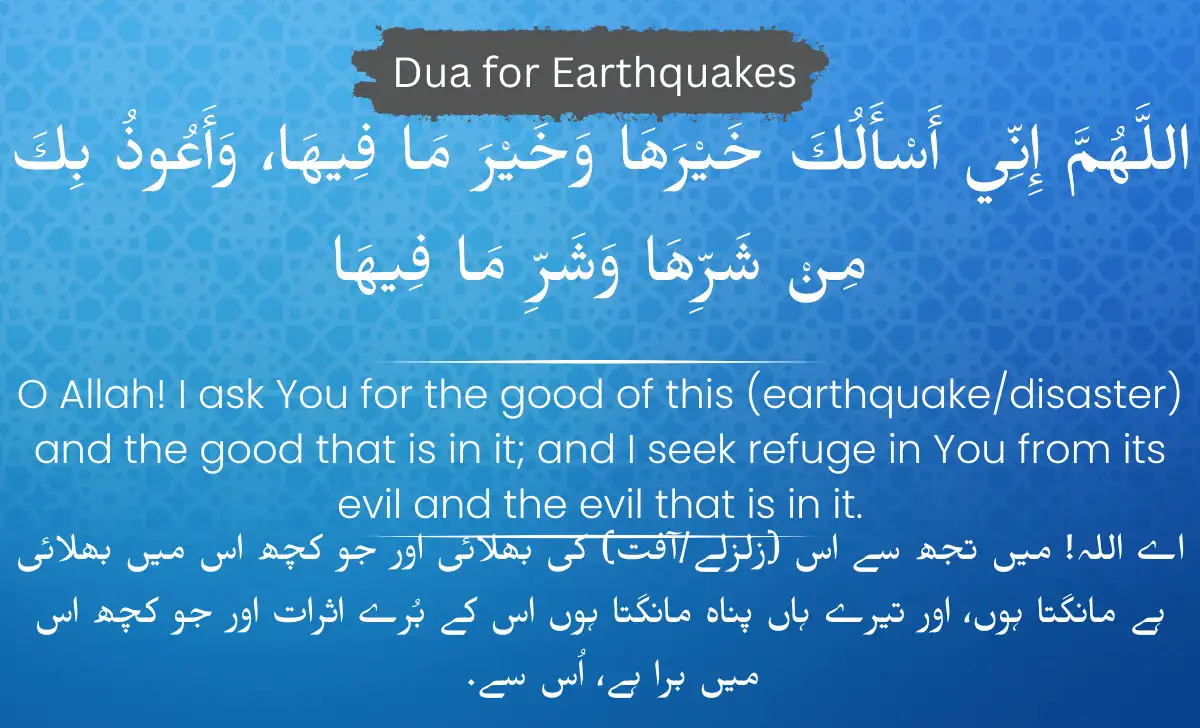
اللَّهُمَّ إِنِّي أَسْأَلُكَ خَيْرَهَا وَخَيْرَ مَا فِيهَا، وَأَعُوذُ بِكَ مِنْ شَرِّهَا وَشَرِّ مَا فِيهَا
Transliteration:
Allāhumma innī as-’aluka khayrahā wa khayra mā fīhā, wa aʿūdhu bika min sharrihā wa sharri mā fīhā.
Meaning (English):
O Allah! I ask You for the good of this (earthquake/disaster) and the good that is in it; and I seek refuge in You from its evil and the evil that is in it.
Urdu Translation:
اے اللہ! میں تجھ سے اس (زلزلے/آفت) کی بھلائی اور جو کچھ اس میں بھلائی ہے مانگتا ہوں، اور تیرے ہاں پناہ مانگتا ہوں اس کے بُرے اثرات اور جو کچھ اس میں برا ہے، اُس سے۔
Why this dua?
This supplication — often attributed to calamities like storms or disasters — is recommended by scholars when earthquakes, strong winds or other signs occur.
It expresses both hope and fear: hope for goodness, mercy, protection; fear of harm. That balance reflects a believer’s humble reliance on Allah.
🔹 B: Tafarruʿ & Istighfar — Turning to Allah in Humility
In times of fear and disaster, Islam encourages believers to:
- Make dhikr and remember Allah often,
- Seek forgiveness (istighfar) for sins,
- Turn to Allah with humility, recognizing human weakness.
- Give charity (sadaqah) and help those in need, especially if others are affected.
This approach reminds us that disasters are not just physical events — they are spiritual calls to awaken, repent, and renew our faith.
4. Qur’anic Verses to Reflect During Earthquakes
Earthquakes are also mentioned in the Qur’an — not always as immediate disasters, but as reminders of the Hereafter, accountability, and Allah’s power. Reflecting on these verses can bring solace, hope, and perspective.
Here are a few with transliteration, Urdu & English translation:
| Arabic (آیت) | Transliteration | Meaning (English) | اردو ترجمہ / معنی |
|---|---|---|---|
| ﴿إِذَا زُلْزِلَتِ الْأَرْضُ زِلْزَالَهَا﴾ | Izhā zulzilati al-arḍu zilzālaha | “When the earth is shaken with its (final) earthquake.” | “جب زمین اپنی زلزلہ انگیز ہلاہٹ محسوس کرے گی” — (یومِ قیامت کی زلزلہ) |
| ﴿كُلُّ نَفْسٍ ذَائِقَةُ الْمَوْتِ﴾ | Kullu nafsin dhā’iqatul-mawt | “Every soul will taste death.” (Hereafter reminder) | “ہر جان کو موت کا مزہ چکھنا ہے” |
| ﴿وَمَا كَانَ لِنَفْسٍ أَنْ تُؤْمِنَ إِلَّا بِإِذْنِ اللَّهِ﴾ | Wa mā kāna linafsin an tu’mina illā bi-idhni Allāh | “No soul can believe except by Allah’s permission.” (Humility & dependence) | “کوئی شخص ایمان ناصرف خود نہیں لا سکتا — سوائے اس کے کہ اللہ کی رضا ہو” |
Reflection:
The first verse (from Surah Az‑Zalzalah) reminds us that the earth’s trembling is natural — and terrifying — but also a sign. Every quake we feel is a call: to reflect, to humble ourselves before Allah’s might, to prepare for the Day when the real, final quake will come.
The second and third verses remind us that life is temporary, and faith itself is a gift from Allah. In calamity, our hearts should turn to Him, acknowledging our fragility and His Mercy.
Reciting these verses, with reflection, helps calm the heart — giving a deeper, Qur’an-rooted solace than mere mechanical recitation of words.
5. What Should a Believer Do — Spiritual & Practical Steps During an Earthquake
When the earth quakes — especially in a region prone to seismic activity (like many parts of Pakistan, India, or global fault zones) — a believer must act with both faith and sense. Here’s a balanced, step-by-step guide:
✅ Spiritual Steps
- Pause & Breathe: When tremors begin — stop, calm your heart, don’t panic.
- Turn to Allah Immediately: Recite any sincere dua, or use the general supplication above. Ask Allah for safety, mercy, and protection.
- Make Istighfar & Dhikr: Seek forgiveness for your sins. Remember Allah’s power and your dependence on Him.
- Pray (if safe): Perform voluntary prayers (nawafil) or short dua-prayers thanking Allah, seeking refuge, or asking for protection.
- Think of Others: After safety, check on family, neighbors, and those who might be vulnerable. Show compassion, help, give charity if people are harmed.
- Evaluate Your Life: Reflect on your deeds, whether you need to repent, correct your path, increase good deeds.
🛡️ Practical Safety Steps
- Try to take cover under a sturdy table / desk if indoors, avoid windows or heavy unstable objects.
- If outside, move to a safe open area, away from buildings, tall structures, or things that can fall.
- Avoid using elevators or narrow staircases during quakes.
- After shaking stops, evacuate if building seems unstable — but stay calm, alert for aftershocks.
- Keep emergency kit ready (flashlight, water, first aid, contact numbers).
Combining spiritual “dua + dhikr + tawakkul” with practical sense helps us face calamity with hope and wisdom.
8. Personal Reflection — Why Earthquakes Teach Us Humility
I still remember the first time I felt a quake: the walls shook, the ground beneath felt uncertain, hearts raced. In that moment, everyone stopped — regardless of faith, status, or background.
It struck me how fragile we are — how much we take for granted: a stable home, safety, a predictable day. And within seconds, everything felt uncertain.
But then, in that stillness, I whispered to Allah: “O Creator of the earth and sky — You are the only Protector.”
I felt small. I felt a renewed need for Allah. Not just for physical safety — but for mercy, forgiveness, and spiritual steadiness.
That’s what earthquakes awaken in us: humility before the Creator, awareness of our mortality, urgency to reflect, repent, and reform.
May Allah grant us safety, strengthen our faith, and make every tremor a reminder to turn back to Him with sincerity.
9. Conclusion & Spiritual Encouragement
Earthquakes — and natural calamities in general — are not always punishments or doom. Often, they are signs and reminders: of the fragility of life, the fleeting nature of comfort, and the absolute power of Allah.
As believers, our response should not be panic or blind superstition — but calmness, trust (tawakkul), humility, and turning to Allah with sincerity. Du’a, dhikr, istighfar, good deeds, charity — these are the actions that draw the heart close to Allah.
May Allah protect us, our families, and all believers from harm. May He give us strength, sabr (patience), iman (faith), and tawakkul in every test. And may every earthquake — whether small or great — remind us of our purpose: to worship Him, remember Him, and live righteously.
No — there is no authenticated hadith that prescribes a fixed dua exclusively for earthquakes. What is recommended is to turn to Allah with any sincere dua, remembrance, and repentance.
You may use a general supplication for calamity (see Section 3), or simply speak from your heart — ask Allah for protection, mercy, forgiveness, safety for yourself and others. The sincerity of the heart matters more than specific words.
Yes — verses such as those from Surah Az‑Zalzalah remind us of Allah’s power and the Day of Judgment. Also, verses about human mortality and dependence upon Allah bring humility and hope.
Increase dhikr and istighfar, give charity (sadaqah), help others, pray voluntary prayers, and if possible, work on strengthening one’s faith and deeds. Practically, ensure safety measures during earthquakes — secure your home, have emergency kits, know safe spots.
While charity cannot guarantee physical safety (because calamities are under Allah’s will), giving sadaqah is strongly encouraged — it purifies the soul, draws Allah’s mercy, and helps those who may suffer.