Have you ever finished a prayer and felt like your heart wasn’t truly “there”? We all have days where our focus slips, our worries distract us, or our gratitude feels thin.
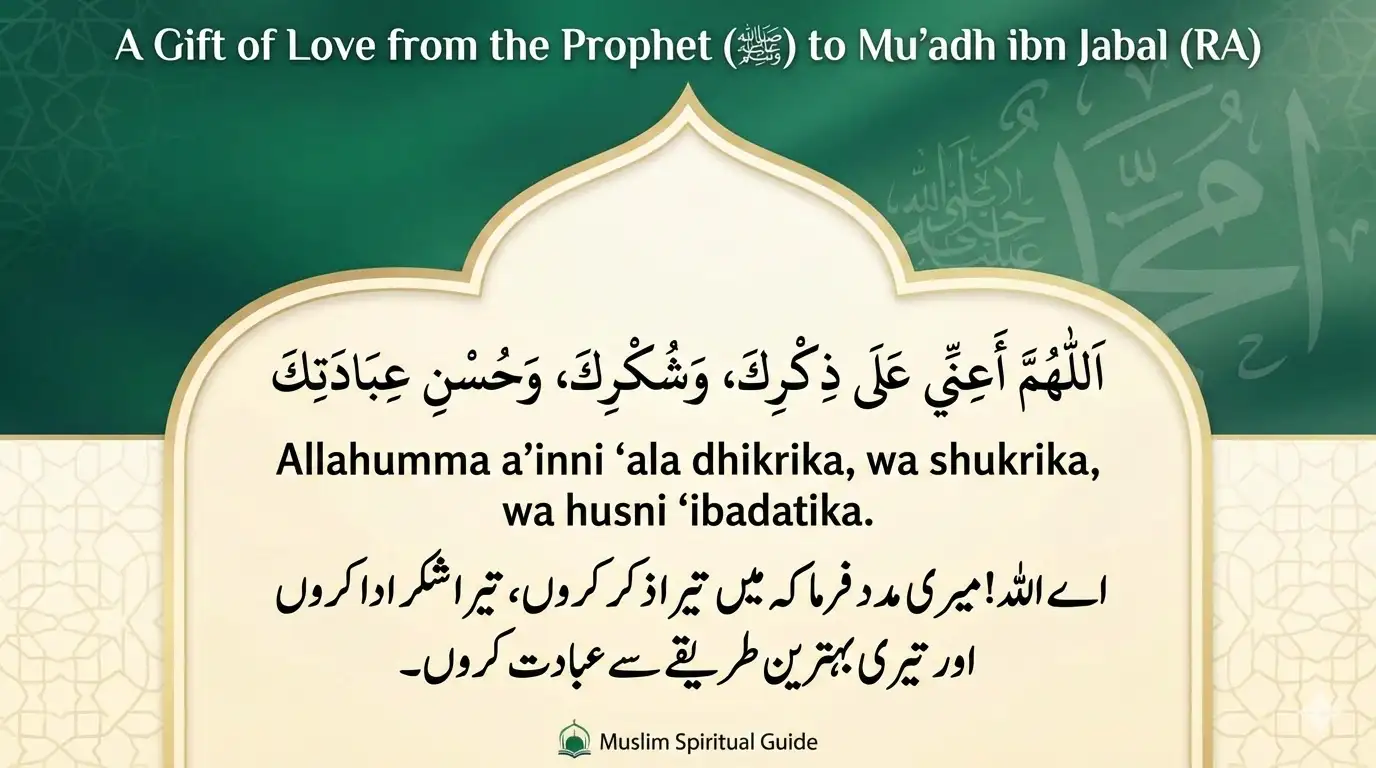
There is a beautiful secret found in a short prayer from the Sunnah (the traditions of the Prophet ﷺ). It is the dua: “Rabbi a’inni ‘ala zikrika wa shukrika wa husni ‘ibadatika.”
This isn’t just a set of words; it is a spiritual roadmap to a better, more connected life.
The Story Behind the Dua (The Hadith of Love)
To understand this dua, we must look at how it was given. The Prophet Muhammad (ﷺ) took his companion, Mu’adh ibn Jabal, by the hand. He looked at him and said:
“O Mu’adh, by Allah, I love you. So, I advise you, O Mu’adh, never forget to say at the end of every prayer…” (Sunan Abi Dawud, 1522).
Imagine the scene. The Prophet (ﷺ) declares his love first, then gives this gift. This tells us that these words are the most valuable advice a loved one can give.
Arabic Text, Transliteration, and Translations
It is important to recite the words correctly to feel their full weight.
Arabic Text
رَبِّ أَعِنِّي عَلَى ذِكْرِكَ ، وَشُكْرِكَ ، وَحُسْنِ عِبَادَتِكَ (Note: Commonly started with “Allahumma” or “Rabbi”)
Transliteration
Rabbi a’inni ‘ala zikrika, wa shukrika, wa husni ‘ibadatika.
English Translation
“My Lord, help me to remember You, to give thanks to You, and to worship You in the best manner.”
Urdu Translation (اردو ترجمہ)
اے میرے رب! میری مدد فرما کہ میں تجھے یاد کروں، تیرا شکر ادا کروں اور تیری بہترین طریقے سے عبادت کروں۔
Official Hadith References for the “Dua of Mu’adh”
| Source Collection | Hadith Number | Classification | Key Narrator |
| Sunan Abi Dawud | 1522 | Sahih (Authentic) | Mu’adh ibn Jabal (RA) |
| Sunan an-Nasa’i | 1303 | Sahih (Authentic) | Mu’adh ibn Jabal (RA) |
| Riyad as-Salihin | 384 | Sahih (Authentic) | Mu’adh ibn Jabal (RA) |
| Musnad Ahmad | 22119 | Sahih (Authentic) | Mu’adh ibn Jabal (RA) |
Breaking Down the 3 Pillars of This Dua
Why did the Prophet (ﷺ) choose these three specific things? Let’s look deeper.
1. Zikrika (Remembrance)
We often forget God during our busy workdays. Dhikr is the polish for the heart. When you ask for help with Zikr, you are asking to stay mindful and connected to your Creator throughout the day.
2. Shukrika (Gratitude)
Gratitude is a magnet for more blessings. The Quran says, “If you are grateful, I will surely increase you” (Surah Ibrahim 14:7). By asking for help to be grateful, you are protecting yourself from bitterness and greed.
3. Husni ‘Ibadatika (Excellence in Worship)
This is the “secret sauce.” Many people pray, but few pray with Husn (beauty). This part of the dua is a request for Quality over Quantity. It’s about praying with a calm heart and perfect focus.
💎 The “Spirituality Gap”
Every time you say this dua, pick one part of your next prayer to make “more beautiful” (Husn). Maybe it’s a slower Sujud or a more focused Surah Fatiha. This dua is your request for the Divine “fuel” to make that 1% change possible. You aren’t doing it alone; you’ve asked the Lord of the worlds to help you.
Benefits of Reciting This Dua
- Ease in Worship: You will find that praying feels less like a “chore” and more like a conversation.
- Mental Peace: Gratitude (Shukr) is scientifically proven to reduce stress and anxiety.
- Closeness to the Sunnah: You are following a specific advice given out of love by the Prophet (ﷺ).
- Consistency: It helps you stay firm on your five daily prayers.
A Final Reflection
Think about the last time you felt truly “connected” during prayer. That feeling is a gift. We cannot achieve it through our own willpower alone. We are weak, and the world is distracting.
By reciting “Rabbi a’inni…”, you are admitting your weakness and leaning on the strength of Allah. It is a beautiful way to start and end every prayer—with humility, love, and a desire to be better.
Next time you pray, remember: the Prophet (ﷺ) loved you enough to leave you these words. Don’t let them go to waste.
Why Mu’adh ibn Jabal? The Scholar of the Ummah
To truly appreciate this Dua, we must look at the man who received it. Mu’adh ibn Jabal was not just any companion; he was a giant of knowledge.
- The Prophet’s Endorsement: The Messenger of Allah (ﷺ) said: “The most knowledgeable of my Ummah regarding the Halal (permissible) and the Haram (forbidden) is Mu’adh ibn Jabal.” (Tirmidhi).
- A Leader at a Young Age: He was sent to Yemen as a judge and teacher, showing the Prophet’s complete trust in his intellect and character.
- The “Hadith of Love”: The fact that the Prophet (ﷺ) chose Mu’adh to teach this specific Dua—after explicitly stating his love for him—tells us that this is a high-level spiritual secret. It was a gift from the best teacher to one of his best students.
People Also Ask
The best time is at the end of every fard (obligatory) prayer. Scholars suggest saying it after the Tashahhud but before the final Salam. You can also say it immediately after finishing your prayer.
No, this is a Hadith. It was taught by Prophet Muhammad (ﷺ) to Mu’adh ibn Jabal. However, its meanings are supported by many verses in the Quran.
While the Arabic is preferred because it’s the exact wording of the Prophet (ﷺ), the doors of dua are always open. You can ask Allah for help in any language.