Why Ayat al-Dayn (The Verse of Debt) is the ultimate guide to financial peace in 2026.
By [Shahab khan/Scholar islamic]
Senior Fellow in Islamic Finance & Digital Ethics
Imagine for a moment: You lend money to a cousin. Six months later, you ask for it back. He frowns, “I thought that was a gift?” Suddenly, the relationship is broken, and family gatherings become awkward.
Why does the Quran—a book of spiritual guidance—dedicate its single longest verse not to prayer (Salah), not to fasting (Sawm), but to writing down detailed financial contracts?
Because Allah ﷻ knows that ambiguity breaks hearts faster than it breaks bank accounts. The longest verse in the Quran isn’t just a rule; it is a divine shield for your relationships.
1. What is the Longest Verse in the Quran?
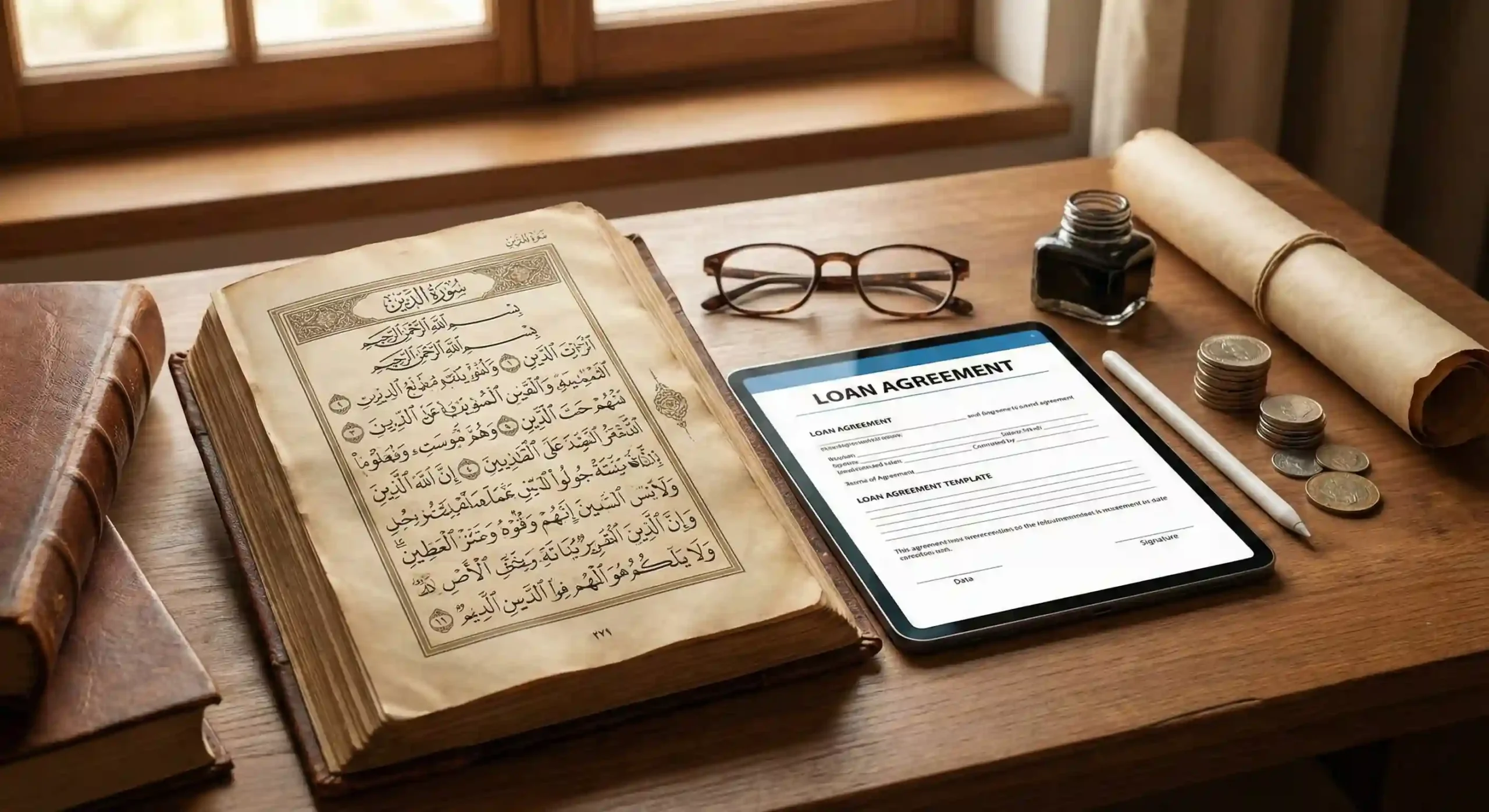
The longest verse in the Quran is Ayat al-Dayn (The Verse of Debt). It is Verse 282 of Surah Al-Baqarah (Chapter 2). It provides a comprehensive legal framework for lending, borrowing, and writing financial contracts to ensure justice and prevent disputes.
The Multilingual Quadrant
For students of knowledge and easy recitation.
| Language | Text |
| Arabic | يَا أَيُّهَا الَّذِينَ آمَنُوا إِذَا تَدَايَنتُم بِدَيْنٍ إِلَىٰ أَجَلٍ مُّسَمًّى فَاكْتُبُوهُ… (See full verse below) |
| Transliteration | Ya ayyuha allatheena amanoo itha tadayantum bidaynin ila ajalin musamman faktuboohu… |
| English | “O you who have believed, when you contract a debt for a specified term, write it down. And let a scribe write [it] between you in justice…” (Saheeh International) |
| Urdu | “مومنو! جب تم آپس میں کسی میعاد معین کے لئے قرض کا معاملہ کرنے لگو تو اس کو لکھ لیا کرو…” (Fateh Muhammad Jalandhari) |
Scholar’s Note: This verse is approximately one full page in the standard Madani script. Its placement in Surah Al-Baqarah (The Cow) signifies that economic stability is a pillar of a God-conscious society.
2. Word-by-Word Analysis: The Anatomy of a Deal
This verse breaks down a loan contract into five essential parts: the command to write, the scribe’s duty, the debtor’s dictation, the fear of God, and the requirement of witnesses.
To understand the Fiqh (jurisprudence) deeply, let’s look at the key terms used by Allah ﷻ:
- Idha tadayantum (إِذَا تَدَايَنتُم): “When you contract a debt.” This covers loans, business credit, and future payments.
- Faktuboohu (فَاكْتُبُوهُ): “Write it down.” A command (Amr). It eliminates “he said/she said” disputes.
- Bil-adl (بِالْعَدْلِ): “In justice.” The scribe must be neutral favoring neither the rich lender nor the desperate borrower.
- Walyumlil (وَلْيُمْلِلِ): “Let him dictate.” The borrower (debtor) should speak the terms. Why? So, they acknowledge exactly what they owe, preventing denial later.
- Shahidayn (شَهِيدَيْنِ): “Two witnesses.” To verify the contract if one party forgets or dies.
3. The “Digital Sunnah”: Applying 2:282 in 2026
In the modern world, “writing it down” applies to digital contracts. Emails, WhatsApp messages, and banking apps can serve as compliant records if they clearly state the amount, the repayment date, and are acknowledged by both parties.
Many Muslims ask: “Does a text message count as ‘writing it down’?”
Yes, if it meets the criteria of Ayat al-Dayn:
- Clarity: “I am lending you $500, to be repaid by Dec 1st.”
- Acknowledgment: The borrower replies, “Agreed.”
- Witnessing: Ideally, CC a third party or take a screenshot and send it to a witness.
The “Spiritual Habit Loop”:
- Trigger: Someone asks for a loan.
- Action: You say, “Let’s follow the Sunnah of Ayat al-Dayn,” and draft a quick agreement.
- Reward: You gain the Barakah (blessing) of following the Quran and the peace of mind that your relationship is protected.
4. Benefits & “Wazifa” of Ayat al-Dayn
The greatest benefit of Ayat al-Dayn is protection from social discord and financial loss. While some recite it for memory, its true power lies in acting upon it. Implementing this verse ensures Barakah in your wealth.
Is there a specific Wazifa?
While specific wazifas (repetitive litanies) for this verse are not narrated in the primary books of Hadith (Bukhari/Muslim), the benefit is intrinsic:
- For Debt Relief: Combine acting on this verse with the authentic Dua of the Prophet ﷺ:
- Allahumma inni a’udhu bika mina al-ma’tham wa al-maghram (O Allah, I seek refuge in You from sin and heavy debt).
Warning: Do not treat this verse as a “magic spell.” It is a legal instruction. Reading it 100 times but failing to write your contracts negates its purpose.
5. People Also Ask:
It highlights that Islam is a complete way of life (Deen). God cares about your financial dealings because unfair money matters destroy brotherhood, community trust, and spiritual focus.
The verse says, “Do not be weary to write it, whether it is small or large.” However, scholars agree that for very small, day-to-day amounts (like buying lunch), it is flexible. For anything significant enough to cause a dispute, write it down.
Yes. The verse mentions two men, or one man and two women. Classical Tafsir explains this was due to the societal context where women were less familiar with commercial contracts. Modern scholars emphasize that the goal is accurate testimony, and women are fully competent witnesses in Islam.