In a world of constant scrolling and high-speed anxiety, we often find ourselves searching for a “pause” button. For many of us, that pause happens on the prayer mat. But are you just saying words, or are you unlocking a spiritual frequency?
Let’s break down why Ameen ya Rabbul Alameen is the ultimate “Mindset Shift” for the modern Muslim.
1. What Are You Actually Saying?
When you whisper these words, you are performing a three-step spiritual activation:
| Arabic Term | Transliteration | Meaning (Coaching Perspective) |
| آمِينَ | Ameen | “Let it be.” (Total Affirmation) |
| يَا رَبَّ | Ya Rabb | “O My Sustainer.” (The Source) |
| الْعَالَمِينَ | Al-Alameen | “Of all dimensions/worlds.” (The Infinite) |
The Meaning Breakdown
- Ameen (آمِينَ): This is a verbal noun meaning “O Allah, respond” or “Let it be so.” It is a plea for the acceptance of the supplication you have just made.
- Ya (يَا): A calling particle used to address someone directly, translated as “O.”
- Rabb (رَبّ): While often translated as “Lord,” it carries the deeper meaning of a Sustainer, Provider, and Nourisher who brings all things to perfection.
- Al-Alameen (الْعَالَمِينَ): This refers to “All the Worlds.” It encompasses everything in existence, including humans, angels, the animal kingdom, and dimensions beyond our physical understanding.
Translation
- English: “O Allah, respond [to this prayer], O Lord of all the worlds.”
- Urdu: اے اللہ! میری دعا قبول فرما، اے تمام جہانوں کے رب۔
Why It Is a “Spiritual Reset”
Ending your Dua with this phrase provides a powerful mental and emotional shift:
- Perspective: It moves your focus from your “small” problem to the “Infinite” power of the One who manages billions of galaxies.
- Trust (Tawakkul): By acknowledging Allah as the Lord of all worlds, you affirm that nothing is too difficult for Him to grant.
- Closure: It acts as a spiritual “send button,” allowing you to release your anxiety and leave the outcome in the hands of the most capable Sustainer.
How to Reply
If someone says this to you after a wish or prayer, the most appropriate replies are:
- Allahumma Ameen: “O Allah, accept it.”
- Ameen, wa Iyyak: “Ameen, and to you as well.”
- Jazak Allahu Khairan: “May Allah reward you with goodness.”
2. The Practical Benefits: Why Your Brain Needs This
- Decision Fatigue Relief: By calling Him Rabbul Alameen, you acknowledge He manages billions of galaxies. Suddenly, your “big” decision feels manageable in His hands.
- The “Seal” of Intentionality: Saying Ameen is like hitting ‘Send’ on an email. It prevents you from “overthinking” the prayer after you’re done.
- Universal Connection: It reminds you that your struggle isn’t isolated. The same Lord who manages the “Alameen” (the stars, the deep oceans, the digital world) is listening to your specific heartbeat.
3. Proof from the Source
We don’t just say it because it sounds nice. It is rooted in the perfection of the Quran and Sunnah.
The Quranic Frequency:
The phrase “Rabbul Alameen” appears dozens of times in the Quran, starting with the very first chapter.
الْحَمْدُ لِلَّهِ رَبِّ الْعَالَمِينَ
(Al-hamdu lillahi Rabbil-alamin)
“All praise is for Allah, Lord of all the worlds.” — Surah Al-Fatiha, 1:2
The Prophetic Promise:
Prophet Muhammad (ﷺ) taught us that our Ameen has the power to sync with the heavens.
“If a person’s Ameen coincides with the Ameen of the angels, his previous sins will be forgiven.” (Sahih al-Bukhari 780)
4. How to use this in your “Daily Glow-Up”
Don’t just save this for the Mosque. Use it as a Micro-Meditation:
- Feeling Anxious? Whisper Ya Rabbul Alameen to remind yourself who is in control.
- Manifesting a Goal? Make your Dua, be specific, and then seal it with Ameen to signify your trust (Tawakkul).
📖 Expand Your Spiritual Knowledge
2. The Quranic Connection: Where does it come from?
While the phrase “Ameen” isn’t written inside the text of the Quran, the phrase “Rabbul Alameen” is the very first description of Allah we read in Surah Al-Fatiha.
الْحَمْدُ لِلَّهِ رَبِّ الْعَالَمِينَ Al-hamdu lillahi Rabbil-alamin “All praise is for Allah, Lord of all the worlds.” (Quran 1:2)
When you add “Ameen” to this, you are connecting your personal small need to the Master of the entire universe. It’s like saying, “The One who manages the orbits of the planets can surely manage my small problem.”
3. The Power of the “Angel’s Ameen”
Did you know that you aren’t the only one saying Ameen? There is a beautiful secret in the Sunnah about the timing of this word.
The Hadith (Evidence): Prophet Muhammad (ﷺ) said: “When the Imam says ‘Ameen’, then you say ‘Ameen’, for if a person’s Ameen coincides with the Ameen of the angels, his previous sins will be forgiven.” (Sahih al-Bukhari 780)
4. Why This Phrase Changes Your Mindset
- It Builds Trust (Tawakkul): By calling Him “Lord of the Worlds,” you admit He knows better than you.
- It Humbles the Ego: You realize you are just one soul in a vast “Alameen,” yet the King of those worlds is listening to you.
- It Unites Us: Whether you are in New York, Karachi, or London, every Muslim uses the same “seal.” It is our global spiritual language.
🌿 A Personal Reflection: The “Universe” in Your Hands
I used to think my problems were too “small” for the Lord of the Worlds. Why would the Creator of Black Holes care about my exam or my job interview?
But then I realized: He isn’t just the Lord of the Big Worlds; He is the Lord of the Micro-Worlds too. Every cell in your body is a “world” He sustains. When you say Ameen ya Rabbul Alameen, you are inviting the Power that runs the universe to run your life.
Stop worrying. You’ve sent the request. The Seal is on.
FAQs:
In Arabic, the pronunciation is “Aa-meen” with a long ‘a’. While “Amen” is used in English, “Ameen” preserves the original Islamic phonetic root.
Both are correct. Ameen means “Accept it,” while Allahumma Ameen specifically adds “O Allah, accept it.”
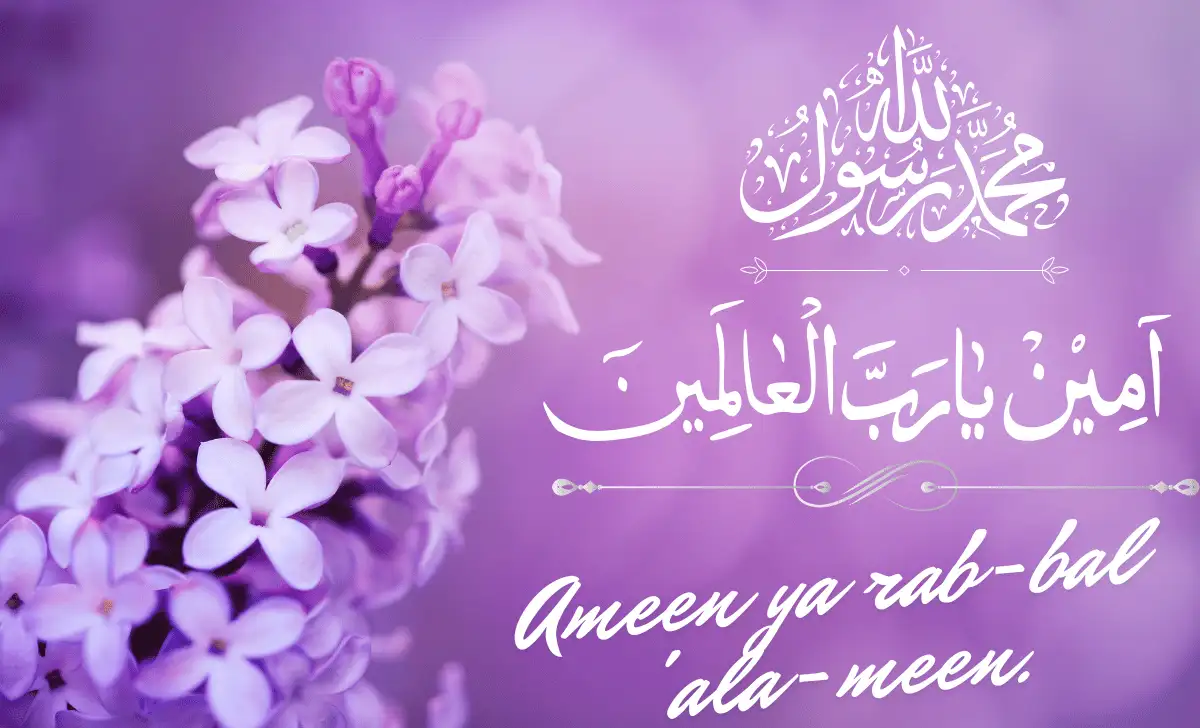
It is written as: آمين يا رب العالمين. The pronunciation is “Aa-meen ya Rab-bul Aa-la-meen.”
We say it to recognize Allah’s absolute authority over every world—the physical, the spiritual, and the unseen. It shifts our focus from our problem to the Greatness of the Creator.
According to scholars, ending with praise for Allah and the “Seal” of Ameen ya Rabbul Alameen is one of the most beautiful ways to ensure your heart is in a state of surrender.
No, Ameen is not one of the 99 names of Allah. It is a verbal noun (Ism Fi’l) that means “O Allah, accept our prayer.”
The phrase “Rabbul Alameen” appears frequently (e.g., Surah Al-Fatiha 1:2), while “Ameen” is a Sunnah practice used to conclude prayers.