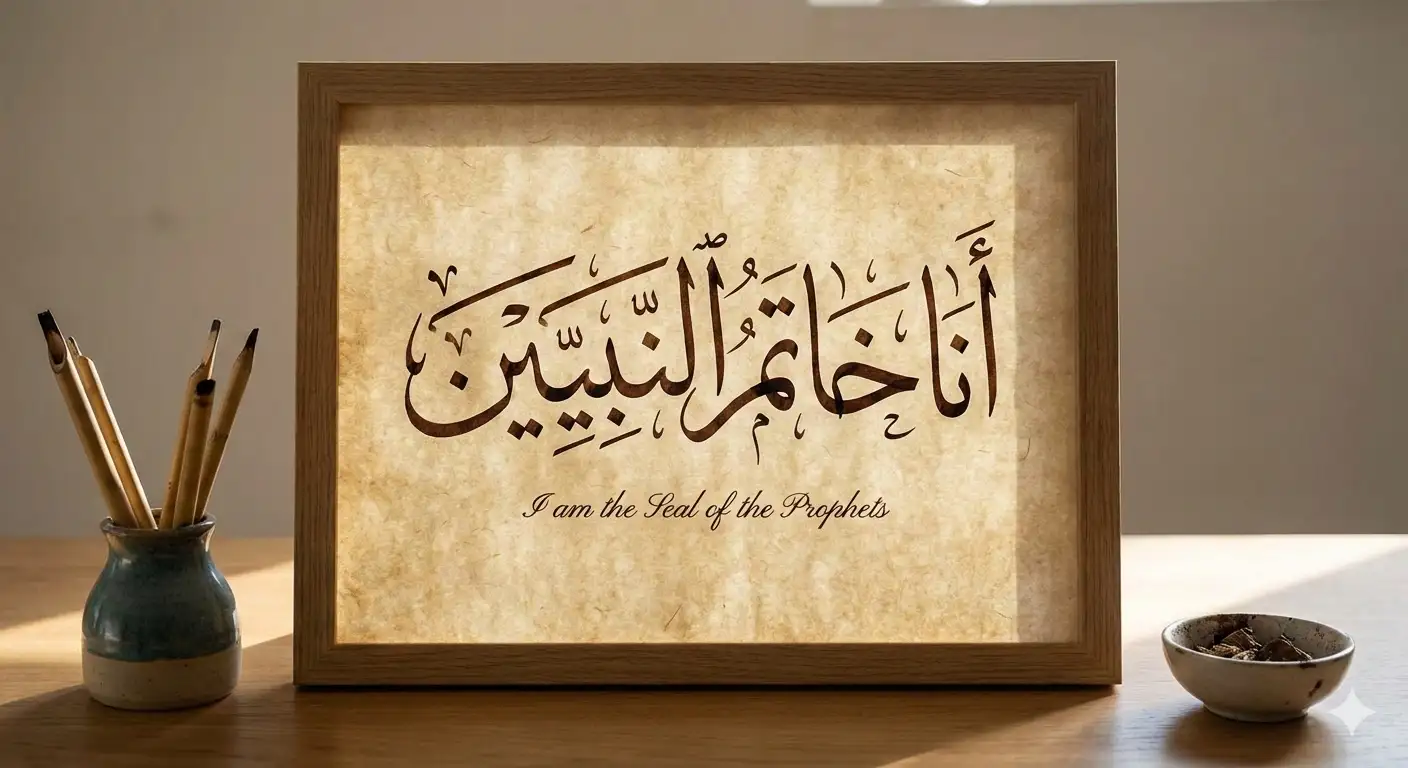
Have you ever wondered why the Quran uses the specific word “Seal” (Khatam) instead of just saying “Last” (Akhir)? This single word holds the key to understanding the entire structure of Islam. As someone who has spent years reflecting on the beauty of our Deen, I want to share a perspective that connects the heart and the mind.
📖 The Foundation: Quranic Evidence
The term Khatamun Nabiyyeen appears in Surah Al-Ahzab. It is the cornerstone of our Aqidah (faith).
Surah Al-Ahzab (33:40)
Arabic:
مَا كَانَ مُحَمَّدٌ أَبَا أَحَدٍ مِّن رِّجَالِكُمْ وَلَكِن رَّسُولَ اللَّهِ وَخَاتَمَ النَّبِيِّينَ ۗ وَكَانَ اللَّهُ بِكُلِّ شَيْءٍ عَلِيمًا
Transliteration: Ma kana Muhammadun aba ahadin min rijalikum walakin Rasoola Allahi wa Khatama an-Nabiyyeen; wa kana Allahu bikulli shay’in ‘Aliman.
English Translation: “Muhammad is not the father of [any] one of your men, but [he is] the Messenger of Allah and the last (Seal) of the prophets. And ever is Allah, of all things, Knowing.”
Urdu Translation:
محمد (صلی اللہ علیہ وآلہ وسلم) تمہارے مَرِدوں میں سے کسی کے والد نہیں ہیں، لیکن وہ اللہ کے رسول ہیں اور تمام نبیوں میں آخری نبی (مہر) ہیں۔ اور اللہ ہر چیز کا خوب جاننے والا ہے۔
💡 Linguistic Analysis: Khatam vs. Khatim
In the Arabic language, the word K-T-M (خ-ت-م) is fascinating. Let’s break it down in a way most blogs miss:
| Term | Pronunciation | Primary Meaning | Significance in Prophethood |
| Khatam | Khaa-tam | The Seal/Ring | Indicates the perfection and “stamping” of a document to prevent further additions. |
| Khatim | Khaa-tim | The One who ends | Indicates the chronological finality (the very last in the line). |
| Khatme Nabuwat | Khat-may-Na-bu-wat | Finality of Prophethood | The belief that the office of Prophethood is closed forever. |
📜 Authentic Hadith on Finality
we look at the words of the Prophet (ﷺ) himself:
The Parable of the Missing Brick:
“My likeness and the likeness of the prophets before me is the likeness of a person who built a house, made it fine and beautiful, except for the place of one brick in a corner. The people went around it and wondered at it and said: ‘Why has not this brick been placed?’ I am that brick and I am the last of the prophets.”
— Sahih Bukhari (Book 56, Hadith 735)
PRIMARY GUIDE The Perfect Role Model (Uswatun Hasanah)
To understand the “Seal of the Prophets,” one must study his character. Explore the deep meaning of Surah Ahzab Ayat 21, which defines the Prophet (ﷺ) as the ultimate example for humanity.
Read Tafsir: Surah Ahzab Ayat 21 & The Prophetic Character →TAFSIR STUDY Divine Selection: Surah Al-Imran Insights
The chain of Prophethood is a divine legacy. Delve into the benefits and tafsir of Surah Al-Imran Ayat 35 to understand how Allah chose the righteous lineages throughout history.
Explore Benefits & Context of Surah Al-Imran Ayat 35 →References and Classical Tafsir
To understand the weight of “Khatamun Nabiyyeen,” we must look at how the greatest scholars of history interpreted it. This ensures our understanding is not modern guesswork but rooted in 1,400 years of scholarship.
1. Tafsir Ibn Kathir
Imam Ibn Kathir, in his world-renowned commentary, states regarding Surah Al-Ahzab, Verse 40:
“This verse is a definitive text (Nass) showing that there is no Prophet after him. And since there is no Prophet after him, there is certainly no Messenger (Rasool) after him either… Anyone who claims this rank after him is a fabricator, a liar, and an impostor.”
2. Tafsir al-Jalalayn
The “Two Jalals” (Imam al-Mahalli and Imam al-Suyuti) clarify the recitation (Qira’at):
- They confirm that whether read as Khatam (the seal/instrument) or Khatim (the one who finishes), the meaning remains absolute: Muhammad (ﷺ) closed the gate of Prophethood forever.
🕋 The Prophetic Evidence (Hadith)
Here are 6 (the six authentic books of Hadith).
| Book Reference | Hadith Content Summary | Authority Level |
| Sahih Bukhari (3535) | The Parable of the Final Brick (The house is incomplete without him). | Highest (Sahih) |
| Sahih Muslim (2272) | “I have been given preference over other prophets… and the line of prophets is closed with me.” | Highest (Sahih) |
| Sunan Tirmidhi (2219) | “Prophethood and Messengership have reached their end; there is no messenger or prophet after me.” | Authentic (Hasan Sahih) |
🌟 Personal Reflection: The Beauty of Finality
As I sit and write this, I am struck by the mercy of Allah. By making Prophet Muhammad (ﷺ) the Khatamun Nabiyyeen, Allah gave us a gift that is “complete.” We don’t need to wait for a new manual for life; we have the final, most refined version in the Quran and Sunnah.
It’s like a masterpiece painting. You don’t keep adding strokes to a finished masterpiece; you sign it, seal it, and protect it. Our Prophet (ﷺ) is that signature.
My Spiritual Encouragement: Let us not just “believe” in the finality, but “live” it. If he is the final guide, then every answer we seek for our modern problems—mental health, social justice, or family peace—must already exist in his teachings. Let’s go back and find them.
📋 Checklist for Your Faith
- Belief: Heartfelt conviction that no prophet comes after 632 CE.
- Action: Following the Sunnah as the final standard of character.
- Protection: Guarding yourself against false claims and modern misinterpretations.
People Also Ask
It is the Islamic belief that Prophet Muhammad (ﷺ) is the absolute final Messenger of Allah. No new prophet—whether bringing a new law or following an old one—will ever come after him.
Not at all. Prophet Isa (A.S.) was commissioned before Prophet Muhammad (ﷺ). When he returns, he will come as a follower (Ummati) of the Prophet’s Shariah, not as a “new” prophet with a new message.
It protects the religion from corruption. If anyone could claim to be a prophet today, the original message of the Quran could be altered. Finality means the message is now perfect and preserved.
Yes. According to the Quran (33:40) and multiple Sahih Hadiths, Prophet Muhammad (ﷺ) is the Khatamun Nabiyyeen. This means the chain of Divine revelation through prophets has ended.
n classical scholarship, a Rasool (Messenger) is given a new Divine Law (Shariah), while a Nabi (Prophet) follows and revives an existing Law. The title Khatamun Nabiyyeen (Seal of the Prophets) covers both, meaning no new Law and no new Prophet will come.