Becoming a parent is one of the sweetest blessings Allah grants to a family. And in Islam, one of the most beautiful acts performed for a newborn is the Aqiqah—a Sunnah that expresses gratitude, protection, barakah, and love. Many new parents search for “Aqiqah ki Dua kya hai?” or “What to recite during Aqiqah?” but often find incomplete information, no Arabic references, or confusing cultural practices.
This guide solves that problem.
You’ll find here:
- Authentic duas with Arabic, transliteration, English & Urdu
- Aqiqah rulings (with Shafi‘i fiqh notes where needed)
- Duas for newborns
- Step-by-step simple guidance
- Qur’anic verses with translations
- A beginner-friendly explanation of how Aqiqah should be done in Islam
- Answers to the most commonly asked questions
Let’s begin with the spiritual foundation of Aqiqah.
🕊 What Is Aqiqah?
Aqiqah is a Sunnah Mu’akkadah—a strongly recommended Sunnah of Prophet Muhammad ﷺ. It is performed by slaughtering an animal for a newborn on the 7th day (or later if needed) as an act of gratitude to Allah and protection for the baby.
✔ Purpose of Aqiqah:
- Shukr (gratitude) for the blessing of a child
- Protection from harm
- Bringing barakah into the baby’s life
- Charity & feeding others
- Reviving a beautiful Sunnah
📘 Qur’anic Foundations Related to Gratitude & Children
Although the Qur’an does not mention Aqiqah directly, it repeatedly commands gratitude, protection, and dua for righteous children—all connected to the spirit of Aqiqah.
📖 Verse 1 — Gratitude to Allah (Shukr)
Arabic:
وَإِذْ تَأَذَّنَ رَبُّكُمْ لَئِن شَكَرْتُمْ لَأَزِيدَنَّكُمْ
Transliteration:
Wa idh ta’adhana rabbukum la’in shakartum la’azeedannakum
English:
“And when your Lord proclaimed: If you are grateful, I will surely increase you.”
Urdu:
“اور جب تمہارے رب نے اعلان کیا کہ اگر تم شکر کرو گے تو میں تمہیں ضرور زیادہ دوں گا۔”
Aqiqah is one of the most beautiful forms of showing gratitude.
📖 Verse 2 — Dua for Righteous Children
Arabic:
رَبِّ هَبْ لِي مِن لَّدُنكَ ذُرِّيَّةً طَيِّبَةً
Transliteration:
Rabbi hab li min ladunka dhurriyyatan tayyibah
English:
“My Lord, grant me from Yourself righteous offspring.”
Urdu:
“اے میرے رب! مجھے اپنی جانب سے نیک اور پاکیزہ اولاد عطا فرما۔”
This dua captures the heart of every parent.
🐐 Aqiqah Rules (With Shafi‘i Fiqh Notes)
✔ When to Perform Aqiqah?
Sunnah time: 7th day after birth.
If not possible:
- 14th day
- 21st day
Shafi‘i Fiqh Note:
In the Shafi‘i madhhab, performing Aqiqah on the 7th day is preferred. If delayed, it may be done any time before the child reaches puberty.
✔ Number of Animals
- Baby Boy: 2 goats/sheep
- Baby Girl: 1 goat/sheep
This ruling is agreed upon by all four madhāhib including the Shafi‘i school.
✔ Shaving the Baby’s Head
Sunnah for both boys and girls according to the authentic narrations.
The hair is weighed, and charity is given in silver.
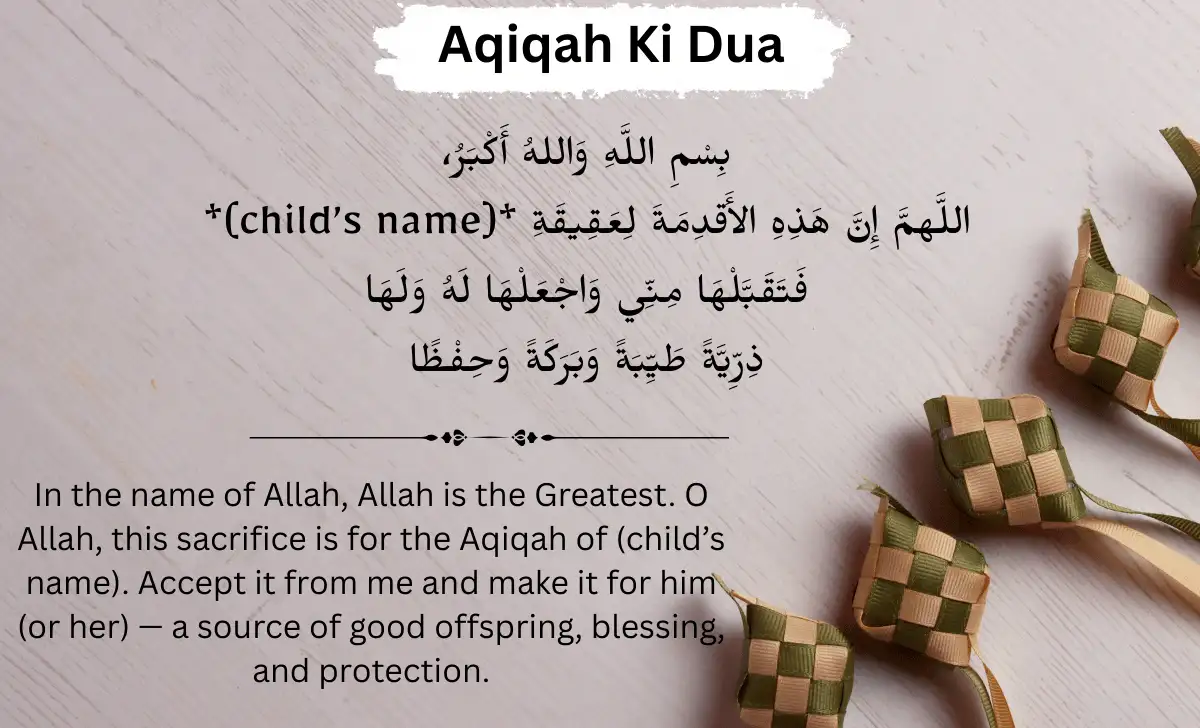
🌿 Aqiqah Ki Dua (Authentic Duas with Translation)
There is no single fixed dua for Aqiqah in Hadith. The Prophet ﷺ recited general duas for protection, barakah, and purity.
Below are authentic duas from Hadith which scholars recommend to read during Aqiqah.
🕌 1. Dua When Slaughtering the Aqiqah Animal
Arabic:
بِسْمِ اللهِ وَاللهُ أَكْبَرُ، اللَّهُمَّ لَكَ وَلَكَ هَذِهِ العَقِيقَةُ
Transliteration:
Bismillahi wallahu akbar, Allahumma laka wa laka hadhihil ‘aqiqah.
English:
“In the name of Allah, Allah is the Greatest. O Allah, this Aqiqah is for You and from Your blessings.”
Urdu:
“اللہ کے نام سے، اللہ سب سے بڑا ہے۔ اے اللہ! یہ عقیقہ تیرے لیے ہے اور تیری ہی نعمت سے ہے۔”
This captures the essence: gratitude, intention, and submission.
👶 2. Dua for the Newborn (Sunnah Dua)
Arabic:
أُعِيذُكَ بِكَلِمَاتِ اللهِ التَّامَّةِ مِنْ كُلِّ شَيْطَانٍ وَهَامَّةٍ وَمِنْ كُلِّ عَيْنٍ لَامَّةٍ
Transliteration:
U‘eedhuka bi kalimatillāhi-t-tāmmati min kulli shayṭānin wa hāmmatin wa min kulli ‘aynin lāmmah.
English:
“I seek Allah’s perfect protection for you from every devil, poisonous thing, and every harmful evil eye.”
Urdu:
“میں تمہارے لیے اللہ کے کامل کلمات کی پناہ چاہتا ہوں، ہر شیطان، ہر زہریلی چیز اور ہر نقصان دینے والی نظر بد سے۔”
This dua was recited by the Prophet ﷺ for children.
🍼 3. Dua of Barakah for the Child
Arabic:
اللَّهُمَّ بَارِكْ فِيهِ وَانْبِتْهُ نَبَاتًا حَسَنًا
Transliteration:
Allahumma barik fihi wanbit’hu nabātan ḥasanan.
English:
“O Allah, bless this child and help him/her grow in goodness.”
Urdu:
“اے اللہ! اس بچے میں برکت عطا فرما اور اسے اچھے طریقے سے پروان چڑھا۔”
✂️ 4. Dua When Shaving the Baby’s Head
Arabic:
اللَّهُمَّ اجْعَلْ هَذَا لَهُ وِقَاءً وَبَرَكَةً
Transliteration:
Allahummaj‘al hādhā lahu wiqā’an wa barakah.
English:
“O Allah, make this (act) a protection and blessing for him/her.”
Urdu:
“اے اللہ! اس عمل کو اس کے لیے حفاظت اور برکت کا ذریعہ بنا دے۔”
🌸 5. Dua of Gratitude
Arabic:
الْحَمْدُ لِلَّهِ الَّذِي بِنِعْمَتِهِ تَتِمُّ الصَّالِحَاتُ
Transliteration:
Alhamdulillāhilladhī bini‘matihi tatimmuṣ-ṣāliḥāt.
English:
“All praise is for Allah, by whose blessings good things are completed.”
Urdu:
“تمام تعریفیں اللہ کے لیے ہیں جس کی نعمت سے نیک کام مکمل ہوتے ہیں۔”
Perfect to recite after Aqiqah is complete.
🌼 How to Perform Aqiqah (Simple, Step-by-Step Guide)
- Make intention (niyyah)
- Recite Bismillah and Takbeer
- Read the dua for slaughter
- Slaughter the animal humanely
- Shave the baby’s head
- Give sadaqah equal to hair weight in silver
- Name the child (if not already named)
- Distribute or cook the meat
- Recite duas of barakah and protection
Shafi‘i Note:
In Shafi‘i fiqh, distribution of meat is flexible. Cooking and feeding others is considered mustahabb (recommended).
❤️ A Short Personal Reflection
Last year, a close friend of mine became a father after many years of making dua. When the day of Aqiqah arrived, he held his son, whispered the protection dua softly, and tears rolled down his eyes.
He said:
“I never knew Aqiqah wasn’t just a ritual… it felt like handing my child over to Allah’s special protection.”
Many parents feel the same.
Aqiqah isn’t only a Sunnah—
It’s a moment of gratitude, humility, and hope.
If you are interested in reading, please visit these links:
FAQs:
There is no single “fixed” dua, but the dua recited while slaughtering—“Allahumma laka wa laka hadhihil ‘aqiqah”—is most relevant.
Aqiqah is Sunnah Mu’akkadah, not fard.
Highly recommended but not sinful to miss.
Yes, Aqiqah is valid even if no special dua is recited.
But reading Bismillah, Takbeer, and Sunnah duas is recommended.
Yes.
According to Shafi‘i scholars, Aqiqah may be performed any time before the child reaches puberty.
If missed in childhood, some scholars allow the person to perform it for themselves later.
🌟 Conclusion – A Moment of Prayer, Gratitude, and Barakah
Aqiqah is more than a tradition.
It is a parent’s quiet whisper of gratitude… a shield of protection… a gateway to blessings.
When you recite the duas, shave the head, give charity, and share food, you are doing exactly what the Messenger of Allah ﷺ taught us with love and simplicity.
May Allah bless all newborns, protect them from harm, and fill their lives with light, mercy, and barakah.
اللَّهُمَّ بَارِكْ لِأَبْنَائِنَا وَاحْفَظْهُمْ وَاجْعَلْهُمْ مِنْ عِبَادِكَ الصَّالِحِينَ
“O Allah, bless our children, protect them, and make them among Your righteous servants.”
Ameen. 🤲✨