Umrah ki Dua – A Practical, Heart-Touching Guide for Your Journey
If you’re searching “Umrah ki dua” right now, there’s a good chance your heart is already on the way to Makkah – even if your body is not there yet.
Maybe:
- You’re about to travel and feel worried: “Duas yaad nahi ho rahi, kya karun?”
- Or you’re helping a parent / spouse who can’t read Arabic fluently.
- Or you just want authentic duas – not random lines copied from booklets.
This guide is written for you.
You’ll find here:
- ✅ Step-by-step Umrah duas – from before leaving home till after Halq/Taqsir
- ✅ Each dua in Arabic + transliteration + English + Urdu
- ✅ Clear note where Qur’anic verses and sahih hadith are used
- ✅ Honest clarification: where no fixed dua exists and you can make your own
- ✅ Simple English and a conversational tone
Quick Overview – Main “Umrah ki Dua” Points (Cheat Sheet)
You can bookmark or print this as a quick reference.
1. Dua before leaving for Umrah (home):
Ask Allah to invite you, protect you, and accept your Umrah.
2. Niyyat / Ihram at Miqat:
- “Labbayka ‘umratan” or “Allahumma labbayka ‘umratan” – intention in heart is the main thing.
- Start reciting Talbiyah.
3. Entering Masjid al-Haram:
- “Allahumma iftaḥ lī abwāba raḥmatik.”
4. Tawaf start at Hajr-e-Aswad:
- Say “Bismillah, Allahu Akbar”, then any dua.
5. Between Rukn Yamani and Hajr-e-Aswad:
- Qur’anic dua:
“Rabbana ātinā fi d-dunya ḥasanah wa fi l-ākhirati ḥasanah wa qinā ‘adhāba n-nār.” (2:201)
6. Maqam Ibrahim – 2 rakaat after tawaf:
- Recite any surah; many recite Surah al-Kāfirūn and Surah al-Ikhlās.
7. Sa’i (Safa–Marwah):
- At Safa: recite the verse “Inna s-ṣafā wal-marwata min sha‘ā’iri llāh” (2:158). Quran.com
- Then praise Allah and make dua.
8. Halq / Taqsir:
- Ask Allah for forgiveness, renewal, and a new start.
We’ll now go step by step, with full duas.
Are There Fixed Duas for Every Step of Umrah?
Short answer:
❌ No, there is no authentic evidence that a different, fixed dua is required for each round of tawaf or each lap of sa’i.
Reliable scholars and fatwa sites clearly state:
- There is no specific supplication narrated from the Prophet ﷺ for each tawaf circuit. Assigning one dua to round 1, another to round 2, etc., has no basis in Sunnah and can become a bid‘ah (innovation).
- What is established:
- Saying “Allahu Akbar” at Hajr-e-Aswad. Fiqh Islamonlone
- Saying “Rabbana ātinā…” between Rukn Yamani and Hajr-e-Aswad (Qur’an 2:201).
So if you see booklets with one strictly assigned dua for each circle, know that they’re optional, not obligatory.
Good news: This means during Umrah you can speak to Allah from your heart – in Arabic, Urdu, English, or any language – while also benefiting from Qur’anic and Sunnah duas.
Before the Journey – Dua to Go for Umrah
Even before your ticket is booked, many people make dua simply to get the chance to perform Umrah. Scholars often mention the general principle: dua is always powerful, and there is no special fixed wording for “dua to go for Umrah”.
Here’s a beautiful, general dua you can use (not a hadith text, just a permissible wording):
Arabic (suggested wording):
اللَّهُمَّ ارْزُقْنِي زِيَارَةَ بَيْتِكَ الْحَرَامِ عَاجِلًا غَيْرَ آجلٍ، وَيَسِّرْ لِي عُمْرَةً مَبْرُورَةً
Transliteration:
Allāhumma urzuqnī ziyārata baytika l-ḥarām ‘ājilan ghayra ājil, wa yassir lī ‘umratan mabrūrah.
English:
“O Allah, grant me the opportunity to visit Your Sacred House soon, and make Umrah easy and accepted for me.”
Urdu:
اے اللہ! مجھے اپنے گھر (بیت اللہ) کی حاضری نصیب فرما، جلد از جلد، اور میرے لیے عمرہ کو آسان اور مقبول فرما۔
You can repeat this after every salah, in tahajjud, and whenever your heart feels that longing.
Dua & Intention at Miqat – “Umrah Niyyat ki Dua”
At the Miqat, you:
- Clean yourself / take ghusl if possible.
- Wear ihram.
- Pray 2 rakaat (if there’s time).
- Make intention and start Talbiyah.
1 Intention (Niyyah) for Umrah
Scholars clarify: the real niyyah is in the heart; you don’t have to say anything loudly. Islam-QA+1
But many people still say a short wording to help focus.
Arabic:
لَبَّيْكَ عُمْرَةً
or
اللَّهُمَّ لَبَّيْكَ عُمْرَةً
Transliteration:
Labbayka ‘umratan.
Allāhumma labbayka ‘umratan.
English:
“Here I am, O Allah, (responding to Your call) for Umrah.”
Urdu:
حاضر ہوں، اے اللہ! میں عمرہ کی نیت کے ساتھ حاضر ہوں۔
2 Talbiyah – The Core “Umrah ki Dua” in Ihram
This is the most famous dua of Hajj and Umrah, firmly established in authentic hadith.
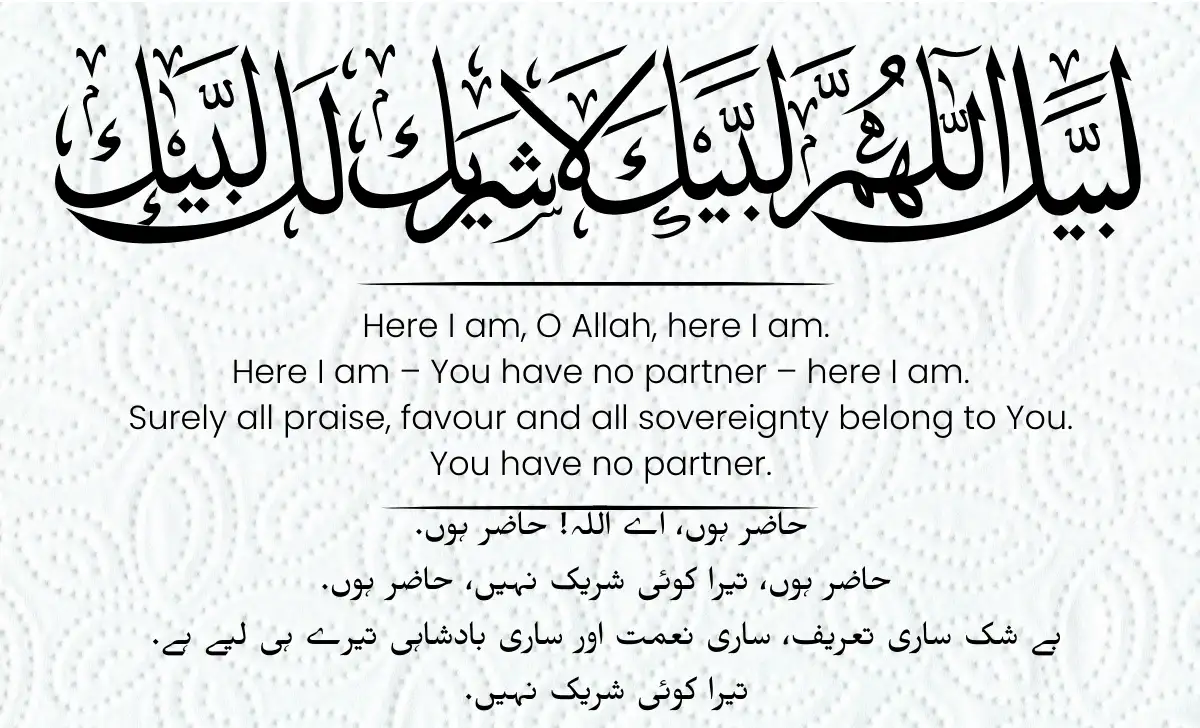
Arabic:
لَبَّيْكَ اللّٰهُمَّ لَبَّيْكَ،
لَبَّيْكَ لَا شَرِيكَ لَكَ لَبَّيْكَ،
إِنَّ الْحَمْدَ وَالنِّعْمَةَ لَكَ وَالْمُلْكَ،
لَا شَرِيكَ لَكَ
Transliteration:
Labbayka Allāhumma labbayk,
labbayka lā sharīka laka labbayk,
inna l-ḥamda wa n-ni‘mata laka wa l-mulk,
lā sharīka lak.
English:
“Here I am, O Allah, here I am.
Here I am – You have no partner – here I am.
Surely all praise, favour and all sovereignty belong to You.
You have no partner.”
Urdu:
حاضر ہوں، اے اللہ! حاضر ہوں۔
حاضر ہوں، تیرا کوئی شریک نہیں، حاضر ہوں۔
بے شک ساری تعریف، ساری نعمت اور ساری بادشاہی تیرے ہی لیے ہے۔
تیرا کوئی شریک نہیں۔
👉 Tip: Keep this as your main dhikr from miqat until you reach Makkah (except in times when Talbiyah is paused, like during khutbah, salah, etc., according to scholars).
Entering Makkah & Masjid al-Haram – “Masjid mein dakhil hone ki dua”
When you reach Masjid al-Haram, your heart will beat differently. At the door, step in with your right foot and read the general dua for entering any masjid (from authentic narrations):
Arabic:
بِسْمِ اللّٰهِ،
اللَّهُمَّ صَلِّ عَلَى مُحَمَّدٍ،
اللَّهُمَّ افْتَحْ لِي أَبْوَابَ رَحْمَتِكَ
Transliteration:
Bismillāh,
Allāhumma ṣalli ‘alā Muḥammad,
Allāhumma iftaḥ lī abwāba raḥmatik.
English:
“In the name of Allah.
O Allah, send blessings upon Muhammad.
O Allah, open for me the doors of Your mercy.”
Urdu:
اللہ کے نام سے۔
اے اللہ! محمد ﷺ پر رحمت نازل فرما۔
اے اللہ! اپنے رحمت کے دروازے میرے لیے کھول دے۔
Dua When Seeing the Ka‘bah for the First Time
Scholars differ about specific narrations, and some hadith on “dua being surely accepted at first sight” are considered weak. Islam-QA+2Islamweb+2
However, many scholars still encourage a lot of dua at this special moment, even if there is no fixed wording.
A beautiful, widely-mentioned wording (again, not an obligation; cited by various contemporary scholars):
Arabic:
اللَّهُمَّ زِدْ هَذَا الْبَيْتَ تَشْرِيفًا وَتَعْظِيمًا وَمَهَابَةً،
وَزِدْ مَنْ شَرَّفَهُ وَعَظَّمَهُ مِمَّنْ حَجَّهُ أَوِ اعْتَمَرَهُ تَشْرِيفًا وَتَعْظِيمًا وَبِرًّا وَتَقْوًى
Transliteration:
Allāhumma zid hādhā l-bayta tashrīfan wa ta‘ẓīman wa mahābatan,
wa zid man sharrafahu wa ‘aẓẓamahu mimman ḥajjahu awi‘ tamarahū tashrīfan wa ta‘ẓīman wa birran wa taqwā.
English (approximate):
“O Allah, increase this House in honour, greatness and awe.
And increase those who honour it and perform Hajj or Umrah here in honour, greatness, righteousness and piety.”
Urdu:
اے اللہ! اس گھر کی عظمت، شرف اور ہیبت میں اضافہ فرما۔
اور جو لوگ یہاں حج یا عمرہ کرتے ہیں، ان کے شرف، عظمت، نیکی اور تقویٰ میں بھی اضافہ فرما۔
After that, make personal dua: for forgiveness, guidance, your parents, rizq, marriage, children, the whole Ummah – as much as you can.
Tawaf – Main “Umrah ki Dua” Around the Ka‘bah
You will now perform seven circles (shawṭ) of tawaf around the Ka‘bah.
1 Starting Tawaf at Hajr-e-Aswad
At the start of each circuit, when you reach Hajr-e-Aswad, face it (if possible), raise your right hand, and say:
Arabic:
بِسْمِ اللّٰهِ، اللّٰهُ أَكْبَرُ
Transliteration:
Bismillāh, Allāhu Akbar.
English:
“In the name of Allah, Allah is the Greatest.”
Urdu:
اللہ کے نام سے، اللہ سب سے بڑا ہے۔
If you can’t reach the Black Stone due to crowd, just face its direction and gesture with your hand.
2 What to Read During Tawaf?
As mentioned earlier, there is no fixed dua for each circle. But there are two very important points:
(a) Between Rukn Yamani and Hajr-e-Aswad – Qur’anic Dua (2:201)
Arabic (Qur’an 2:201):
رَبَّنَا آتِنَا فِي الدُّنْيَا حَسَنَةً
وَفِي الْآخِرَةِ حَسَنَةً
وَقِنَا عَذَابَ النَّارِ
Transliteration:
Rabbana ātinā fi d-dunyā ḥasanah
wa fi l-ākhirati ḥasanah
wa qinā ‘adhāba n-nār.
English:
“Our Lord! Grant us good in this world
and good in the Hereafter,
and protect us from the punishment of the Fire.”
Urdu:
اے ہمارے رب! ہمیں دنیا میں بھی بھلائی عطا فرما،
اور آخرت میں بھی بھلائی عطا فرما،
اور ہمیں آگ کے عذاب سے بچا لے۔
This is explicitly recommended between these two corners by scholars. Islam-QA+2Fiqh Islamonlone+2
(b) General Duas During Tawaf
You may recite:
- Qur’anic duas (like “Rabbighfir lī wa liwālidayya”, etc.)
- Dhikr: Subḥānallāh, al-ḥamdu lillāh, Allāhu Akbar, lā ilāha illa llāh.
- Personal duas in Urdu / English.
For example:
Arabic (general dua):
رَبِّ اغْفِرْ لِي وَارْحَمْنِي وَاهْدِنِي وَارْزُقْنِي
Transliteration:
Rabbighfir lī warḥamnī wahdinī warzuqnī.
English:
“My Lord, forgive me, have mercy on me, guide me, and provide for me.”
Urdu:
اے میرے رب! مجھے بخش دے، مجھ پر رحم فرما، مجھے ہدایت دے، اور مجھے رزق عطا فرما۔
Maqam Ibrahim – Salah and Dua
After 7 rounds of tawaf, you pray two rakaat behind Maqam Ibrahim, if possible (or anywhere in the Masjid if it’s crowded).
The Qur’an mentions:
“…And take the Maqam of Ibrahim as a place of prayer.” (2:125)
Many people read Surah al-Kāfirūn in the first rakaat, al-Ikhlās in the second – but any surahs are fine.
After salah, you may make this dua (not obligatory but commonly used):
Arabic:
اللَّهُمَّ اجْعَلْنِي مِنَ التَّوَّابِينَ، وَاجْعَلْنِي مِنَ الْمُتَطَهِّرِينَ
Transliteration:
Allāhummaj‘alnī mina t-tawwābīn, waj‘alnī mina l-mutatahirīn.
English:
“O Allah, make me among those who constantly repent and those who purify themselves.”
Urdu:
اے اللہ! مجھے بہت زیادہ توبہ کرنے والوں میں شامل فرما،
اور پاکیزگی اختیار کرنے والوں میں شامل فرما۔
Drinking Zamzam – Dua for Healing & Guidance
When you drink Zamzam, the Prophet ﷺ said it is “for whatever it is drunk for” (meaning your intention matters).
So stand facing the Qiblah (if possible), say “Bismillah”, drink, and then make dua, for example:
Arabic:
اللَّهُمَّ إِنِّي أَسْأَلُكَ عِلْمًا نَافِعًا، وَرِزْقًا وَاسِعًا، وَشِفَاءً مِنْ كُلِّ دَاءٍ
Transliteration:
Allāhumma innī as’aluka ‘ilman nāfi‘an, wa rizqan wāsi‘an, wa shifā’an min kulli dā’.
English:
“O Allah, I ask You for beneficial knowledge, wide sustenance, and cure from every illness.”
Urdu:
اے اللہ! میں تجھ سے نفع دینے والا علم، کشادہ رزق اور ہر بیماری سے شفا مانگتا ہوں۔
Sa’i Between Safa and Marwah – “Safa Marwah ki Dua”
Before Sa’i, you go to Safa and recite the beginning of the verse:
Arabic (from 2:158):
إِنَّ الصَّفَا وَالْمَرْوَةَ مِنْ شَعَائِرِ اللَّهِ
Transliteration:
Inna s-Ṣafā wal-Marwata min sha‘ā’iri llāh.
English:
“Indeed, Safa and Marwah are among the symbols of Allah.”
Urdu:
بیشک صفا اور مروہ اللہ کی نشانیوں میں سے ہیں۔
Then you can say (reported from the Prophet ﷺ during Sa’i):
Arabic:
اللَّهُ أَكْبَرُ، اللَّهُ أَكْبَرُ، اللَّهُ أَكْبَرُ
لَا إِلٰهَ إِلَّا اللّٰهُ وَحْدَهُ لَا شَرِيكَ لَهُ،
لَهُ الْمُلْكُ وَلَهُ الْحَمْدُ،
وَهُوَ عَلَى كُلِّ شَيْءٍ قَدِيرٌ
Transliteration:
Allāhu Akbar, Allāhu Akbar, Allāhu Akbar.
Lā ilāha illa llāhu waḥdahu lā sharīka lah,
lahu l-mulk wa lahu l-ḥamd,
wa huwa ‘alā kulli shay’in qadīr.
English:
“Allah is the Greatest, Allah is the Greatest, Allah is the Greatest.
None has the right to be worshipped except Allah alone, without partner.
To Him belongs the kingdom and to Him is all praise,
and He is Able to do all things.”
Urdu:
اللہ سب سے بڑا ہے، اللہ سب سے بڑا ہے، اللہ سب سے بڑا ہے۔
کوئی معبود برحق نہیں مگر اللہ، وہ اکیلا ہے، اس کا کوئی شریک نہیں۔
اسی کی بادشاہی ہے اور اسی کے لیے ساری تعریف ہے،
اور وہ ہر چیز پر کامل قدرت رکھنے والا ہے۔
Then you may raise your hands, face the Ka‘bah, and make any dua you want.
When you reach Marwah, you can repeat the same dhikr and make dua again.
During the walking itself (between the hills), you can:
- Read Qur’anic duas
- Say dhikr
- Speak to Allah in your own words
There is no fixed compulsory dua for each lap of Sa’i – just like tawaf.
Halq / Taqsir – Dua When Shaving or Trimming Hair
At the end of Umrah, men will shave (halq) or shorten (taqsir) the hair; women shorten a small portion of their hair.
The Prophet ﷺ made dua three times for those who shaved and once for those who shortened.
Here is a suitable dua (again, general wording, not a mandatory formula):
Arabic:
اللَّهُمَّ اغْفِرْ لِي، وَلِوَالِدَيَّ، وَلِكُلِّ مَنْ أَحْسَنَ إِلَيَّ، وَاجْعَلْ هَذَا التَّحْلِيقَ نُقْطَةَ بَدْءٍ لِطَاعَتِكَ
Transliteration:
Allāhumma’ghfir lī, wa liwālidayya, wa likulli man aḥsana ilayya, waj‘al hādhā t-taḥlīqa nuqṭata bad’in liṭā‘atik.
English:
“O Allah, forgive me, my parents, and everyone who has done good to me, and make this shaving/cutting of hair a new beginning in obeying You.”
Urdu:
اے اللہ! مجھے، میرے والدین کو، اور ہر اس شخص کو بخش دے جس نے مجھ پر احسان کیا،
اور اس حلق/تقصیر کو تیری اطاعت کی نئی شروعات بنا دے۔
After this, your Umrah is complete, in shā’ Allah.
Qur’an & Hadith Evidence
To ensure the article stays authentic and trustworthy:
- Umrah’s virtue: The hadith “Umrah is an expiation for the sins committed between it and the previous one…” is found in Sahih al-Bukhari and commonly quoted in fiqh resources.
- Safa & Marwah verse (2:158): Explains that Sa’i is part of the symbols of Allah, and tafsir books (like Ibn Kathir, Maududi) clarify its rulings.
- No fixed dua each round: IslamQA and IslamWeb explicitly warn against booklets that invent a separate dua for every circuit of tawaf and sa’i.
- Talbiyah wording: Reported from the Prophet ﷺ in major hadith collections such as Sunan Ibn Majah and others.
You can also strengthen your understanding by checking any reliable fiqh of Hajj & Umrah book by recognized scholars, or Urdu works like traditional Rahnuma-e-Hajj o Umrah.
Common Questions
Q1: “Umrah ki niyyat ki dua kya hai?”
There is no obligatory sentence. Intention in the heart is enough. You may say “Labbayka ‘umratan” to help your heart focus.
Q2: “Kya har round mein alag dua parhna zaroori hai?”
No. There is no specific dua for each circle in authentic Sunnah. Recite any Qur’anic duas, dhikr, or personal supplications. Only “Rabbana ātinā…” between Rukn Yamani and Hajr-e-Aswad is specifically recommended.
Q3: “Agar Arabic yaad na ho, kya Urdu mein dua kar sakte hain?”
Yes. Scholars allow dua in your own language, especially during tawaf and sa’i, as long as the meanings are good and respectful.
Q4: “Shortest Umrah ki dua list for parents / elders?”
- Talbiyah
- “Allahumma iftaḥ lī abwāba raḥmatik”
- “Rabbana ātinā fi d-dunyā ḥasanah…”
- Few short duas like “Rabbighfir lī warḥamnī”
(You can print these 3–4 duas in big font.)
Personal Reflection – Turning Duas into a Real Change
Let’s be real.
You can memorize every line of every Umrah ki dua book, but still come back unchanged.
Or…
You might only know a few duas, but say them with:
- Tears in your eyes
- Regret for old sins
- Hope that Allah really will forgive you this time
Which one do you think matters more?
When you walk around the Ka‘bah, ask yourself quietly:
“What do I really want Allah to change in my life after this Umrah?”
Maybe:
- A hidden sin you want to leave
- A bad habit you’ve tried to escape many times
- A heartbreak you want healed
- Or simply a softer heart that loves salah, Qur’an, and dhikr
Use the duas in this article as templates, but fill them with your own story. That’s where Umrah becomes more than a trip – it becomes a turning point.
Conclusion – Make Your “Umrah ki Dua” Your Signature with Allah
You now have:
- A step-by-step Umrah ki dua guide (from home to Halq/Taqsir)
- Arabic, transliteration, Urdu, and English for each major stage
- Clear understanding that no fixed dua is required per round
- Authentic support from Qur’an, hadith, and reputable fiqh sites
If Allah has written Umrah for you, then your name is already in the list of guests to His House. Your job now is to prepare your heart and your duas.
When you finally stand under the open sky of Masjid al-Haram and raise your hands, remember:
Allah already knew your dua before you even typed “Umrah ki dua” into Google.
May Allah grant you a mabrur Umrah, forgive your past, open your future, and make you among those whose duas are accepted in those blessed moments. Āmīn. 🤲
There is no obligatory sentence. Intention in the heart is enough. You may say “Labbayka ‘umratan” to help your heart focus.
No. There is no specific dua for each circle in authentic Sunnah. Recite any Qur’anic duas, dhikr, or personal supplications. Only “Rabbana ātinā…” between Rukn Yamani and Hajr-e-Aswad is specifically recommended.
Yes. Scholars allow dua in your own language, especially during tawaf and sa’i, as long as the meanings are good and respectful.
Talbiyah
“Allahumma iftaḥ lī abwāba raḥmatik”
“Rabbana ātinā fi d-dunyā ḥasanah…”
Few short duas like “Rabbighfir lī warḥamnī”