Have you ever felt a heaviness in your chest that no amount of sleep or distraction can fix? It’s that subtle, nagging weight of mistakes—sins we remember, and worse, the ones we’ve forgotten. Imagine if there was a single act of worship, a “Spiritual Reset Button,” that could wipe your slate completely clean forgiving every sin, old or new, secret or open.
This isn’t just a comforting thought; it is a specific promise found in the Salat al-Tasbih (Prayer of Forgiveness). Let’s walk through exactly how to perform this life-changing prayer, step-by-step.
What is Salat al-Tasbih (Namaz e Tasbeeh)?
Salat al-Tasbih is a special four-unit voluntary prayer (Nafl) gifted by Prophet Muhammad ﷺ to his uncle Abbas (RA). It involves reciting a specific glorification (Tasbih) 300 times throughout the four Rak’ats. Scholars recommend performing it once a day, once a week, or at least once in a lifetime to seek total forgiveness.
Why is it called the “Prayer of Forgiveness”?
The power of this prayer lies in its specific promise. Unlike regular Nafl prayers, this method is designed to address every category of human error.
The Hadith of Promise:
The Prophet ﷺ said to his uncle Abbas (RA): “If you do this, Allah will forgive you your sins: the first and the last, the old and the new, the involuntary and the voluntary, the small and the great, the secret and the open.”
(Sunan Abi Dawud: 1297)
The Tasbih You Will Recite
You will recite this phrase 300 times in total. Memorize this rhythm before you begin.
The Quadrant of Praise:
| Language | Text |
| Arabic | سُبْحَانَ اللَّهِ وَالْحَمْدُ لِلَّهِ وَلاَ إِلَهَ إِلاَّ اللَّهُ وَاللَّهُ أَكْبَرُ |
| Transliteration | Subhanallahi wal hamdulillahi wala ilaha illallahu wallahu akbar |
| English | Glory be to Allah, All Praise be to Allah, there is no god but Allah, and Allah is the Greatest. |
| Urdu | اللہ پاک ہے، اور تمام تعریفیں اللہ ہی کے لیے ہیں، اور اللہ کے سوا کوئی معبود نہیں، اور اللہ سب سے بڑا ہے۔ |
How to Perform Namaz e Tasbeeh (Step-by-Step Method)
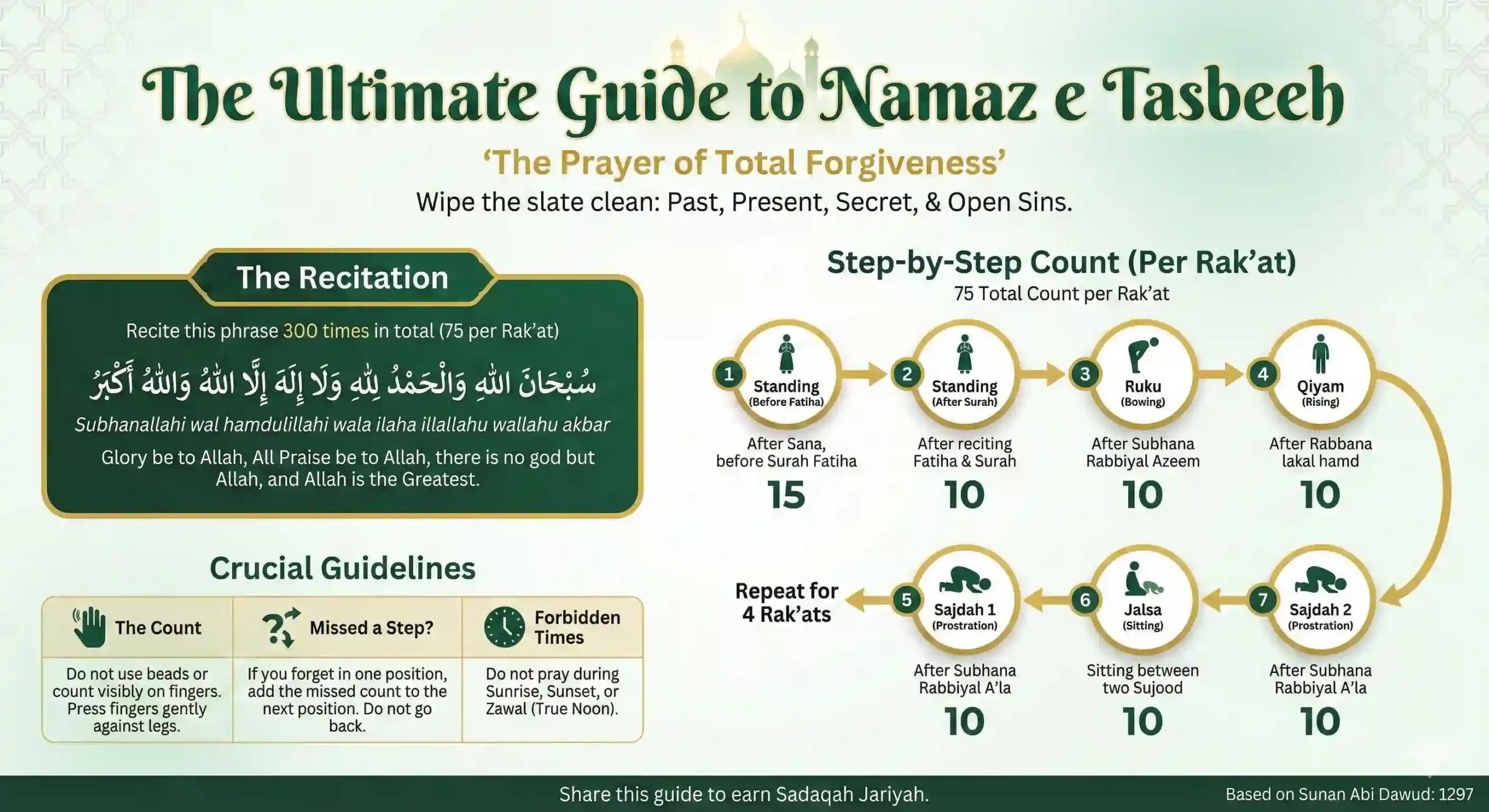
To perform Namaz e Tasbeeh, make the intention (Niyat) for 4 Rak’ats of Nafl. In every Rak’at, you will recite the Tasbih 75 times. The method below follows the “Ibn Mubarak” tradition, where you recite 15 times before Surah Fatiha.
The Breakdown Per Rak’at (75 Tasbihs Total)
Here is the exact count you must keep in your mind. Do not count on your fingers; press your fingers gently against your palms or knees to keep track.
- After Sana (Thana), Before Fatiha: Recite 15 times. (Then recite Surah Fatiha and a Surah)
- After the Surah (Standing): Recite 10 times.
- In Ruku (Bowing): After Subhana Rabbiyal Azeem, recite 10 times.
- In Qiyam (Standing after Ruku): After Rabbana lakal hamd, recite 10 times.
- In the 1st Sajdah: After Subhana Rabbiyal A’la, recite 10 times.
- In Jalsa (Sitting between Sajdahs): Recite 10 times.
- In the 2nd Sajdah: After Subhana Rabbiyal A’la, recite 10 times.
Total per Rak’at: 75
Total for 4 Rak’ats: 300
Important Note for the 2nd Rak’at: When you stand up for the second Rak’at, start immediately with the 15 Tasbihs before reciting Surah Fatiha. You do not read Sana again.
People Also Ask:
You can pray Namaz e Tasbeeh at any time of the day or night, except during the forbidden times (Sunrise, Sunset, and Zawal/True Noon). Many scholars recommend praying it before Zuhr or as a nightly vigil to maximize focus.
It is disliked (Makruh) to count visibly on your fingers or use a bead tasbih while holding your hands in prayer. The best method is to gently press your fingers down against your knees or thighs to keep count without breaking your posture.
If you forget to recite the Tasbih in one position (e.g., Ruku), do not go back. Instead, add the missed number to the next position (e.g., the first Sajdah). This ensures you still complete the count of 75 for that Rak’at.
Building the Spiritual Habit Loop
Let’s look at the heart of the issue. We often treat worship as a “to-do list,” but Salat al-Tasbih is different. Think of it as Deep Work for your soul.
In a world designed to fracture your attention, standing for 20-30 minutes and holding a count of 300 requires intense mindfulness (Khushu). It forces you to disconnect from the noise and reconnect with your Creator. Even if you can only manage this once a month, it acts as a powerful anchor, reminding you that no matter how far you drift, the door to return is always wide open.
A Scholar’s Note on Authenticity
While great scholars like Imam Tirmidhi, Ibn Hajar, and Al-Albani authenticated the Hadith of Salat al-Tasbih, others like Ibn Taymiyyah considered it weak. However, in matters of virtue (Fada’il al-A’mal), the majority of scholars agree it is a virtuous act to perform.