Have you ever admired something—your child’s smile, a new home, a job offer—and felt a tiny fear in your heart?
Like: “I hope nazar doesn’t hit.”
Or: “I hope I don’t lose this.”
Islam gives us a beautiful way to admire blessings without arrogance and without anxiety:
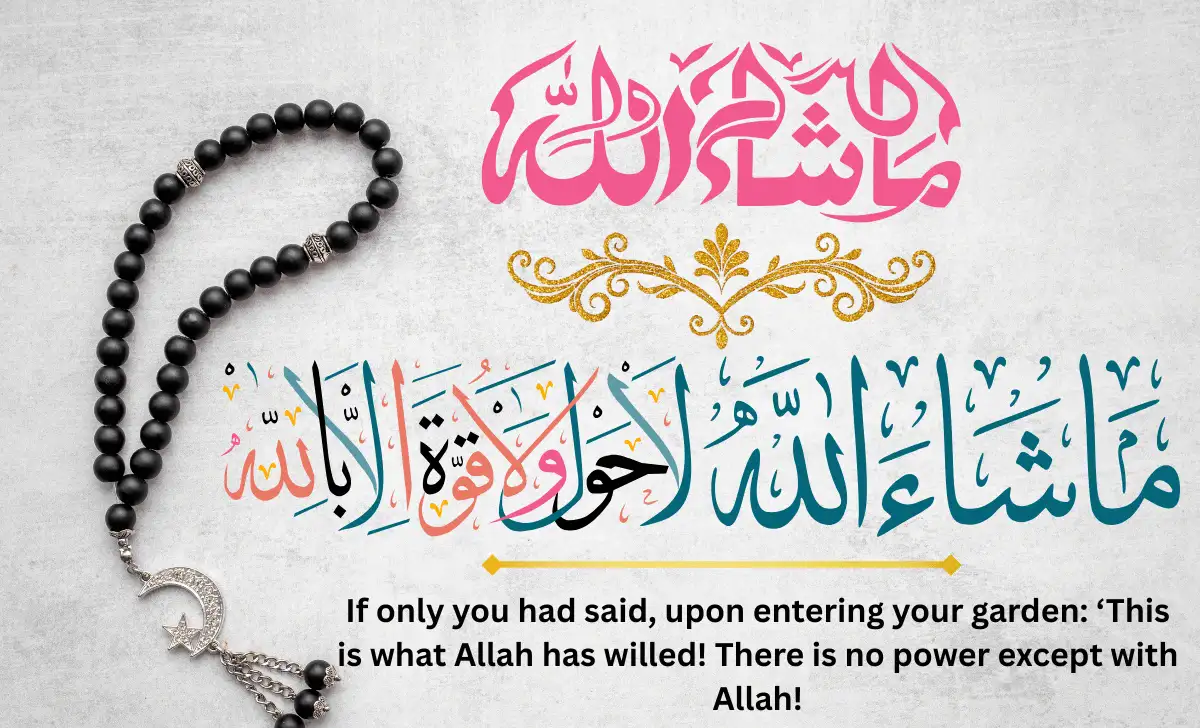
مَا شَاءَ اللهُ لَا قُوَّةَ إِلَّا بِاللهِ
Mashallah la quwwata illa billah
This is not just a cultural line. It is rooted in the Qur’an.
Quick meaning (simple English)
Mashallah = “As Allah willed.”
La quwwata illa billah = “There is no power/strength except through Allah.”
Together it means:
“This blessing is only by Allah’s will, and it can only stay and benefit me by Allah’s power.”
Arabic text, transliteration, and translations
The phrase in Arabic
مَا شَاءَ اللهُ لَا قُوَّةَ إِلَّا بِاللهِ
Transliteration: mā shāʾa Allāhu lā quwwata illā billāh
English: “What Allah has willed; there is no power except with Allah.”
Urdu: “جو اللہ نے چاہا، اللہ ہی کی مدد سے (ہی) طاقت ہے / اللہ کے سوا کوئی طاقت نہیں۔”
Where is it in the Qur’an?
The exact wording appears in Surah Al-Kahf (18:39)—in the story of two men and their gardens.
Surah Al-Kahf 18:39 (complete ayah)
Arabic:
وَلَوۡلَآ إِذۡ دَخَلۡتَ جَنَّتَكَ قُلۡتَ مَا شَآءَ ٱللَّهُ لَا قُوَّةَ إِلَّا بِٱللَّهِۚ إِن تَرَنِ أَنَا۠ أَقَلَّ مِنكَ مَالٗا وَوَلَدٗا
Transliteration:
Wa law lā idh dakhalt(a) jannataka qulta mā shāʾa Allāhu lā quwwata illā billāh…
English (meaning):
“If only you had said, upon entering your garden: ‘This is what Allah has willed! There is no power except with Allah!’…”
Urdu (meaning):
“تو نے اپنے باغ میں جاتے وقت کیوں نہ کہا کہ اللہ کا چاہا ہونے والا ہے، کوئی طاقت نہیں مگر اللہ کی مدد سے…”
What’s the lesson of 18:39?
It teaches two protections at once:
- Don’t claim blessings as “my achievement.”
- Don’t feel secure in blessings without Allah.
That balance creates shukr (gratitude) and tawakkul (reliance) at the same time.
Mashallah La Quwwata Illa Billah – Meaning, Urdu Translation (PDF)
Is it a “wazifa”?
In Pakistani/Indian usage, “wazifa” often means “a fixed recitation for benefit.”
Here’s the Islamic boundary:
- Dhikr and du‘a are encouraged.
- But Islam does not require a specific number unless it’s proven from Qur’an/Sunnah.
- So we can do a “wazifa-style routine,” but we should treat it as a personal habit, not a guaranteed formula.
A practical Wazifa routine (safe, simple, evidence)
1) When you see a blessing (yours or someone else’s)
Say:
- “Mashallah la quwwata illa billah”
And add the Sunnah-style du‘a for barakah: - “Allahumma barik” (O Allah, bless it.)
Why add Allahumma barik?
Because the Prophet ﷺ warned about harming with admiration and instructed making du‘a for blessing when you see something you like.
Real-life example (human moment):
I’ve seen this happen in families: someone praises a new car loudly, eyes wide, lots of hype—then later everyone feels uneasy. A calmer, sunnah-based habit is to praise Allah first. It changes the whole vibe. It turns admiration into worship.
2) After a success (exam, job, business deal)
Say it once slowly. Then say:
- “Alhamdulillah.”
This trains your heart: effort matters, but outcomes are from Allah.
3) When you feel weak, anxious, or stuck
Use its close “sister dhikr”:
لَا حَوْلَ وَلَا قُوَّةَ إِلَّا بِاللهِ
Lā hawla wa lā quwwata illā billāh
The Prophet ﷺ called this a treasure from Paradise.
Benefits (what we can say with confidence)
1) It builds humility and protects from arrogance
Surah Al-Kahf links this phrase to someone who became proud of wealth. The ayah teaches the cure: return credit to Allah.
2) It strengthens tawakkul (trust in Allah)
“La quwwata illa billah” is a direct reminder that power is not “inside my hands.” It’s from Allah.
3) It helps with nazar (evil eye) by correcting the heart’s gaze
Islam confirms that evil eye is real.
And it teaches us to respond with:
- dhikr,
- du‘a for barakah,
- and ruqyah methods that avoid superstition.
4) It gives emotional calm
When you say this sincerely, you stop fighting reality.
You still work hard.
But you stop worshipping control.
Mashallah la quwwata illa billah for Nazar (complete protection section)
Step 1: When admiring, always add barakah
The Prophet ﷺ said (meaning): if you see something you like, pray for blessing—instead of harming with admiration.
So use this combo:
- Mashallah la quwwata illa billah
- Allahumma barik
Step 2: Daily Qur’anic protection (Ruqyah)
For nazar, the most common daily protection is reciting:
- Surah Al-Falaq (113)
- Surah An-Nas (114)
(These are core “seeking refuge” surahs used widely in ruqyah.)
You can read them morning/evening and before sleep.
Surah Al-Falaq (113:1–5) — Arabic + transliteration
- قُلْ أَعُوذُ بِرَبِّ الْفَلَقِ — Qul a‘ūdhu bi-rabbi l-falaq
- مِن شَرِّ مَا خَلَقَ — Min sharri mā khalaq
- وَمِن شَرِّ غَاسِقٍ إِذَا وَقَبَ — Wa min sharri ghāsiqin idhā waqab
- وَمِن شَرِّ النَّفَّاثَاتِ فِي الْعُقَدِ — Wa min sharri n-naffāthāti fī l-‘uqad
- وَمِن شَرِّ حَاسِدٍ إِذَا حَسَدَ — Wa min sharri ḥāsidin idhā ḥasad
English (summary meaning): seeking Allah’s protection from all evil, including envy.
Surah An-Nas (114:1–6) — Arabic + transliteration
(Full surah is short; it seeks refuge from whispers and harm.)
Step 3: “Wa in yakād” (68:51) — where it comes in
Many Muslims recite Surah Al-Qalam 68:51–52 for nazar. The ayah describes people almost harming with their eyes when hearing Qur’an.
A tafsir note in Ma‘ārif al-Qur’ān mentions a report from Hasan al-Basri (رحمه الله) about reciting these verses for evil eye.
Important balance: treat it as a permissible ruqyah practice, not a magical charm.
The “3-Point Barakah Map”
Whenever you say mashallah la quwwata illa billah, do this 10-second “map” in your head:
- Name it: “This is a blessing from Allah.”
- Aim it: “Ya Allah, keep it halal and beneficial.”
- Share it: “How can I use it for khayr?”
- charity, family rights, helping someone, gratitude action
This transforms the phrase from a sentence into a lifestyle.
It also prevents a common trap: people protect blessings from nazar, but forget to protect them from sin.
What should I say when I see something beautiful in Islam?”
Say: “Mashallah la quwwata illa billah” and add “Allahumma barik” (O Allah, bless it).
“What is the best Qur’an protection for nazar?”
Recite Surah Al-Falaq and Surah An-Nas regularly as part of ruqyah.
“Which surah has ‘mashallah la quwwata illa billah’?”
Surah Al-Kahf, ayah 39 (18:39).
Reflection questions (to understand and get better results)
You asked me to ask questions—here are some that genuinely help:
- When I say this phrase, do I say it with my tongue only, or does my heart also accept it?
- What blessing do I fear losing the most right now—and why?
- Do I protect my blessings from nazar but ignore the bigger danger: sin, pride, and showing off?
- If Allah took this blessing today, would my relationship with Allah become stronger—or weaker?
- How can I turn my blessing into sadaqah or service so it grows in barakah?
Conclusion (a personal-style encouragement)
Sometimes we say mashallah la quwwata illa billah quickly—like a habit. But when you slow down, it becomes something else.
It becomes a soft surrender.
A way of saying:
“Ya Allah, I’m grateful. I’m not the owner. I’m only a caretaker.”
If you make this your daily language—when you see blessings, when you succeed, when you feel weak—you’ll notice a change. Less fear. Less ego. More peace.
And honestly, that peace itself is a blessing worth protecting.
It means: “What Allah has willed; there is no power except with Allah.” It’s a reminder that blessings come from Allah and remain only by His support.
It appears in Surah Al-Kahf 18:39.
It is often said when admiring blessings, and Islam teaches us to make du‘a for barakah when we admire something. Evil eye is real, and ruqyah practices like Al-Falaq/An-Nas are recommended as protection.
“Mashallah” acknowledges Allah’s will. Adding “la quwwata illa billah” adds the deeper meaning: no ability, protection, or continuation happens without Allah’s power.
Yes. The Prophet ﷺ described it as a treasure from the treasures of Paradise.