Have you ever wondered why some of the most powerful prayers we recite every single day start with the exact same word? “Qul” (قل). It’s a short, sharp command that translates to “Say.” Whether you are looking for protection from the “evil eye” or trying to explain your faith to a friend, these Surahs are your go-to. But exactly how many are there, and why does this word matter so much in Islam? Let’s dive deep into the heart of the Quran to find out.
The Quick Answer: How Many Surahs Start with Qul?
In the Holy Quran, there are 5 Surahs that begin with the word “Qul.” While most people are familiar with the “4 Quls” recited for protection, there is actually a fifth one often overlooked in casual conversation.
| Surah Name | Surah Number | Total Verses |
| Surah Al-Jinn | 72 | 28 |
| Surah Al-Kafirun | 109 | 6 |
| Surah Al-Ikhlas | 112 | 4 |
| Surah Al-Falaq | 113 | 5 |
| Surah An-Nas | 114 | 6 |
1. Surah Al-Jinn (The Jinn)
This is the “hidden” Qul that many forget! It was revealed in Makkah and tells the incredible story of a group of Jinn who heard the Quran and immediately believed.
- Arabic: قُلْ أُوحِيَ إِلَيَّ أَنَّهُ اسْتَمَعَ نَفَرٌ مِّنَ الْجِنِّ
- Transliteration: Qul ooḥiya ilayya annahu-stama‘a nafarum-minal jinn
- English: Say, [O Muhammad], “It has been revealed to me that a group of the jinn listened…”
- Urdu: فرمائیے! میری طرف وحی کی گئی ہے کہ جنات کی ایک جماعت نے (قرآن) سنا۔
2. Surah Al-Kafirun (The Disbelievers)
This Surah is the “Clearance from Shirk.” It’s a powerful declaration of the purity of our worship.
- Arabic: قُلْ يَا أَيُّهَا الْكَافِرُونَ
- Transliteration: Qul yā ayyuha-l-kāfirūn
- English: Say, “O disbelievers,”
- Urdu: فرما دیجئے: اے کافرو!
3. Surah Al-Ikhlas (The Sincerity)
Often called “one-third of the Quran,” this Surah defines who Allah is in just four short verses.
- Arabic: قُلْ هُوَ اللَّهُ أَحَدٌ
- Transliteration: Qul huwallāhu aḥad
- English: Say, “He is Allah, [who is] One.”
- Urdu: فرما دیجئے: وہ اللہ ایک ہے۔
4. Surah Al-Falaq (The Daybreak)
The first of the Mu’awwidhatayn (the two surahs of refuge). It protects you from external evils like envy and black magic.
- Arabic: قُلْ أَعُوذُ بِرَبِّ الْفَلَقِ
- Transliteration: Qul a‘ūdhu bi-rabbi-l-falaq
- English: Say, “I seek refuge in the Lord of daybreak.”
- Urdu: آپ کہہ دیجئے کہ میں صبح کے رب کی پناہ مانگتا ہوں۔
5. Surah An-Nas (Mankind)
The final chapter of the Quran. This protects you from internal evils—the whispers (Waswasa) that happen inside your own heart.
- Arabic: قُلْ أَعُوذُ بِرَبِّ النَّاسِ
- Transliteration: Qul a‘ūdhu bi-rabbi-n-nās
- English: Say, “I seek refuge in the Lord of mankind.”
- Urdu: آپ کہہ دیجئے کہ میں انسانوں کے پروردگار کی پناہ میں آتا ہوں۔
How many times is the word “Qul” repeated in the Quran?
Deep analysis shows that the word “Qul” (Say) appears 332 times in the Quran.
Interestingly, the word “Qalu” (They said) also appears exactly 332 times. This is a beautiful numerical miracle of the Quran, showing a perfect balance between the Divine Command and the human response.
Is “Qul” Allowed in Islam? (Clarifying the Confusion)
Some people ask, “Is Qul allowed?” usually referring to the South Asian tradition of “Qul Khani” (a gathering for the deceased).
- The Surahs: Reciting these Surahs is highly Sunnah and encouraged by the Prophet ﷺ.
- The Tradition: While gathering to pray for the dead is good, scholars remind us that fixing a specific day (like the 3rd day) as a religious requirement is not found in the Sunnah. The best “Qul” is to recite these Surahs with sincerity yourself!
Reflection: Why the word “Say”?
When I first started studying these Surahs, I wondered: Why didn’t Allah just say, “I am One” instead of “Say: He is Allah is One”? The word Qul is a reminder that Prophet Muhammad ﷺ was a messenger. He didn’t change a single word of the message—he even kept the command “Say” exactly as it was given to him. When you recite these Surahs, you aren’t just praying; you are repeating the exact command given by the Creator to His beloved Prophet ﷺ.
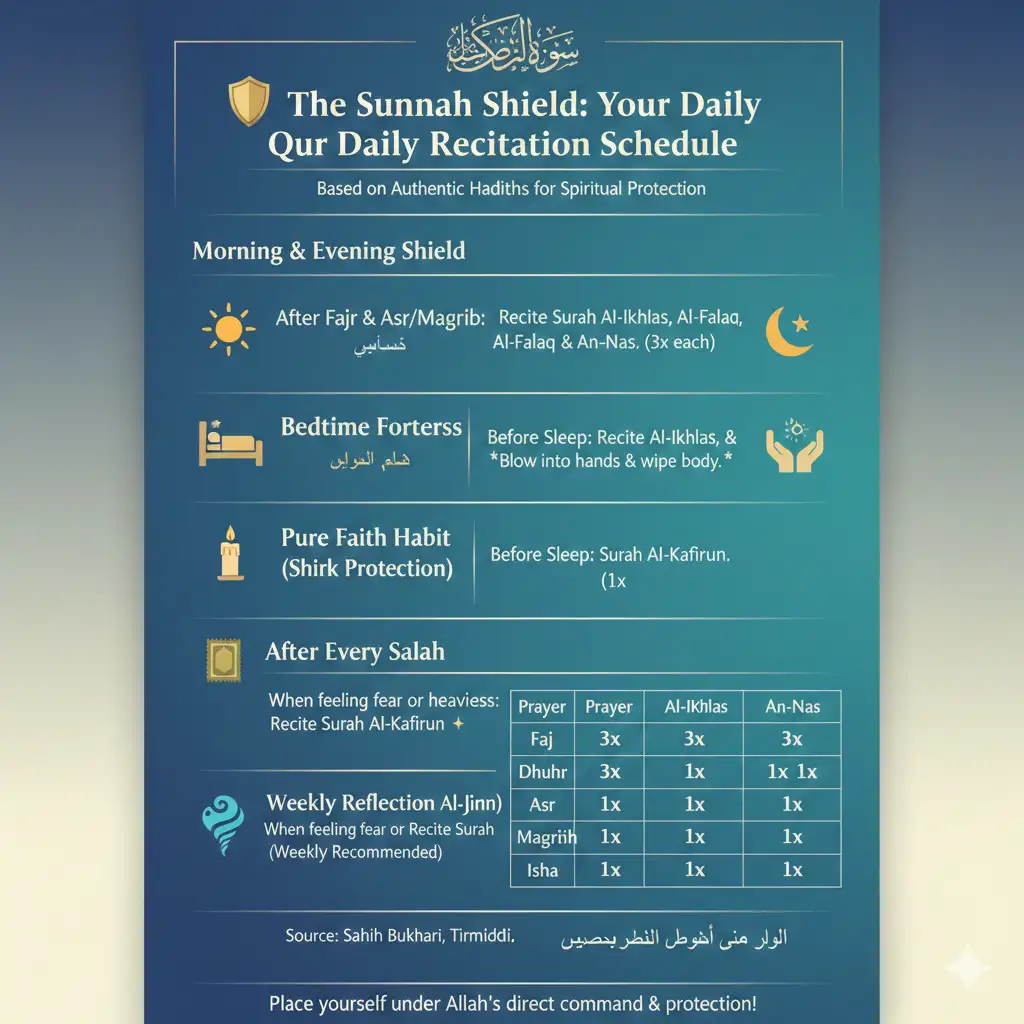
🛡️ The “Sunnah Shield”: Your Daily Recitation Schedule
Understanding the number of Surahs that start with “Qul” is knowledge; reciting them daily is power. To help you implement this “Shield & Speaker” strategy, here is a practical schedule based on authentic Hadiths.
If you want to feel the spiritual benefits and protection in your life, try following this routine:
1. The Morning and Evening Routine (Protection from all Harm)
The Prophet ﷺ said: “Recite ‘Qul Huwallahu Ahad’ and the Mu’awwidhatayn (Al-Falaq and An-Nas) three times in the morning and evening; they will suffice you against everything.” (Source: Tirmidhi).
- When: After Fajr and after Asr/Maghrib.
- What: Surah Al-Ikhlas, Al-Falaq, and An-Nas.
- Quantity: 3 times each.
2. The Bedtime Shield (Protection from the Unseen)
Aisha (R.A) narrated that every night when the Prophet ﷺ went to bed, he would cup his hands together, blow in them, and recite the last three Quls. He would then wipe his hands over as much of his body as he could. (Source: Sahih Bukhari).
- When: Right before closing your eyes to sleep.
- What: Surah Al-Ikhlas, Al-Falaq, and An-Nas.
- Action: Recite, blow into your palms, and wipe over your body (3 times).
3. The “Pure Faith” Habit (Protection from Shirk)
The Prophet ﷺ recommended reciting Surah Al-Kafirun before sleeping to clear oneself from any trace of polytheism.
- What: Surah Al-Kafirun.
- Spiritual Tip: Think of this as “resetting” your belief to its purest form before you end your day.
4. After Every Salah
It is Sunnah to recite the “3 Quls” once after every obligatory prayer. However, after Fajr and Maghrib, it is recommended to increase this.
| Prayer Time | Surah Al-Ikhlas | Surah Al-Falaq | Surah An-Nas |
| Fajr | 3 Times | 3 Times | 3 Times |
| Dhuhr | 1 Time | 1 Time | 1 Time |
| Asr | 1 Time | 1 Time | 1 Time |
| Maghrib | 3 Times | 3 Times | 3 Times |
| Isha | 1 Time | 1 Time | 1 Time |
Why include Surah Al-Jinn in your weekly reading?
While the “4 Quls” are for daily protection, Surah Al-Jinn is a powerful reminder of the unseen world. Many scholars suggest reciting it when you feel a sense of fear or “heaviness” in your home. It establishes the authority of Allah’s word over all creation—human or jinn.
A Quick Reflection: > Have you ever noticed how your heart feels lighter after reciting these? It’s not just psychology; it’s a spiritual reality. When you say “Qul”, you are placing yourself under the direct command and protection of Allah. You are telling your problems, your fears, and your enemies that you have a Protector who is Greater than everything.
There are 5 Surahs: Al-Jinn, Al-Kafirun, Al-Ikhlas, Al-Falaq, and An-Nas.
They are used for spiritual protection against the evil eye, magic, and whispers of Shaitan. The Prophet ﷺ used to recite the last three every night before sleeping.
Yes, you can recite them from memory without Wudu, though being in a state of purity is always better for Dhikr.
The best Surahs for the evil eye (Nazar) are Surah Al-Falaq and Surah An-Nas. These are known as the Mu’awwidhatayn.
Because the Quran is divided into three main themes: Law, Stories, and Tawheed (the Oneness of Allah). Since Al-Ikhlas perfectly summarizes Tawheed, it covers one-third of the Quran’s core message.
I encourage you to start with the Bedtime Shield tonight. It takes less than two minutes, but it guards you for eight hours. May Allah protect us all from every evil and keep our hearts firm on the path of “Qul.”