Have you ever felt like the world is turning its back on you? Or perhaps you’re carrying a burden that feels too heavy for your heart?
In the final moments of Surah At-Tawbah, Allah gives us a beautiful gift. While most of the Surah is known for its stern warnings and rules, it ends with two of the most comforting verses in the entire Quran. These are the verses of Prophetic love and Divine sufficiency.
📖 The Arabic Text & Transliteration
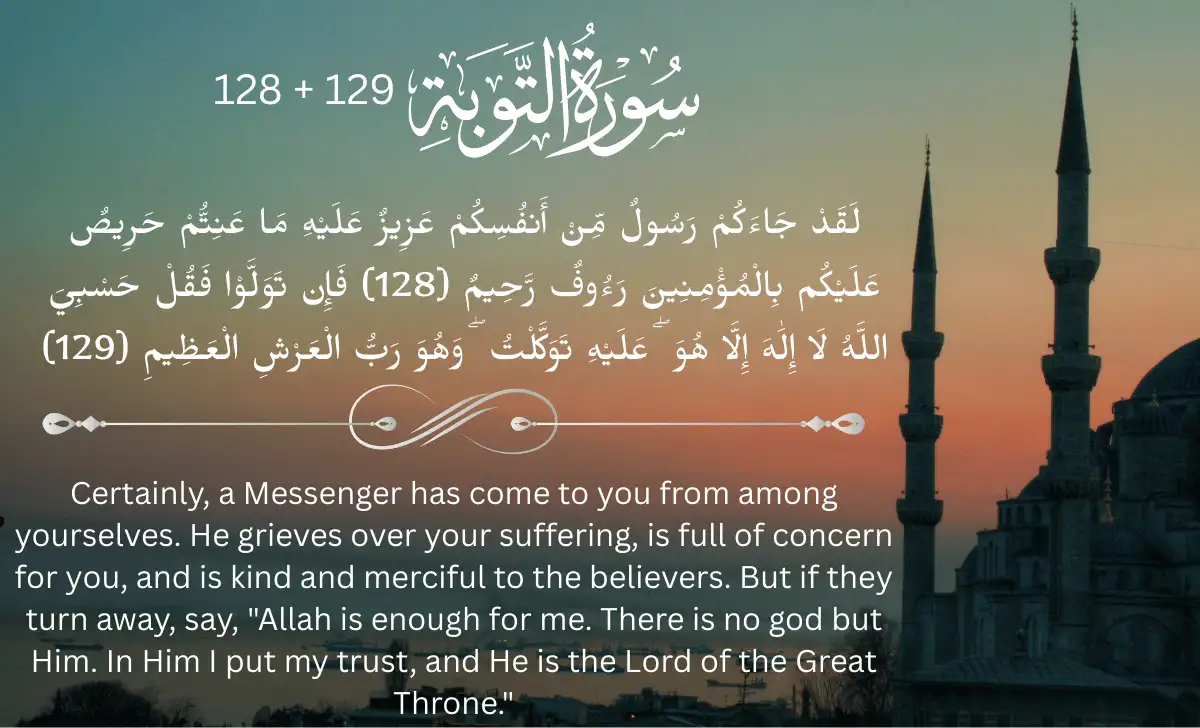
Let’s start with the beautiful words themselves. These are verses 128 and 129 of Surah At-Tawbah.1
Arabic Text:
لَقَدْ جَاءَكُمْ رَسُولٌ مِّنْ أَنفُسِكُمْ عَزِيزٌ عَلَيْهِ مَا عَنِتُّمْ حَرِيصٌ عَلَيْكُم بِالْمُؤْمِنِينَ رَءُوفٌ رَّحِيمٌ (128) فَإِن تَوَلَّوْا فَقُلْ حَسْبِيَ اللَّهُ لَا إِلَٰهَ إِلَّا هُوَ ۖ عَلَيْهِ تَوَكَّلْتُ ۖ وَهُوَ رَبُّ الْعَرْشِ الْعَظِيمِ (129)
Transliteration:
128: Laqad ja’akum rasoolum min anfusikum ‘azizun ‘alayhi ma ‘anittum harisun ‘alaykum bil-mu’mineena ra’oofur-raheem.2
129: Fa-in tawallaw faqul hasbiyallahu la ilaha illa huwa ‘alayhi tawakkaltu wa huwa rabbul ‘arshil ‘azeem.3
🌍 Meaning in English & Urdu
To truly feel the power of these verses, we must understand them in our own language.
| Verse | English Translation | Urdu Translation |
| 9:128 | Certainly, a Messenger has come to you from among yourselves. He grieves over your suffering, is full of concern for you, and is kind and merciful to the believers. | بیشک تمہارے پاس تم ہی میں سے ایک رسول تشریف لائے، جن پر تمہاری تکلیف گراں گزرتی ہے، وہ تمہاری بھلائی کے بہت خواہش مند ہیں اور مومنوں پر نہایت شفقت کرنے والے، مہربان ہیں۔ |
| 9:129 | But if they turn away, say, “Allah is enough for me. There is no god but Him. In Him I put my trust, and He is the Lord of the Great Throne.” | پھر اگر وہ منہ پھیر لیں تو کہہ دیجیے: اللہ میرے لیے کافی ہے، اس کے سوا کوئی معبود نہیں، اسی پر میں نے بھروسہ کیا اور وہی عرشِ عظیم کا مالک ہے۔ |
Surah Taubah Last 2 Ayat: Meaning, Wazifa, and PDF Guide
✨ Spiritual Benefits & Power of “Hasbiyallahu”
Why do scholars call these verses a “Fortress”? Based on authentic traditions (Hadith) and the works of classical scholars like Mufti Shafi Uthmani, here are the core benefits:
- Relief from Anxiety: Reciting Hasbiyallahu (Allah is enough for me) instantly shifts your focus from the problem to the Provider.4
- Protection from Harms: It is narrated that the one who recites these verses will not die by drowning, burning, or a sudden accident on that day (narrated by scholars with specific conditions).5
- Independence of Soul: When you say “He is enough,” you stop seeking validation from people who let you down.
- Divine Sufficiency: If the whole world leaves you, the Lord of the Great Throne stays.
🤲 How to Perform the Wazifa (Recommended Method)
For those seeking a specific daily practice (Wazifa), Islamic tradition suggests a beautiful morning and evening routine:
- Count: 7 Times.6
- Time: After Fajr and after Maghrib.
- The Prayer: Recite Verse 129 (Hasbiyallahu la ilaha illa huwa…) seven times.
- The Promise: Abu Darda (RA) narrated that whoever does this, Allah will suffice them in all their worldly and spiritual worries.
🔍 Deep Insights: Why these verses are special?
Most people don’t realize that Ayah 128 is unique. In it, Allah uses two of His own names—Ar-Ra’uf (The Kind) and Ar-Rahim (The Merciful)—to describe the Prophet Muhammad ﷺ.7 This shows just how much the Prophet ﷺ loves his Ummah.
Then, Ayah 129 teaches us Tawakkul (Reliance).8 If people reject your kindness or turn away, don’t be sad. Your worth isn’t tied to people; it’s tied to the “Lord of the Great Throne.”
📚 Scholarly Evidence & Authentic Foundations of Surah Taubah 128-129
Authentic Hadith Tradition (Sunan Abi Dawud): The primary authority for the specific wazifa (reciting seven times) comes from a narration by Abu Darda (RA) found in Sunan Abi Dawud. This narration explicitly states that whoever recites Verse 129 seven times in the morning and evening will find that Allah (SWT) suffices them in all their worldly and spiritual concerns.
Historical Compilation (The Witness of Abu Khuzaimah): Classical accounts of the Quran’s compilation—documented by early scholars—highlight that these two verses held a unique status. When the Mushaf was being standardized, these verses were uniquely verified through Abu Khuzaimah al-Ansari, whose single testimony was famously equated to that of two men by the Prophet ﷺ himself.
Classical Tafsir (Linguistic Depth): Classical Tafsir works, such as Ma’ariful Quran and Tafsir Ibn Kathir, provide deep analysis of the term “Azeezun ‘alayhi” in Verse 128. Scholars explain this as the Prophet’s ﷺ profound empathy, where your hardships weigh heavily upon his soul—a level of compassion mirrored by the Divine Names Ar-Ra’uf and Ar-Rahim.
The “Final Revelation” Status: Several classical scholars, including Ubayy bin Ka’b, have noted that these were among the very last verses revealed to the Prophet ﷺ, serving as a merciful “seal” to the divine message.
Scholarly Guidance on Virtues: In the Kitab Mujarrabat Ad-Dairabi Al-Kabir, Syeikh Ahmad Dairabi discusses the “Al-Hirsh” (the recitation of these two verses) as a source of physical and spiritual protection.
❤️ A Personal Reflection
When I first started reciting these verses daily, I noticed a shift in my heart. I used to worry about “what people thought” or “what if I fail?” But the words “Hasbiyallahu” (Allah is enough) changed that. It’s like a deep breath for the soul.
If you’re feeling lonely today, remember Verse 128: You have a Prophet ﷺ who grieves when you suffer. And if you’re feeling weak, remember Verse 129: You have a Lord who owns the very Throne of the Universe. You are never truly alone.
People Also Ask
Yes, because you are reciting them as a Dhikr (remembrance) or Dua with the intention of protection, it is generally permissible.
It means “Verily, there has come to you a Messenger from among yourselves.” It highlights that the Prophet ﷺ is human and understands our pain.
The Sunnah recommendation is 7 times in the morning and 7 times in the evening to be “sufficed” by Allah.